Scratch-built Software-Defined Radio

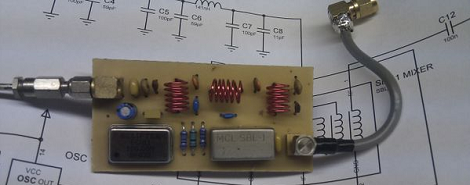
[Ben] is showing off some results from his Software-Define Radio project. The board seen above, which he designed from the ground up, is receiving a WWV radio broadcast. This is the atomic clock signal from Fort Collins, Colorado. The audio heard in the clip after the break is a bit noisy, but since he’s about 2000 miles from the origin of the signal we think he’s done really well!

The seed for this build was planted in [Ben’s] head back in July when he saw [Jeri Ellsworth’s] SDR project. He’s posted some of the build details up in a forum post. The approach is similar to [Jeri’s] but there are several key differences. He’s using a DS1085 programmable oscillator where she chose an FPGA for that purpose. Once his hardware demodulates and filters the incoming signal, a PIC32 does the rest of the work and outputs a PWM signal to an Op-Amp to generate audio.

Continue reading “Scratch-built Software-Defined Radio”

Eight-dollar Airplane For Really Bad Pilots

Have a habit of hitting the bottle before getting into the cockpit? Find that your mind wanders mid-flight? Lack the hand-eye coordination to keep that RC creation of yours in the air? Worry not, you can build this flyer and crash it with impunity.

[HammyDude] built the RC aircraft out of laminated foam board. He’s had it for years and it’s survived multiple crashes. You can see the one real injury suffered, a snapped fuselage at the leading edge of the wings. He repaired it with popsicle sticks and it’s been going strong ever since.

In addition to the wooden reinforcements he’s covered the fuselage with fibrous packing tape (you know, the stuff with the strings running in it). There’s also a carbon fiber tube at the leading edge of each wing. It’s light, strong, and robust (with the exception of the propeller of which he’s broken about 10).

Check out the video after the break for an explanation of the aircraft, list of materials, and HD images of the patterns you need to make them yourself. The only thing you won’t see is flight footage.

Continue reading “Eight-dollar Airplane For Really Bad Pilots”

Grab Your Own Images From NOAA Weather Satellites

Can you believe that [hpux735] pulled this satellite weather image down from one of the National Oceanic and Atmospheric Administration’s weather satellites using home equipment? It turns out that they’ve got three weather satellites in low earth orbit that pass overhead a few times a day. If you’ve got some homebrew hardware and post processing chops you can grab your own images from these weather satellites.

The first step is data acquisition. [hpux735] used a software defined radio receiver that he built from a kit. This makes us think back to the software-radio project that [Jeri Ellsworth] built using an FPGA–could that be adapted for this purpose? But we digress. To record the incoming data a Mac program called DSP Radio was used. Once you do capture an audio sample, you’ll need something to turn it into an image. It just so happens there’s a program specifically for weather image decoding called WXtoImg, and another which runs under Linux called WXAPT. Throw in a little post processing, Robert’s your mother’s brother, and you’ve got the image seen above.

[Hpux735] mentioned that he’s working on a post about the antenna he built for the project and has future plans for an automated system where he’ll have a webpage that always shows the most current image. We’re looking forward hearing about that.

AVR Chiptune Project Turns This Simple Code Into Music

[Mark] had seen a few examples of algorithmic music generation that takes some simple code and produces complex-sounding results. Apparently it’s possible to pipe the output of code like this directly to audio devices on a Linux box, but [Mark] decided to go a different direction. His project lets you play simple algorithms as audio using AVR microcontrollers.

Now the code work for this is very simple, but he hardware implementation is where things get interesting. Ostensibly, [Mark] didn’t have the components available to build a filter to use PWM as an audio signal. Being that he’s a ham operator, he grabbed some radio equipment he had on hand and whipped up an alternative. He’s feeding the PWM from an Arduino into the voltage controlled oscillator on a board meant for high-altitude balloon telemetry. The signal broadcast by this board is then picked up by his radio receiver, and played on some speakers.

Rube-Goldberg contraptions aside, the effect is pretty interesting, as you can hear in the latter half of the video clip which we’ve embedded after the jump.

Continue reading “AVR Chiptune Project Turns This Simple Code Into Music”

Over-the-air FM Radio Gains Internet Control

[Old bit collector] is giving up control of his radio dial to the Internet. He combined a couple of Parallax products which now allow him to tune, adjust volume, and toggle the power for an FM radio receiver.

The setup is pretty simple. An FM receiver module is mounted in the breadboard seen above which helps to break out its control pins. Those are connected to a Parallax Spinnarette web server board. It’s auxiliary I/O pins are controlled via a web interface that he set up and plans to operate with the browser on his Android phone. But as you can see after the break, any web browser works as long as you know the correct address.

This is pretty good if you’re on a quest to make everything controllable from your smart phone. But we would love to use the concept to make our own streaming radio. You’d be able to tune in to all of your local stations from anywhere in the world.

Continue reading “Over-the-air FM Radio Gains Internet Control”

Project 25 Digital Radios (law Enforcement Grade) Vulnerable To The IM-ME

Would you believe you can track, and even jam law enforcement radio communications using a pretty pink pager? It turns out the digital radios using the APCO-25 protocol can be jammed using the IM-ME hardware. We’ve seen this ‘toy’ so many times… yet it keeps on surprising us. Or rather, [Travis Goodspeed’s] ability to do amazing stuff with the hardware is what makes us perk up.

Details about this were presented in a paper at the USENIX conference a few weeks ago. Join us after the break where we’ve embedded the thirty-minute talk. There’s a lot of interesting stuff in there. The IM-ME can be used to decode the metadata that starts each radio communication. That means you can track who is talking to whom. But for us the most interesting part was starting at about 15:30 when the presenter, [Matt Blaze], talked about directed jamming that can be used to alter law enforcement behavior. A jammer can be set to only jam encrypted communications. This may prompt an officer to switch off encryption, allowing the attackers to listen in on everything being said to or from that radio.

Continue reading “Project 25 Digital Radios (law Enforcement Grade) Vulnerable To The IM-ME”

Playing SNES With An R/C Controller

Normally when we see an R/C transmitter used in a build we’re prepared for robots, quadcopters, or UAVs. [Alex] found a new use for his Futaba radio – hooking it up to his Super Nintendo.

We’ve seen a lot of builds using game controllers as interfaces to other hardware. The N64 media remote comes to mind, as does the NES iPod dock. Outside of a few builds to automatically win in-game currency for you, we haven’t seen much of anything to control a video game with additional electronics. [Alex]’s build happily bucks that trend, and technically gives the SNES an analog controller.

The build uses an mBed microcontroller to capture the radio’s button and stick positions. This is sent through a two shift registers to produce the 16-bit packet required of the SNES controller protocol. [Alex] posted all the software for his build, and from the looks of it the code seems pretty portable. [Alex] says he’s working on getting his Sega Saturn running with his Futaba, so we can’t wait to see some Panzer Dragoon action. Check out [Alex] demoing his controller with Gradius III after the break.

Continue reading “Playing SNES With An R/C Controller”