Real Or Fake? The Amazing Ping-Pong Robot

Would you like to play a robot in ping pong (translated)? We sure would. Inspired by an upcoming face-off between man and machine, [Jakob] wrote in to tell us about [Ulf Hoffmann’s] ping-pong playing robot. If you ever wanted to play ping-pong when no one else was around or are just sick and tired of playing against the same opponents this project is for you. Boy is this thing amazing; you simply must see the robot in action in the video after the break.

While the robot’s build is not documented all in one post, [Ulf Hoffmann’s] blog has many videos and mini posts about how he went about building the paddle wielding wonder. The build runs the range from first ideas, to hand-drawn sketches, to the technical drawings seen above. From these the parts of the arm were built, but the mechanical assembly is only one portion of the project. It also required software to track the ball and calculate how to properly return it. Be sure to browse through his past posts, there is a wealth of information there.

Also be sure to check in on March 11th to see who wins the epic face-off between man and machine. See the trailer (the second embedded video) after the break.

UPDATE: Many commentators are calling this one a fake. It’s so sad to think that, because this is a really cool project. But we’ve changed the title and are asking you to weigh in on whether you think it is real or fake. We’ve also contacted [Ulf] and asked if it is real hardware, or a CGI enhanced video. We’ll let you know if/when we hear back from him.

Continue reading “Real Or Fake? The Amazing Ping-Pong Robot”

Sparkfun’s AVC 2014: Robots, Copters, And Red Balloons Of Death, Oh My!

SparkFunAVC2014

Registration is open for Sparkfun’s 2014 Autonomous Vehicle Competition (AVC)! Every year the fine folks at Sparkfun invite people to bring their robots, rovers, and drones  to Colorado to see who is the king of the hill – or reservoir as the case may be. We see plenty of robots here at Hackaday, but precious few of them are autonomous. To us that means capable of completing complex tasks without human intervention. Sparkfun has spent the last five years working toward changing that. Each year the robots get more complex and complete increasingly difficult tasks.

The competition is essentially a race through the Boulder reservoir. Time is key, though there are multiple ways to gain bonus points. For aerial vehicles there are two classes: fixed and rotary wing. Planes fall under the fixed wing category. Helicopters, gyrocopters, tricopters, quadcopters, and beyond fall into rotary wing. We’re holding out hope that e-volo shows up with their Octadecacopter. Ground vehicles have a few more class options. Micro/PBR class is for robots with a build cost less than $350 total, or small enough to fit into box that’s 10″x6″x4″. The doping class is unlimited. Sparkfun even mentions costs over $1kUSD+, and weights over 25LBS. Non-Traditional Locomotion class is for walkers, WildCats and the like. Peloton is Sparkfun’s class for robots that don’t fit into the other classes.

Sparkfun is also making a few changes to the course this year. A white chalk line will be drawn through the course, so robots don’t have to rely on GPS alone for navigation. We’re hoping to see at least a few vision systems using that chalk line. Aerial robots will have to contend with three “Red Balloons of Death”. Robots can navigate around the balloons without penalty. The balloons can be bumped or even popped for bonus points, but the robot must do this with its own body. Projectile weapons are not allowed. To say we’re excited about the AVC would be an understatement. As much as we enjoy watching the big players at competitions like the DARPA Robotics Challenge, we love seeing individuals and small teams of hobbyists compete every year at the AVC. Click on past the break for Sparkfun’s AVC 2013 wrap up video.

Continue reading “Sparkfun’s AVC 2014: Robots, Copters, And Red Balloons Of Death, Oh My!”

Robot Foosball Will Kick Your Butt If You Play Slowly

foosball_pt3_1

Sometimes we find a project that is so far outside of our realm of experience, it just makes us sit back and think “wow”. This is definitely one of those projects. [Saba] has created a Robotic Foosball set that learns.

[Saba Khalilnaji] is a recent engineering graduate from UC Berkeley, and his passion is robotics. After taking an Artificial Intelligence class during his degree (you can take it online through edX!), he has decided to dabble in AI by building this awesome robot Foosball set.

His “basic” understanding of machine learning includes a few topics such as Supervised Learning, Unsupervised Learning and Reinforcement Learning. For this project he’s testing out a real-world application of Reinforcement Learning using the Markov Decision Process or MDP for short. At an extremely top level description it works by programming an agent to learn from the consequences of its actions in a given environment. There are a set of states, actions, probabilities for given state and action, and rewards for specific state and action sets.

Before we butcher the explanation anymore, check out his blog for more information — and watch the following video.

Continue reading “Robot Foosball Will Kick Your Butt If You Play Slowly”

Hexapod Robot Terrifies Humans And Wallets

hexapod

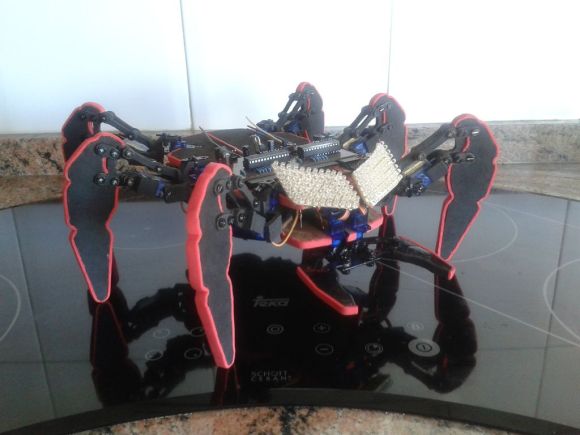
[Kevin] brings us Golem, his latest robot project. Golem is crafted not of clay and stone like his namesake, but of T6 Aluminum and Servos. We don’t have a banana for scale, but Golem is big. Not [Jamie Mantzel’s] Giant Robot Project big, but at 2.5 feet (76.2 cm) in diameter and 16 lbs (7.3 Kg), no one is going to call Golem a lightweight. With that kind of mass, standard R/C servos don’t stand much of a chance. [Kevin] pulled out all the stops and picked up Dynamixel MX64 servos for Golem’s legs. Those servos alone propelled the Golem’s costs well beyond the budget of the average hobbyist. Kevin wasn’t done though. He added an Intel NUC motherboard with a fourth generation i5 processor, a 120 Gigabyte solid state drive, and 8 Gigbytes of Ram.  Sensing is handled by gyros, accelerometers, and an on-board compass module. We’re assuming from the lack of a GPS that Golem will mainly see indoor use. We definitely like the mini subwoofer mounted on Golem’s back. Hey, even robots gotta have their tunes.

Golem is currently walking under human control via a Dualshock 3 controller paired via bluetooth. [Kevin’s] goal is to use Golem to learn Robotic Operating System (ROS). He’s already installed ubuntu 13.04 and is ready to go. [Kevin] didn’t mention a vision system, but based on the fact that some of his other robots use the Xtion pro live, we’re hopeful. We can’t wait to see Golem’s first autonomous steps.

Continue reading “Hexapod Robot Terrifies Humans And Wallets”

3D Printing Metal Structures With A 6-axis Robot

robot printer

[Joris Laarman] is working on a project called the MX3D-Metal which uses an ABB industrial robot arm and a welding machine to create strong metal structures on any working surface and in any direction.

He started last year with the MX3D Resin printer, which is the exact same concept, but instead of metal, it uses a two-part epoxy that bonds instantly upon mixing. Their lab is located in Amsterdam, and they work closely with IAAC (the Institute for Advanced Architecture of Catalonia) — Autodesk provides funding for the research.

[Joris] has successfully printed complex structures using steel, stainless steel, bronze, copper, and even aluminum. Poking around their website you can find many examples of different things they have printed, including intricate matrices of multiple curved lines which end up looking more organic than mechanical. It uses mostly the same concept as the Rostock Welding robot we covered a few months ago, which is open source and fairly cheap to make at home!

Stick around for a video of both the MX3D-Metal and Resin robot printers in action!

Continue reading “3D Printing Metal Structures With A 6-axis Robot”

Omnidirectional Robot Takes On A Candy Factory

OmniRobot

[AltaPowderDog] is building a competition robot as part of his freshman engineering course at Ohio State University. The contest is sponsored by Nestle, so it’s no surprise the robots have to perform various tasks in a miniature candy factory. Broken up into teams of four, the students are building autonomous robots to move pallets, scoop candy, operate switches and pull pins from tubes. Each team is provided a standard microcontroller board and funds to purchase robot parts from an online store. The factory also sports an overhead infrared navigation system, which should help the robots stay on track.

[AltaPowderDog] took his inspiration from [Michal’s] OmniBot, which used adjustable geometry wheels. A lever and gear system allows the robot to pivot all four wheels synchronously. This effectively allows the robot to turn within its own axis. With some proper path planning and end effector placement, [AltaPowderDog’s] team should be able to shave down their time through the candy factory. The team has run into a few issues though. This robot design only utilizes two powered wheels, which has caused the team to become stuck up on a ramp in the factory. To combat this, the team is installed a simple suspension which allows the non-powered wheels to move up and out of the way on the ramp. The results look promising. The video after the break includes a short clip of [AltaPowderDog’s] ‘bot making a quick turn and activating a switch. Very nice work!

Continue reading “Omnidirectional Robot Takes On A Candy Factory”

Retrotechtacular: Restoring A 19th Century Automaton

eyes

Made sometime in the 1790s or 1800s London, the Maillardet Automaton has a long and storied history. It was exhibited around England for several decades, brought over the Atlantic by [P.T. Barnum], nearly destroyed in a fire, and donated to the Franklin Institute in Philadelphia in the 1920s. From there, this amazingly complex amalgam of cogs, cams, and linkages eventually became the inspiration for the book – and movie – Hugo. Time hasn’t exactly been kind to this marvel of the clockmaker’s art; it has been repaired four times before receiving a complete overhaul in 2007 by [Andrew Baron].

[Fran], one of Hackaday’s sources for awesome projects, recently visited the Franklin Institute and posted a series of videos on the reverse engineering of the Maillardet Automaton. Being nearly destroyed and repaired so many times didn’t make this an easy job; it’s extremely possible no one alive has ever seen the eyes of the Automaton move as originally designed.

Even though the Maillardet Automaton has one of the largest series of cams of any mechanical draftsman, that doesn’t mean it’s simply an enlargement of an earlier machine. The automaton’s pen is like no other writing device on Earth, with a stylus acting as a valve to dispense ink whenever the tip touches paper. The eyes have linkages to follow the pen as it traces a drawing. In 1800, this automaton would have been a singularity in the uncanny valley, and watching it put pen to paper is still a little creepy today.

Below you’ll find a video from [Fran] demonstrating all seven drawings the Maillardet Automaton can reproduce. You can also find a whole bunch of pics of the mechanisms along with the 2007 repair report on [Andrew Baron]’s site.

Retrotechtacular is a weekly column featuring hacks, technology, and kitsch from ages of yore. Help keep it fresh by sending in your ideas for future installments.

Continue reading “Retrotechtacular: Restoring A 19th Century Automaton”