Wall-climbing Bot Does It With Ease

Paraswift is a robot that can climb vertical surfaces with ease. Here you can see the robot motoring up the side of a building with a parachute packed on it’s back for use on the way down. The team that built the robot is calling it a base jumper, but after seeing them catch the falling robot in a net we’d say it’s still a bit too fragile to make that claim.

The parachute isn’t the only way for this guy to get down after a long climb. As you can see in the video after the break, it has no trouble driving in any direction on a wall. Like other wall-climbers the Paraswift is using air to stick to the surface. A vortex of air, similar to a tornado, generates a large amount of negative pressure, sucking the body of the robot to the surface it is climbing. I you’re the one who traded a good portion of your life to spend building the Paraswift we’re guessing you added the parachute to hedge your bets against a power failure.

Continue reading “Wall-climbing Bot Does It With Ease”

Matchbox-sized Line Following Robot

pocketbot_line_following_robot

While they are not nearly as complex as their self-navigating brethren, building line following robots is no simple task, especially when they are this small. The creation of [Ondřej Staněk], this matchbox-sized line following robot is quite impressive.

PocketBot’s 48mm x 32mm circuit board also acts as its frame, supporting the wheels, motors, microcontroller and more. The brains of the operation is an ATmega8 microcontroller mounted on the bottom of the bot. A pair of wheels are driven independently using a set of mobile phone vibration motors that power the bot at speeds of up to 0.35 meters per second. Line detection is achieved by using three different IR sensors paired with four IR emitters located at the front end of the bot.

PocketBot also has an IR receiver on its top side, which allows [Ondřej] to control the robot, tweak its parameters, or calibrate its sensors on the fly using an IR remote or his computer.

The PocketBot might not be the absolute smallest line following bot we’ve seen, but it’s pretty darn close!

Continue reading to see PocketBot in action.

Continue reading “Matchbox-sized Line Following Robot”

Delta Robot 3D Printer

Sometimes, not all our builds work out the way we hoped. That’s what happened to [Rob] and his attempt at a Delta robot that does stereo lithography. A Delta robot is capable of very fast and precise movements, so [Rob] slapped a laser module on the end of the arms. After putting some UV curing resin in front of the laser, he was left with a blob of goo and we’re trying to figure out why.

[Rob] thinks the admittedly terrible print quality was due to diffraction and the reflective build plate. If this were the case, we’d agree with the assessment that adding some dye to the resin would help. Some commentors on [Rob]’s blog have suggested that he’s running the laser too slowly. It’s a shame [Rob] scrapped his build and turned it into a plain-jane X & Y axis build. Delta robots can be really damn fast, and adding a printer to one might mean prints that take minutes instead of hours. There are a few people working to get a Delta RepRap off the ground, but this project still has another prototype or two before that happens. Check out [Rob]’s attempt at Delta robot stereolithography after the break.

Thanks to [techartisan] for sending this one in.

Continue reading “Delta Robot 3D Printer”

Using Nixie Tubes As Robot Eyes

[radmeck] on the ez-robot.com forums came up with a great use for Nixie tubes. Instead of using Nixies for clocks, or indicating values, he used them as robot eyes.

He used the arduNIX Arduino-powered Nixie tube driver to power the tubes. [radmeck] was very impressed with the arduNIX kit. The kit is able to drive eight Nixies or eighty neon bulbs, but there’s no word from [radmeck] on additional Nixies or neons in his build. The eventual goal of the project is to rebuild the Omnibot while adding more servos and motors. The EZ-B robot controller will be used to control the robot, something we’ve seen before.

[radmeck]’s Omnibot looks a lot better after the retr0bright bath, and with Nixie eyes its even more adorable. While the Omnibot didn’t live up to the original promise of impressing your girlfriend, Nixie tube eyes will give you some blog cred.

Check out the video of the much-improved Omnibot after the break.

Continue reading “Using Nixie Tubes As Robot Eyes”

Making A Line-following Toy Into A Programmable Robot

[Eric Gregori] picked up this little yellow robot as a kit build. It has a single PCB inside that has a pair of IR emitters and detectors pointed downward at the front of the robot. It is able to follow a dark line on a light surface based on how the infrared beam reflects back to the detector. But it’s a one-trick pony that [Eric] wanted to make into a programmable robot.

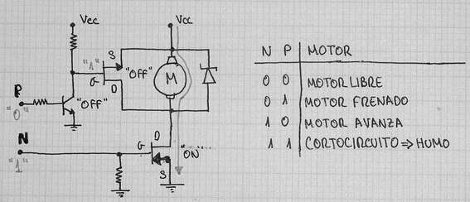
The kit came with a schematic, which makes the process of patching into its logic quite easy. There are two motors, each with a driver circuit made up of a pair of transistors and one flyback diode. This means the motors can only move in one direction, but they also only take one logic connection to control. Instead of populating the transistor that usually connects the IR receiver to the motor driver, [Eric] soldered jumper wires from each to an MSP430 chip (the G2231 that came with his Launchpad).

As you can see in the clip after the break, the first version of the code he wrote makes the robot follow a line as it would if it had not been altered. But there’s still plenty of programming space and several free I/O pins for future improvements.

Continue reading “Making A Line-following Toy Into A Programmable Robot”

Dustbin Computer Lets You Clean And Prototype With A Neato XV-11

So you bought yourself a Neato XV-11 and your floors have never been cleaner. The only problem is that you want to hack around with the hardware without losing your floor-sweeping minion. [Hash] found a solution to the issue by building a computer inside of the dustbin module.

You can see at the center of the image above a touchscreen. Normally this is just blank plastic, as it’s the removable container where your floor sweepings go, but [Hash] was inspired by the modular design. Since that bin is intended to be removable, it’s a perfect way to make add-on hardware removable. All he needed to do was find a way to connect to the Neato’s own electronics. The solution was a non-standard USB cable.

Using the guts from an Insignia Infocast 3.5 (he picked several of them up on clearance at Christmas) he  milled an opening for the touch screen, added a cooling fan, and wired up a toggle switch (not pictured above) which powers everything from the 14-17V coming in from that USB cable. The Infocast is a Chumby with a different branding so there’s plenty of Linux-based power and it’s WiFi enabled. Watch [Hash’s] walk through video after the break to see all that went into this clever concept.

We haven’t seen too many hacks that make use of the Neato XV-11. [Hash] is the same guy who hacked the Lidar on the unit, but there must be others turning out impressive projects. Don’t hesitate to send in a tip if you know of one.

Continue reading “Dustbin Computer Lets You Clean And Prototype With A Neato XV-11”

My First Robot: A Simple Demo To Get Kids Excited About Robotics

revoltlab_balloon_popping_robot

[Will] from Revolt Lab needed a project to get the summer campers he supervises interested in electronics, but when your audience is 5 years old, your subject matter had better be simple, yet interesting enough to hold their attention at length. He settled on using a Lego NXT robot to keep their little minds engaged, because who doesn’t like robots?

He picked up a basic Lego NXT kit and paged through the manual. The first “example” robot looked pretty cool so he decided to give it a shot, though he still hadn’t figured out exactly what he would have the robot do. Inspiration struck, and he decided that he could take advantage of the NXT’s color sensor as well as its proximity sensor to construct a balloon hunting robot.

He constructed a “balloon corral” to keep the balloons in place and the kids out of his thumbtack-wielding robot’s reach. He let his creation loose, and as you can see in the video below, the robot hunts down the blue balloon and pops it, much to the children’s delight.

If you’re in the position to introduce a group of young kids to electronics, this balloon popping robot paired with some conductive Play Dough would make for a fun and educational afternoon workshop.

Continue reading “My First Robot: A Simple Demo To Get Kids Excited About Robotics”