Outside of very small applications, Nikola Tesla’s ideas about transmitting serious power without wires have not been very practical. Sure, we can draw microwatts from radio signals in the air, and if you’re willing to get your phone in just the right spot, you can charge it. But having power sent to your laptop anywhere in your home is still a pipe dream. Sending power from a generating station to a dozen homes without wire is even more fantastic. Or is it? [Paul Jaffe] of the Naval Research Laboratory thinks it isn’t fantastic at all and he explains why in a post on IEEE Spectrum.
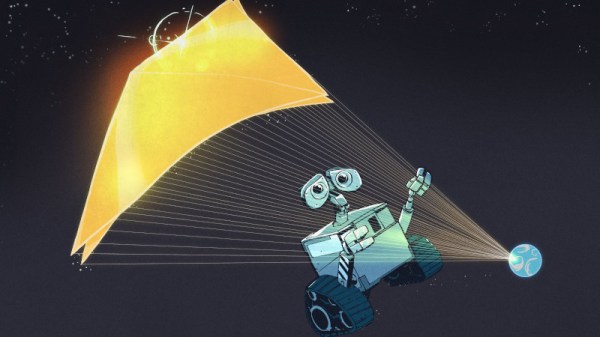
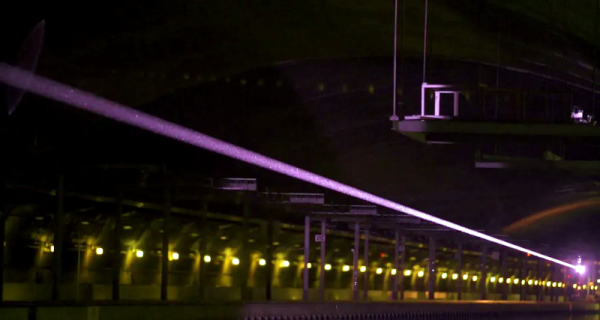
Historically, there have been attempts to move lots of power around wirelessly. In 1975, researchers sent power across a lab using microwaves at 50% efficiency. They were actually making the case for beaming energy down from solar power satellites. According to [Jaffe], the secret is to go beyond even microwaves. A 2019 demonstration by the Navy conveyed 400 watts over 300 meters using a laser. Using a tightly confined beam on a single coherent wavelength allows for very efficient photovoltaic cells that can far outstrip the kind we are used to that accept a mix of solar lighting.
Wait. The Navy. High-powered laser beams. Uh oh, right? According to [Jaffe], it is all a factor of how dense the energy in the beam is, along with the actual wavelengths involved. The 400-watt beam, for example, was in a virtual enclosure that could sense any object approaching the main beam and cut power.
Keep in mind that 400 watts isn’t enough to power a hair dryer. Besides, point-to-point transmission with a laser is fine for sending power to a far-flung community but not great for keeping your laptop charged no matter where you leave it.
Still, this sounds like exciting work. While it might not be Tesla’s exact vision, laser transmission might be closer than it seemed just a few years ago. We’ve seen similar systems that employ safety sensors, but they are all relatively low-power. We still want to know what’s going on in Milford, Texas, though.