In Space (Probably) Everyone Can Hear You.. Well, You Know

The news is full of reports from the moon-bound Integrity, otherwise known as Artemis II. Mostly, the news is good, but there has been one “Houston, we have a problem…” moment. The space toilet, otherwise known as the Universal Waste Management System or UWMS is making a burning smell while in use. While we would love to be astronauts, we really don’t want to go ten days without using the can, and it made us wonder how, exactly, the astronauts answered the call of nature.

The Old Days

Back in the Apollo-era, going to the bathroom was a messy business. The capsule wasn’t that big, and there were no women on board. So you simply strapped an adhesive-rimmed bag or tube to yourself and answered nature’s call with your two closest coworkers right there.
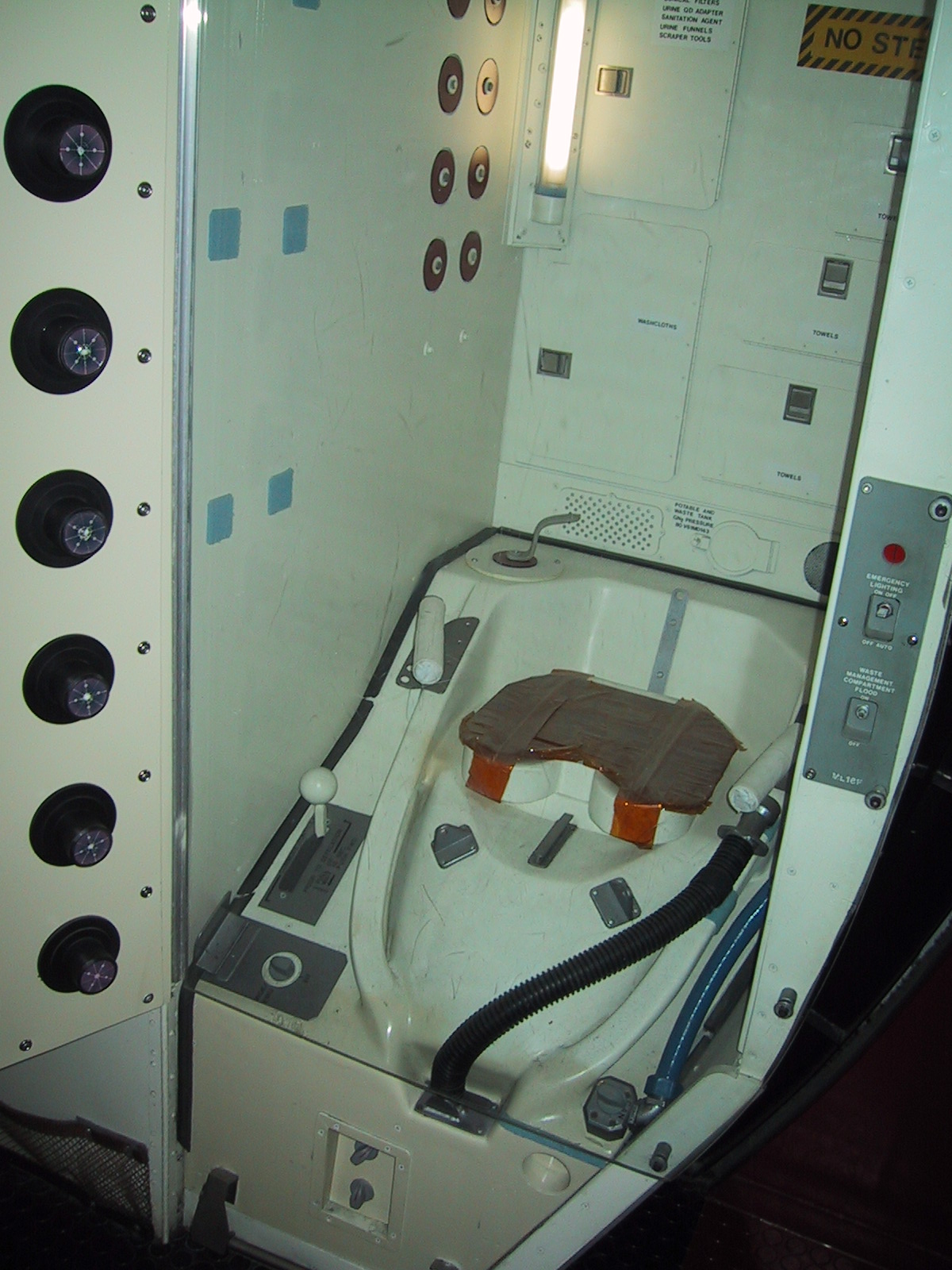
Space Shuttle facilities (by [Svobodat] CC BY-SA 3.0)
To add insult to injury, the “#2 bags” needed some packet mixed in to keep it from going bad in the bag before it could return to Earth for — no kidding — scientific study.

The system was far from perfect. Apollo 8 and Apollo 10 both had to do some housekeeping due to leaky bags.

Astronaut Ken Mattingly reportedly said, “Man, one of the feats of my existence the other day was, in 42 minutes, I strapped on a bag, went out of both ends, and ate lunch…. I used to want to be the first man to Mars. This has convinced me that, if we got to go on Apollo, I ain’t interested.”

Still, it was better than the first Mercury launch, where Alan Shepard famously relieved himself in his spacesuit while sitting on the pad for over eight hours. Later missions used hoses.

Things got slightly better with Skylab, where there was more room. The Shuttle also had a toilet. You got a curtain for privacy, but you couldn’t go #1 and #2 at the same time. Also, apparently, the contraptions were not easily workable for females.

Continue reading “In Space (Probably) Everyone Can Hear You.. Well, You Know”

Hackaday Links Column Banner

Hackaday Links: March 22, 2026

On Friday, Reuters reported that Amazon is going to try to get into the smartphone game…again. The Fire Phone was perhaps Amazon’s biggest commercial misstep, and was only on the market for about a year before it was discontinued in the summer of 2015. But now industry sources are saying that a new phone code-named “Transformer” is in the works from the e-commerce giant.

At this point, there’s no word on how much the phone would cost or when it would hit the market. The only information Reuters was able to squeeze out of their contacts was that the device would feature AI heavily. Real shocker there — anyone with an Echo device in their kitchen could tell you that Amazon is desperate to get you talking to their gadgets, presumably so they can convince you to buy something. While a smartphone with even more AI features we didn’t ask for certainly won’t be on our Wish List, if history is any indicator, we might be able to pick these things up cheap on the second-hand market.

On the subject of AI screwing everything up, earlier this week, the Electronic Frontier Foundation reported that The New York Times had started blocking the Internet Archive’s crawlers, citing concerns over their content being scraped up by bots for training data. The EFF likens this to a newspaper asking libraries to stop storing copies of their old editions, and warns that in an era where most people get their news via the Internet, not having an archived copy of sites like The Times will put holes in the digital record. They also point out that mirroring web pages for the purposes of making them more easily searchable is a widely accepted practice (ask Google) and has been legally recognized as fair use in court.

Assuming we take the NYT’s side of the story at face value, there’s a tiny part of our cold robotic heart that feels some sympathy for them. Over the last year or so, we’ve noticed some suspicious activity that we believe to be bots siphoning up content from the blog and Hackaday.io, and it’s resulted in a few technical headaches for us. On the other hand, what’s Hackaday here for if not to share information? Surely the same could be said for any newspaper, be it the local rag or The New York Times. If a chatbot learning some new phrases from us is the cost of doing business in 2026, so be it. Can’t stop the signal.

Continue reading “Hackaday Links: March 22, 2026”

Artemis II Agenda Keeps Moon-Bound Crew Busy

With the launch of Artemis II from Cape Canaveral potentially just weeks away, NASA has been releasing a steady stream of information about the mission through their official site and social media channels to get the public excited about the agency’s long-awaited return to the Moon. While the slickly produced videos and artist renderings might get the most attention, even the most mundane details about a flight that will put humans on the far side of our nearest celestial neighbor for the first time since 1972 can be fascinating.

The Artemis II Moon Mission Daily Agenda is a perfect example. Released earlier this week via the NASA blog, the document seems to have been all but ignored by the mainstream media. But the day-by-day breakdown of the Artemis II mission contains several interesting entries about what the four crew members will be working on during the ten day flight.

Of course, the exact details of the agenda are subject to change once the mission is underway. Some tasks could run longer than anticipated, experiments may not go as planned, and there’s no way to predict technical issues that may arise.

Conversely, the crew could end up breezing through some of the planned activities, freeing up time in the schedule. There’s simply no way of telling until it’s actually happening.

With the understanding that it’s all somewhat tentative, a look through the plan as it stands right now can give us an idea of the sort of highlights we can expect as we follow this historic mission down here on Earth.

Continue reading “Artemis II Agenda Keeps Moon-Bound Crew Busy”