
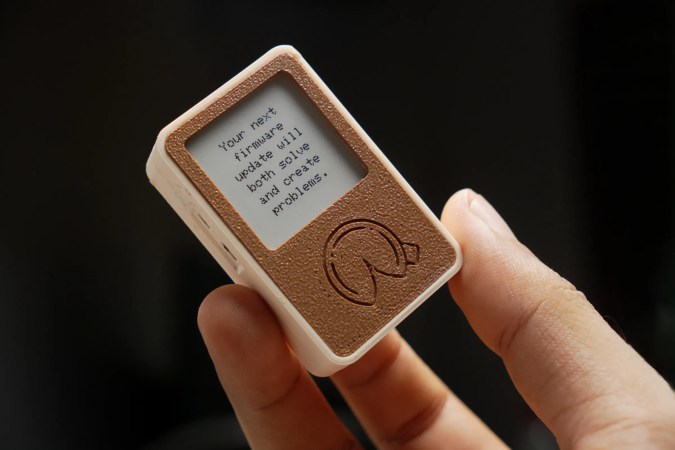
A tiny, rectangular, 3D-printed box with an e-paper display and a fortune cookie design beneath it. The fortune reads: "Your next firmware update will both solve and create problems."

E-Fortune Cookie Will Humble, But Never Crumble

Will your next project be a success? Only time will tell, but if you build [gokux]’s tiny ESP32 fortune cookie, we predict that, at the very least, there won’t be any crumbs involved.

After briefly entertaining the idea of shoving an ESP32 in a standard fortune cookie, [gokux] thought better of it and came up with this instead. Once shaken, this small gadget displays a fortune on its e-paper screen. It can store over 3,000 fortunes and works entirely offline, so you’re never without an oracle.

Inside you’ll find a Seeed Xiao ESP32-S3 Plus and a matching e-paper display board. [gokux] is detecting the shakes with an MPU-6050 accelerometer, and powers everything with a small Li-Po pouch.

If you tire of the fortunes that shake out, the small buttons on the left side will get you into the other modes, which are a dice roller and a coin flipper. Again, you just shake the thing until you get what you want. Be sure to check it out in the video after the break.

Want to know how an MPU-6050 works, and what it looks like under the hood? Yeah, we thought so.

Continue reading “E-Fortune Cookie Will Humble, But Never Crumble”
Autonomous Coin Flipper Flips Expensive Coin

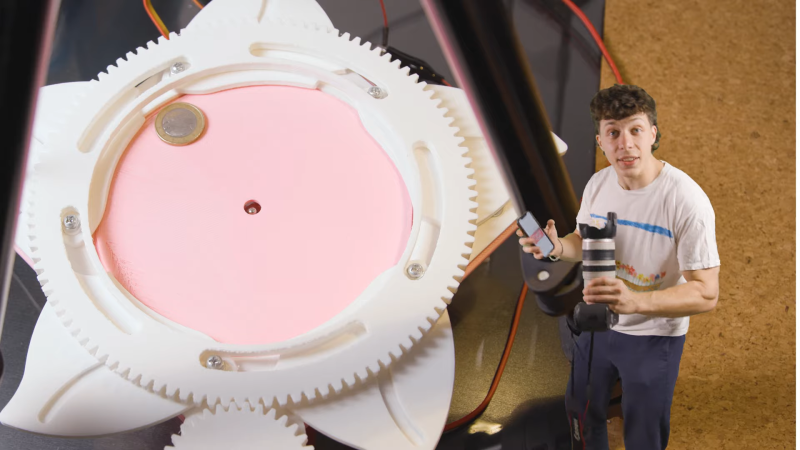
[Térence Grover] had a very special coin—a  €1,000 commemorative piece only available to Monégasque nationals. If you want to flip one, normally you’d have to go snatch one up from somebody in Monaco—or you could just do it online!

Yes, he built an automated online coin flipper to flip this very special piece of coinage. A 12-volt solenoid is fired to flip the coin into the air. It then lands on its 3D-printed tray, where a Raspberry Pi-based computer vision system built with OpenCV and a TFLite model classifies whether the result is heads or tails via a machine learning algorithm. An iris mechanism operated by servo motor then centers the coin on the tray, so it sits back over the solenoid, ready to flip once again. [Térence] was eventually able to refine this simple homemade build to the point that it ran autonomously for a full 50,000 flips on a livestream without issue.

The mechanism in this build is not dissimilar to a coin flipper we’ve seen before. We’ve also explored the statistics involved, too. Video after the break.

Continue reading “Autonomous Coin Flipper Flips Expensive Coin”







