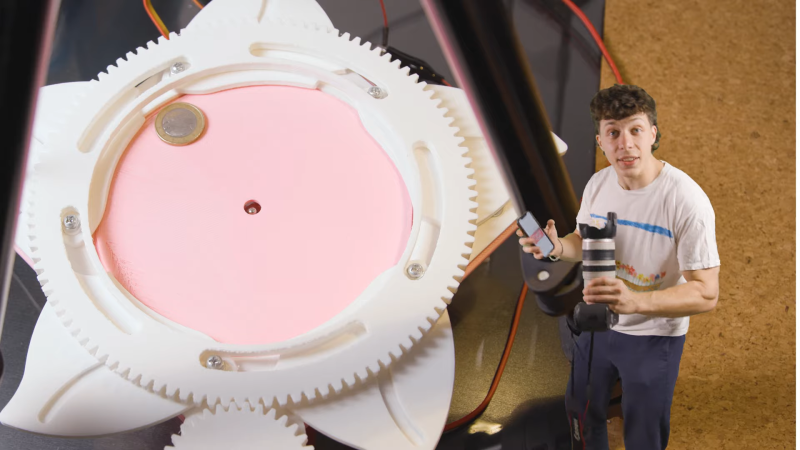
Autonomous Coin Flipper Flips Expensive Coin

[Térence Grover] had a very special coin—a  €1,000 commemorative piece only available to Monégasque nationals. If you want to flip one, normally you’d have to go snatch one up from somebody in Monaco—or you could just do it online!

Yes, he built an automated online coin flipper to flip this very special piece of coinage. A 12-volt solenoid is fired to flip the coin into the air. It then lands on its 3D-printed tray, where a Raspberry Pi-based computer vision system built with OpenCV and a TFLite model classifies whether the result is heads or tails via a machine learning algorithm. An iris mechanism operated by servo motor then centers the coin on the tray, so it sits back over the solenoid, ready to flip once again. [Térence] was eventually able to refine this simple homemade build to the point that it ran autonomously for a full 50,000 flips on a livestream without issue.

The mechanism in this build is not dissimilar to a coin flipper we’ve seen before. We’ve also explored the statistics involved, too. Video after the break.

Continue reading “Autonomous Coin Flipper Flips Expensive Coin”

Making A Locket From A Coin

Some countries have strict laws around the destruction or alteration of issued currency, but then again, some countries don’t. Citizens of those in the latter category may enjoy undertaking a build similar to this locket created by [Elier Olivos], crafted from a large coin.

A compass is first used to mark out a line on the coin’s perimeter, before it is cut in half with a fret saw. Once the two halves of the coin are smoothed out, it’s then time to heat them and quench them so they’re more malleable for pounding into a slightly domed shape. Metal rings are then fabricated and added to each half to give the locket some depth.

A hinge is then carefully made and fixed into the edges of the coin halves, giving the closed coin an almost seamless outside appearance. A small latch installed on the inside helps hold the locket closed. The final touches are to attach a loop for affixing the locket to a chain for the wearer, and to polish the inside of the locket up to a mirror shine.

[Elier] makes the build look easy through a combination of his amazing skills with his hands and the help of a some esoteric tooling. It can be very relaxing to take in a video of a master at work, and we’ve seen some great examples recently. Video after the break.

Continue reading “Making A Locket From A Coin”

Coin Sorter Is Elegant And Beautiful

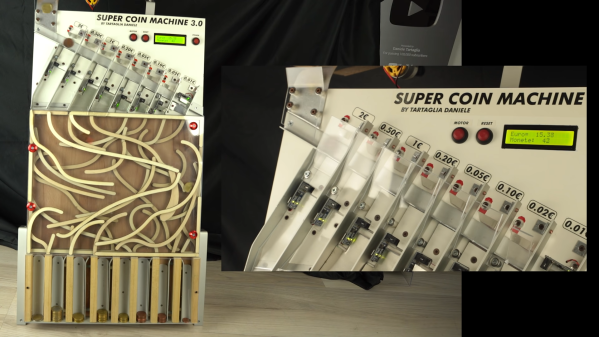
Counting change is a great way to teach children about mathematics and money, but it grows tiresome for those of us that have passed the first grade. Thus, a machine should the job, as [Daniele Tartaglia] demonstrates.

A vibrating motor is used to shake a hopper full of coins, letting them fall through a feeder slot into the machine at a steady rate. They then go through a size-based sorter, which flicks the coins into a different channel depending on their physical dimensions. The coins are counted via infrared sensors wired up to an Arduino, and then pass through a rather lovely maze on their way down to sorting bins at the bottom of the machine.

It’s a tidy build, and a great thing to have if you regularly find yourself needing to count change. We haven’t seen too many coin counters before, but we have seen a laundromat given an overhaul with some hacker skills. Video after the break.

Continue reading “Coin Sorter Is Elegant And Beautiful”

DIY High Voltage Kirlian Photography Rig

High voltage is a fun, if dangerous, thing to play with. [Mirko] is an enthusiast in this space, and built a high-voltage Kirlian photography device that’s capable of creating some stunning images.

The construction of the device itself is basic. High-frequency, high-voltage electricity is connected to a metal object placed on one side of a glass plate. On the other side, salt water is pooled, and connected to a second electrode. This creates a transparent window through which the electrical discharge can be viewed either by eye or with a digital camera. Historically, this was done with photographic film in place of the transparent window, but the principle is the same.

Popular in the paranormal and alternative medicine spaces, the actual scientific application of Kirlian photography is minimal. Rather, it’s an interesting way to explore high voltages that creates some pretty results! If you find yourself becoming a fan of high voltage, you might also consider your own Tesla coil build, too. Video after the break.

Continue reading “DIY High Voltage Kirlian Photography Rig”

Flipping A Coin 10,000 Times With A Dedicated Machine

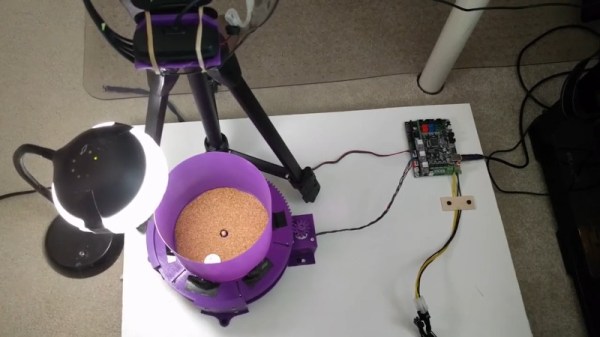
Flipping a coin is often the initial example used to help teach probability and statistics to maths students. Often, there is talk of how, given a fair coin, the probability of landing heads or tails should approach 0.5. Of course, if you want to test this, it pays to have a machine do the hard work for you. [Andrew Consroe] has the rig to do just that.

The build consists largely of 3D printed parts. A large cylindrical shroud is used to keep the coin within the flipping area. A spring-loaded dowel is actuated by a stepper motor spinning a cam, which flips the coin. Once the coin has landed, it is photographed with a webcam. An image processing pipeline then determines whether the coin landed heads or tails. A black spot is used on one side of the coin to aid analysis, as the poor-quality webcam images weren’t good enough to recognise the coin in its standard form. Once the flip has been analysed, a sliding aperture is used to push the coin back towards the flipper for the next cycle.

The machine completes a flip approximately every two seconds, meaning 10,000 flips would take approximately 2.5 days. Unfortunately, due to noise and occasional coin escapes, [Andrew] hasn’t yet been able to achieve his goal. He aims to increase speed significantly before making an all-out attempt.

Coin flips can make for decent random numbers, but if you need better ones, perhaps NIST can help you out. Video after the break.

Continue reading “Flipping A Coin 10,000 Times With A Dedicated Machine”

A Trove Of Arcade Projects

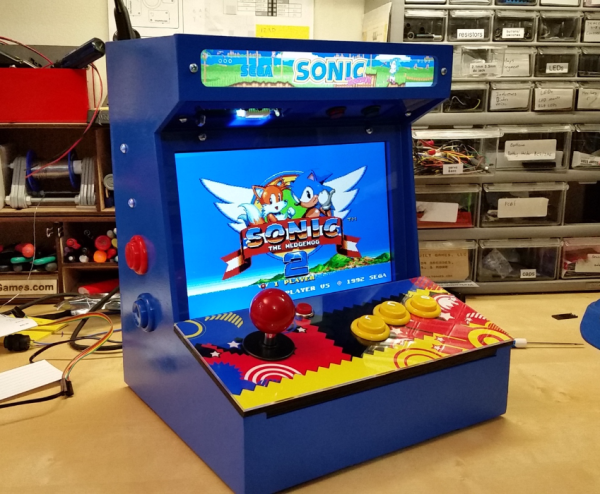
[Ryan Bates] loves arcade games, any arcade games. Which is why you can find claw machines, coin pushers, video games, and more on his website.

We’ve covered his work before with his Venduino project. We also really enjoyed his 3D printed arcade joystick based off the design of a commercial variant. His coin pushing machine could help some us finally live our dream of getting a big win out of the most insidious gambling machine at arcades meant for children.

Speaking of frustrating gambling machines for children, he also built his own claw machine. Nothing like enabling test mode and winning a fluffy teddy bear or an Arduino!

It’s quite a large site and there’s good content hidden in nooks and crannys, so explore. He also sells kits, but it’s well balanced against a lot of open source files if you’d like to do it yourself. If you’re wondering how he gets it all done, his energy drink review might provide a clue.

Vending Coins For Your Vending Machine

Anyone who has worked in an office with a vending machine knows this problem well: someone wants a snack or a drink from the vending machine, but doesn’t have any small change. So, they proceed to walk around the office trying to find someone to make some change for them. It’s a hassle, and a surprisingly common one. Sure, a lot of vending machines now accept credit cards, but they’re still in the minority.

This was the problem facing Belgium-based automation company November Five. As automation and IoT specialists, their first thought was to hack the vending machine itself. But, unfortunately, they didn’t own it; as many of you know, vending machines are generally owned by the distributor. So, they needed a solution that allowed their employees access to the vending machine, without actually modifying the vending machine itself.

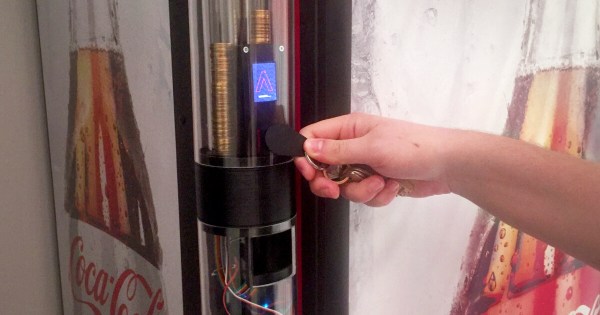
The solution they came up with was to attach an RFID-activated coin dispenser to the vending machine. Everyone at the company already has an RFID badge for opening doors and such, so the system wouldn’t add any burden to the employees. And keeping track of how many coins each employee used was a simple task of logging requests.

Continue reading “Vending Coins For Your Vending Machine”