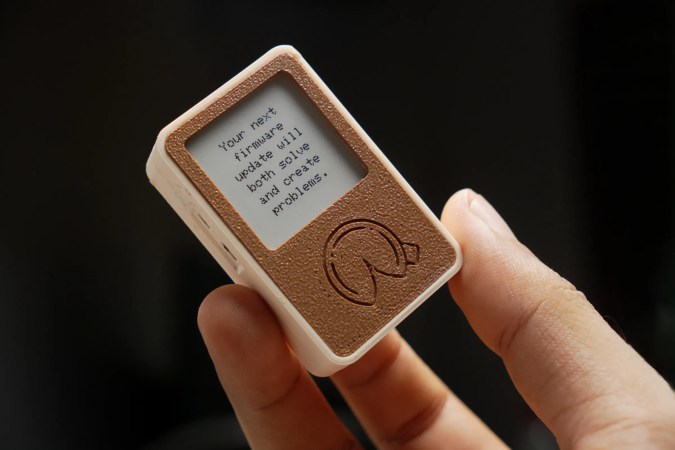
A tiny, rectangular, 3D-printed box with an e-paper display and a fortune cookie design beneath it. The fortune reads: "Your next firmware update will both solve and create problems."

E-Fortune Cookie Will Humble, But Never Crumble

Will your next project be a success? Only time will tell, but if you build [gokux]’s tiny ESP32 fortune cookie, we predict that, at the very least, there won’t be any crumbs involved.

After briefly entertaining the idea of shoving an ESP32 in a standard fortune cookie, [gokux] thought better of it and came up with this instead. Once shaken, this small gadget displays a fortune on its e-paper screen. It can store over 3,000 fortunes and works entirely offline, so you’re never without an oracle.

Inside you’ll find a Seeed Xiao ESP32-S3 Plus and a matching e-paper display board. [gokux] is detecting the shakes with an MPU-6050 accelerometer, and powers everything with a small Li-Po pouch.

If you tire of the fortunes that shake out, the small buttons on the left side will get you into the other modes, which are a dice roller and a coin flipper. Again, you just shake the thing until you get what you want. Be sure to check it out in the video after the break.

Want to know how an MPU-6050 works, and what it looks like under the hood? Yeah, we thought so.

Continue reading “E-Fortune Cookie Will Humble, But Never Crumble”
No Die? No Problem: RealDice.org Has You Covered

Have you ever been out and about and needed to make a check against INT, WIS or CON but not had a die handy? Sure, you could use an app on your phone, but who knows what pseudorandom nonsense that’s getting up to. [Lazy Hovercraft] has got the solution with his new site RealDice.org, which, well, rolls real dice.

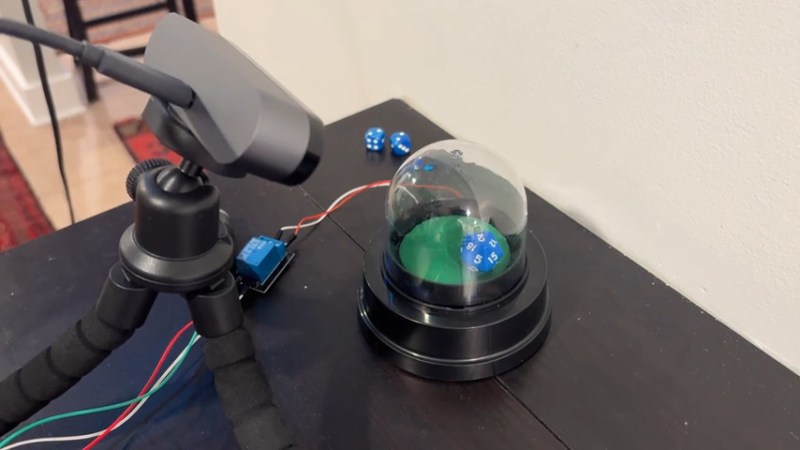
Well, one die, anyway. The webpage presents a button to roll a single twenty-sided die, or “Dee-Twenty” as the cool kids are calling it these days. The rolling is provided by a unit purchased from Amazon that spins the die inside a plastic bubble, similar to this unit we covered back in 2020.  (Alas for fans of the venerable game Trouble, it does not pop.) The die spinner’s button has been replaced by a relay, which is triggered from the server whenever a user hits the “roll” button.

You currently have to look at the camera feed with your own eyes to learn what number was rolled, but [Lazy Hovercraft] assures us that titanic effort will be automated once he trains up the CVE database. To that end you are encouraged to help build the dataset by punching in what number is shown on the die.

This is a fun little hack to get some physical randomness, and would be great for the sort of chatroom tabletop gaming that’s so common these days. It may also become the new way we select the What’s That Sound? winners on the Hackaday Podcast.

Before sitting down for a game session, you might want to make sure you’re all using fair dice. No matter how fair the dice, its hard to beat quantum phenomena for random noise.

Dice Roller Keeps Germs Out Of Your Snake Eyes

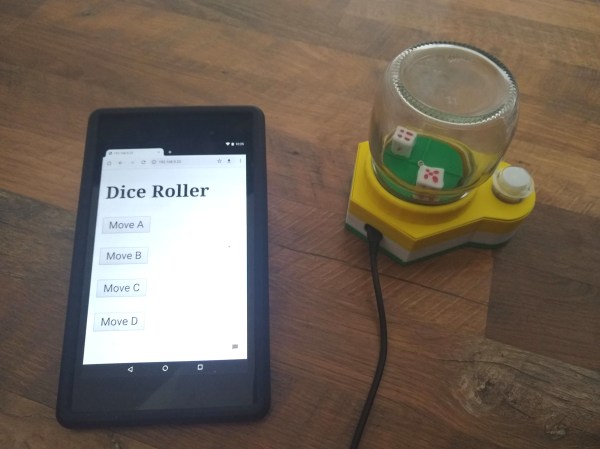
Do you need a to find a more sanitary way to roll the dice at your next socially-distanced board game gathering? [CJA3D]’s pop-o-matic mason jar dice roller can roll the bones two different ways — either by hitting that big, inviting arcade button, or though a web app that everyone can access on their own phones.

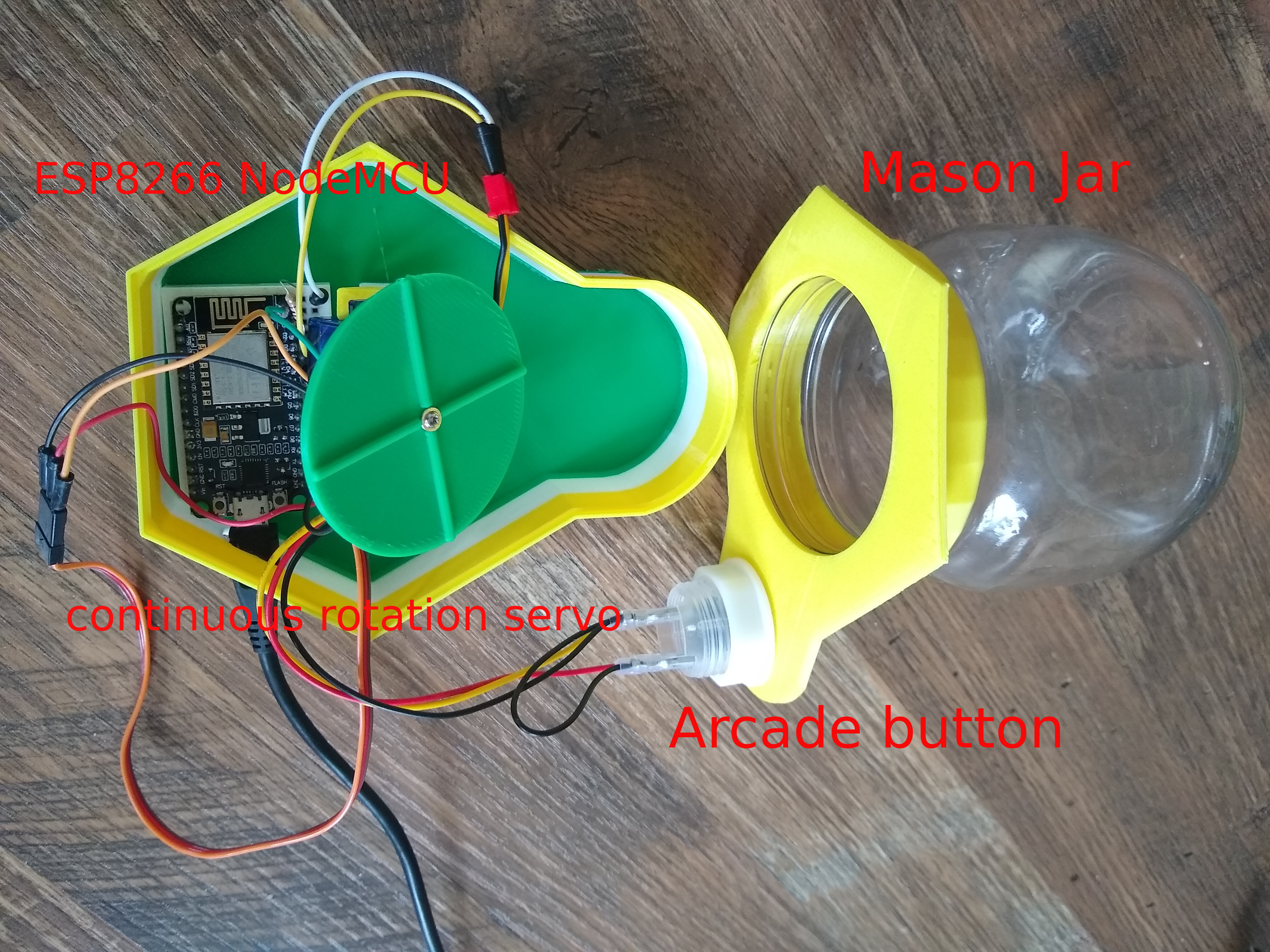
We think this looks great, and is a great reuse of a glass jar. The brains of this operation is an ESP8266, which drives a continuous-rotation servo underneath the dice. Push the button or use the web app and the servo disturbs the plate, moving the dice around.

Besides the sanitary aspect, one benefit of using the web app is that there are four different speed presets for the servo. As a bonus, [CJA3D] included the files for a pair of printed 6-sided dice. Click through to the project to see it in action.

We know you take games seriously, and so do we. Just look at this dice roller that uses machine vision to ensure fairness.