Skip to content
Logo

Hackaday

  • Home
  • Blog
  • Hackaday.io
  • Contests
  • Submit
  • About

haptic feedback

49 Articles

Flutter Dress Vibrates When It Hears Loud Noises

August 13, 2012 by Brian Benchoff 6 Comments

Many people with hearing impairments have assistive devices at home that flash a light whenever a fire truck goes by, an alarm bell goes off, or the doorbell rings. With the exception of a hearing dog, these devices are useless outside the home, and this is where [Halley]’s Flutter dress comes into play. Flutter has microphones and microcontrollers sewn into the dress to listen to the surrounding environment and uses small vibration motors to wave small cloth leaflets whenever a loud sound is detected.

In the writeup for Flutter (PDF), [Halley] tells us she used a quartet of microcontrollers to detect the ambient acoustic environment. Each microcontroller passes the signal from the microphone into a buffer where it performs an FFT on the sound data. From this, the loudness and frequency of a noise – as well as the direction from a time-of-flight calculation – can be determined. Once that is complete, each microcontroller actuates a small vibrator motor in the dress’ leafs according to how loud and in which direction the sound came from.

As with all assistive technologies for the hearing impaired, there is always the aspect of deaf culture’s point of view that such inventions are seen as forcing a disability on someone. [Halley]’s Flutter dress was with the input of a few family members who have hearing impairments and got some positive feedback from members of the community. Good job, and we can see why it won Best in Show at the 2012 International Symposium on Wearable Computer’s Design Exhibition.
Posted in Wearable HacksTagged dress, flutter, haptic feedback, wearable

Robot Arm Provides Haptic Feedback From The Virtual World

May 31, 2012 by Mike Szczys 2 Comments

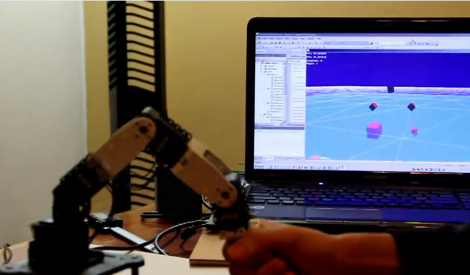
[Diego] wrote in to let us know about the haptic feedback arm project with which he’s hard at work. He calls it the Vimphin, which is uses the beginning letters from the words: Virtual Manipulator Physical Interface. Instead of a claw, the robot arm has a hand grip that lets you easily move it around. That is unless the virtual model of the arm encounters a dense substance, and then it’s going to be more difficult to move.

The test arm seen above includes several high quality robotic servo motors. You probably know that servo motors have feedback circuits that let them sense their position, and this is what is used to detect when a user moves the arm. This movement is tracked in the virtual 3D environment seen on the screen. In this case, the base of the robot is sitting in a pool of water. When the end of the virtual arm is in open air it’s pretty easy to move. When it dips below the water line the motors are used to increase resistance, simulating movement through a denser substance.

This sounds like a great piece of hardware to have around when the OASIS is finally developed.

Continue reading “Robot Arm Provides Haptic Feedback From The Virtual World” →

Posted in Robots HacksTagged haptic, haptic feedback, robot arm, servo, virtual

Weightlifting Coach Will Nag You About Your Form…at Least Until The Batteries Run Dry

March 25, 2012 by Mike Nathan 8 Comments

haptic-exercise-coach

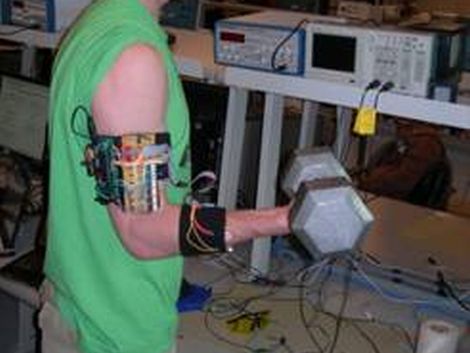
We always enjoy seeing what Electrical and Computer Engineering students dream up for their final projects, and though we must have missed this back in 2010 when it was published, [Bruce Land] dropped us a line to bring our attention to this cool Haptic Exercise Coach.

Designed and built by Cornell students [Michael Lyons] and [Greg Meess], the Haptic Exercise Coach is a small electrical circuit that helps individuals maintain proper form during bicep curls. The device uses accelerometers to monitor the user’s arm position and speed throughout the exercise, offering corrective feedback if it detects poor form. The device is driven by a Mega32 microcontroller which evaluates the data from the accelerometers, triggering one of six pager vibration motors to provide the feedback.

The pair says that the device can be used in athletic training to maximize workout time, or in muscle rehabilitation clinics where proper form can prevent reinjury.

Continue reading to see a video presentation of the device, and be sure to check out their project page for more details on how it was built.

Continue reading “Weightlifting Coach Will Nag You About Your Form…at Least Until The Batteries Run Dry” →

Posted in Medical Hacks, Misc HacksTagged accelerometer, exercise, haptic feedback, mega32

Tactile Computer Interface With Electromagnets

October 25, 2011 by Brian Benchoff 29 Comments

It’s not that touchscreen keyboards are horrible, but it’s nearly impossible to touch type on an iPad or other tablet keyboard. A team at the Media Computing Group at Aachen University figured out how to put a series of electromagnets underneath a display to provide haptic feedback for touchscreens. They showed off their tech at the 2011 UIST conference and made their paper available.

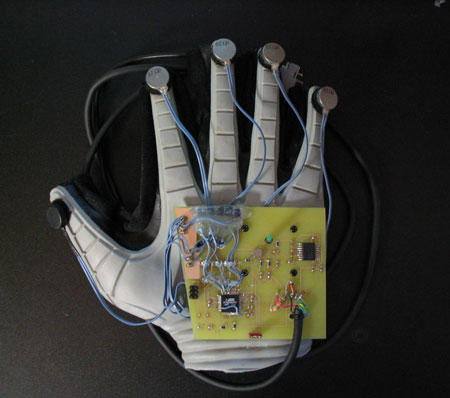
For the FingerFlux, as the team likes to call it, a bed of tiny electromagnets is placed underneath a panel display. The user wears a ‘thimble’ with an attached permanent magnet. Driving the bed of electromagnets slightly moves the magnet and provides a little bit of sensation to the user.

The FingerFlux can be used to provide haptic feedback like a keyboard. The system can also be used to model constraints – making sure that users don’t move outside the controls they operate, and can guide the user to the desired button.

A bed of electromagnets would be a welcome addition to tablets, if only to prevent typung luje rhus. Check out the demo of the FingerFlux after the break.

Thanks go to [John] for sending this one in.

Continue reading “Tactile Computer Interface With Electromagnets” →

Posted in hardwareTagged electromagnets, haptic, haptic feedback, touchscreen

The Laser Guided Wheelchair

June 2, 2011 by Jeremy Cook 10 Comments

Using a scanning laser similar to those used in industrial safety systems, a new wheelchair developed by Sweden’s Luleå University of Technology allows those who are visually impaired to drive it without assistance. A driver is given haptic feedback as a navigation aid, reportedly similar to using a cane.

Although something like this is good in concept, this idea is already a working prototype. Doctoral student Daniel Innala Ahlmark (who is visually impaired himself) has already taken this wheelchair on a test run in his university’s busy Computer Science, Electrical, and Space Engineering Department. After this test run he remarked that he “felt safe like using a white cane.”

It’s really neat to see engineering and hacking skills put to use to help people who are impaired in some way (even cooler to see someone visually impaired helping with the process itself!). For more “hacks” related to helping people check out this brain controlled wheelchair, or this mobility device for kids.

Posted in Transportation HacksTagged haptic feedback, laser, visually impaired, WheelChair

Haptic Feedback For The Blind

December 17, 2010 by Chris Nelson 32 Comments

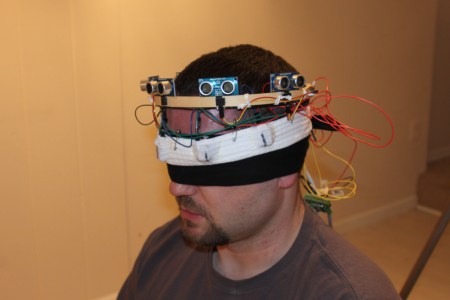
[polymythic] Is helping the blind see with his haptic feedback device called HALO. At the heart of the device is an Arduino Mega 2560 which senses objects with a few ultrasonic range finders and then relays the information back to the user using some vibration motors from old cell phones. The user can feel the distance by the frequency at which the motor pulses. The faster the motors pulse the closer an object is.

This kind of sensing is something that it can be applied to pretty much any sensor allowing the user to feel something that might be otherwise invisible. While haptic feedback is nothing new its good to see continuing work with new sensors and different setups.

Posted in Lifehacks, Wearable HacksTagged haptic feedback

Haptic Feedback Roundup

May 23, 2008 by Sean Percival 4 Comments

Haptic feedback (sometimes referred to as tactile or force feedback) offers what some might call a brave new world of interaction and immersion. The 1932 book of the same name was probably the first introduction many people got to the idea of computer generated touch sensations. In the book, movies are replaced with what are called “feelies”; patrons sit in chairs that provide feedback throughout the screening.

While we don’t see this coming to your local megaplex any time soon, we are starting to see the technology creep into our lives. After the break lets take a look at some examples, talk about projects we’ve covered before, and how you can get started developing your own.

Continue reading “Haptic Feedback Roundup” →

Posted in Peripherals HacksTagged haptic, haptic feedback, haptic technology, hapticfeedback, HapticTechnology, touch, touchscreen, touchsensor

Posts navigation

Newer posts →

Search

Never miss a hack

Follow on facebook Follow on twitter Follow on youtube Follow on rss Contact us

Subscribe

If you missed it

  • I, Integrated Circuit

    55 Comments
  • After 30 Years, Virtual Boy Gets Its Chance To Shine

    15 Comments
  • How Vibe Coding Is Killing Open Source

    91 Comments
  • Building Natural Seawalls To Fight Off The Rising Tide

    36 Comments
  • Ask Hackaday: How Do You Digitize Your Documents?

    81 Comments
More from this category

Our Columns

  • Big Heat Pumps Are Doing Big Things

    20 Comments
  • How Industrial Robot Safety Was Written In Blood

    14 Comments
  • FLOSS Weekly Episode 863: Opencast: That Code Is There For A Reason

    No comments
  • Keebin’ With Kristina: The One With The RollerMouse Keyboard

    3 Comments
  • The Surprising Hackability Of A Knock-Off Chinese Toy Camera

    9 Comments
More from this category

Search

Never miss a hack

Follow on facebook Follow on twitter Follow on youtube Follow on rss Contact us

Subscribe

If you missed it

  • I, Integrated Circuit

    55 Comments
  • After 30 Years, Virtual Boy Gets Its Chance To Shine

    15 Comments
  • How Vibe Coding Is Killing Open Source

    91 Comments
  • Building Natural Seawalls To Fight Off The Rising Tide

    36 Comments
  • Ask Hackaday: How Do You Digitize Your Documents?

    81 Comments
More from this category

Categories

Our Columns

  • Big Heat Pumps Are Doing Big Things

    20 Comments
  • How Industrial Robot Safety Was Written In Blood

    14 Comments
  • FLOSS Weekly Episode 863: Opencast: That Code Is There For A Reason

    No comments
  • Keebin’ With Kristina: The One With The RollerMouse Keyboard

    3 Comments
  • The Surprising Hackability Of A Knock-Off Chinese Toy Camera

    9 Comments
More from this category

Recent comments

  • D on Big Heat Pumps Are Doing Big Things
  • douyarou on Electronic Waste Graveyard Immortalizes Dead Electronics
  • Cap on Electronic Waste Graveyard Immortalizes Dead Electronics
  • Ray on Three Decades Of ReactOS
  • Sampo Laaksonen on LED Interior Lighting Could Compromise Human Visual Performance
  • Lightislight on Detecting Helium Leaks With Sound In A Physics-Based Sensor
  • Steven Clark on Electronic Waste Graveyard Immortalizes Dead Electronics
  • Matt Cramer on Big Heat Pumps Are Doing Big Things
  • WTF Detector on Electronic Waste Graveyard Immortalizes Dead Electronics
  • Grounded on Big Heat Pumps Are Doing Big Things
Logo
  • Home
  • Blog
  • Hackaday.io
  • Tindie
  • Video
  • Submit A Tip
  • About
  • Contact Us

Never miss a hack

Follow on facebook Follow on twitter Follow on youtube Follow on rss Contact us

Subscribe to Newsletter

Copyright © 2026 | Hackaday, Hack A Day, and the Skull and Wrenches Logo are Trademarks of Hackaday.com | Privacy Policy | Terms of Service | Digital Services Act | Do not sell or share my personal information
Powered by WordPress VIP
 

Loading Comments...