Electro-static See-saw

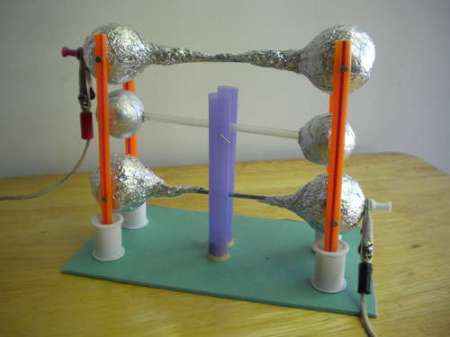
Many of you may have seen these fun little toys in museums or possibly even in school. Instructibles user [brazilero2008] takes us through the process of constructing one on our own.

Most of this toy are constructed from fairly household materials like foil, paper, straws etc. The fun part comes when you find the power supply. [brazilero2008] is using an air ionizer that he found at a rummage sale, though any high voltage DC source should work. He shares some tips on how to save time and effort creating the balls on the end by telling us how he did it the difficult way.

We admit this isn’t the most attention grabbing project, but we think it would be a fun educational weekend project.

High Voltage Rig Wipes CDs Clean

hv_cd_destruction

Here at Hackaday, we’re not against showing videos of gratuitous destruction just for the sake of it, though we try not to make it a habit. In this case we just couldn’t help ourselves. However, this video technically constitutes a security hack, as it does involve erasing sensitive information from CDs…

…with awesome!

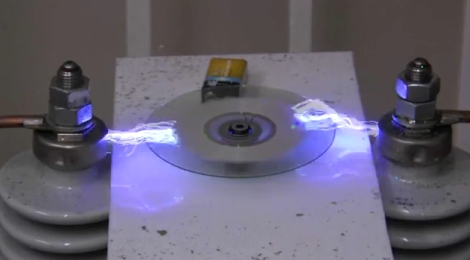
This may be the coolest CD eraser we’ve seen yet. Positioned between two high-voltage transformers, the spinning CD has its data violently stripped off in just a matter of seconds. To be fair, the data isn’t erased per se, but the metallic substrate on which the data is recorded is flaked off by the aggressive application of electricity.

Having destroyed our fair share of AOL CDs in the microwave over the years, we are now a bit sad over the fact that they were disposed of in such a lackluster fashion – if only we had one of these around!

Since we’re on the topic of mindless destruction, you might as well take a few minutes and check out this thermite-roasted Thanksgiving turkey, this self-destructing hard drive, or perhaps this thermic lance built from spaghetti.

You know, for science.

Continue reading “High Voltage Rig Wipes CDs Clean”

Jacob’s Ladder Makes Itself At Home In A Floppy Disk Box

[Plasanator] adds a bit of safety to his Jacob’s Ladder by housing it in a familiar enclosure. It doesn’t take very many components to make one of these, but to get the high voltage you’ll need some type of coil. He’s using one from the electrical system of an old car, then building around it with a big 15mf 220V capacitor, a dimmer switch normally used in household wiring, terminal blocks, and some braising rod or coat hanger for the spark to traverse.

The video after the break shows this in operations, and we’d agree with [Plasanator] that this is a wonderful addition to your Halloween decor. Of course you want to keep fingers away from the dangerous bits and that’s where the enclosure and key lock come into play. Were not sure what he made the upright cylinder from, but the base is a blast from the past. Remember when one of those used to sit proudly on every desk as a tribute to how important the information you had on had really was?

Don’t want to play with high voltage like this? You can build a fake using EL wire.

Continue reading “Jacob’s Ladder Makes Itself At Home In A Floppy Disk Box”

CFL Breakdown

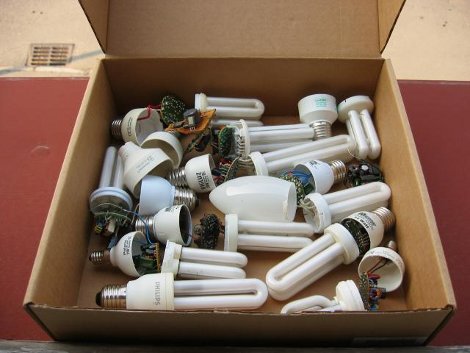
Reader [Jay] was inspired by one of our earlier articles and started digging around the web for some more information, and found a handy web page with tear downs and schematics of popular compact florescent lamps.

Schematics are provided to 15 fairly common models including bigluz, isotronic, luxtek, maway, maxilux, polaris, brownie, Phillips, Ikea, Osram, and eurolight. Also, just in case you were ever interested in these little packages but did not want to open them due to sharp glass, mercury vapor, or phosphorus powders, photos are provided as well.

So if you need a few hundred extra volts to pack a little spark in your next project, need a 63rd way to cook your goose you should check this page out.

More High Voltage Experimentation With A Flyback Inverter

[Electorials] actually makes working with a flyback inverter sound rather easy. This comes hot on the heals of the huge high voltage collection we saw the other day, but slows way down in the presentation of information. This makes the project very approachable for the newbie, especially considering that the majority of the testing is done with low voltages.

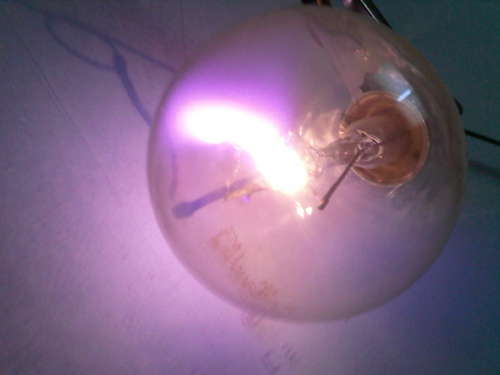
He’s using a flyback transform for this project, which can be pulled from an old CRT monitor. Once you have one in hand, all that’s required to figure out how to use it is a voltometer, a 9V battery, a MOSFET (also salvaged in this case), and miscellaneous components. Once he establishes what each external connection does electronically, [Electorials] builds his circuit on a breadboard, then uses it to create plasma in the bulb above as well as to light up a CCFL.

Building Linear Amplifier Prototypes

We know way too little about this subject but hopefully [Bob4analog] helped us learn a little bit more this time around. He’s building his own linear amplifiers on what looks like sheets of MDF. This is an evolving design and the two videos after the break show two different iterations. He’s salvaged several components, like transformers from microwaves, as well as built his own components like the plate choke to the right of the tubes in the image above. In standby, the amp sits at 2800 volts, warming the filament before the unit is switched on.

So what’s he got planned for this? Good question, but it appears that there’s more than enough power to drive a long-range transmitter.

Continue reading “Building Linear Amplifier Prototypes”

Marx Generator, Knocks Our Rocks Off

What weighs more than 500 pounds, produces 500 kilovolts, and we don’t recommend you try at home in any way shape or form? If you guessed a rock disaggregation device, you’re correct! We also accepted lightning generators as correct answers. Using high voltage electricity, a rock can be split apart down to its grains without destroying the precious minerals inside; unlike traditional grinding and mechanical techniques that often ruin the sample. All it takes is a massive hydro pole transformer, five 1uf 100 kilovolt capacitors, eight hand wound inductors, and two massive cojones to stand within 20 feet of the thing while it’s going off. Video after the divide.

Continue reading “Marx Generator, Knocks Our Rocks Off”