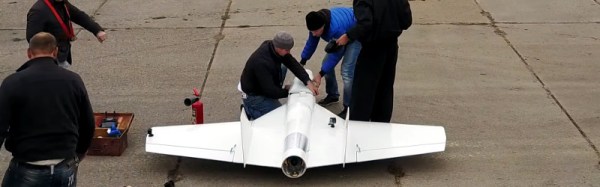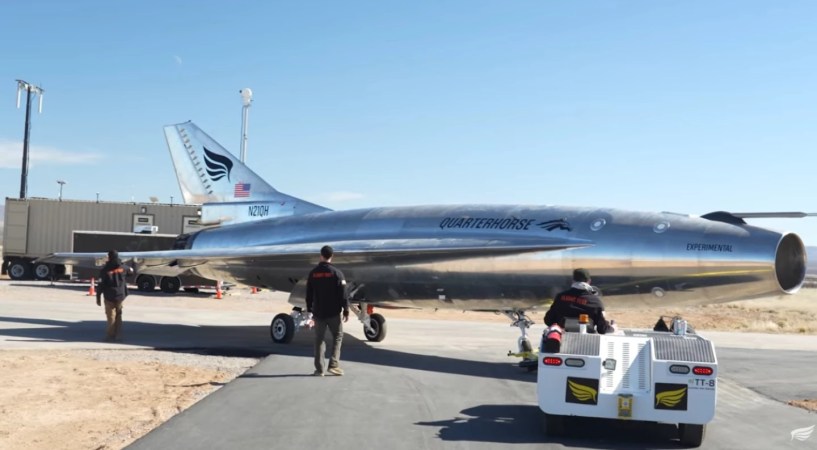
You’ve got to be ambitious to target a legend. If there’s one thing the folks at Hermeus Aerospace are, though, it’s ambitious: not only do they plan on their Quarterhorse unmanned aerial vehicle (UAV) to outfly the SR-71 blackbird, they’re hoping to do it in record time. They took one big step closer to that goal in March 2026, when Quarterhorse 2.1 took off for the first time from Spaceport America.
The F-16-sized prototype is actually the second first flight Hermeus can brag of in the past year– version one first flew in May 2025. They’re iterating fast. Version 2.1 is hoped to prove a key part of the engine design for v2.2, which is the plane Humerus hopes to use to break the SR-71’s air-breathing speed record of Mach 3.3 from 1976. They’re hoping the next prototype can actually hit mach 5, which would be amazing if they pulled it off. Of course when exactly v2.2 will fly will depend largely on how this current model does in its test envelope.
This Quarterhorse hasn’t yet broken the sound barrier, but it certainly will. With the same F100 engine as the F-15 and F-16 fighters, it’s got the thrust, and one look tells you it has the aerodynamics. Of course an F100 can’t fly at Mach 5 — not on its own — but the F100 isn’t purely stock. It’s actually a component in Hermeus’ Chimera engine, which combines the F100 with a pre-chiller to actively cool the incoming supersonic air so the engine doesn’t melt at high speeds, and a ramjet stage that bypasses the engine entirely. That would make the Chimera a turboramjet engine; starting with an old and well-known turbine stage seems like a good move and is arguably a hack.
It would work like this: the engine takes off on turbine, the chiller kicks in when the aircraft goes supersonic, and the turbine is bypassed completely at high mach. This is how they hope to break the SR-71’s record: as well-designed as the J-58 engine was in that plane, it only pushed bleed air into the afterburner, rather than bypassing its turbine stage entirely, so was limited by the need to not melt said turbines. In some ways, the Chimera reminds us of a cheaper, simpler SABER engine. Of course as ambitious as breaking a 50 year old speed record might be, Hermeus’ goals are downright humble compared to the single-stage-to-orbit dreams the SABRE was meant to allow.
It remains to be seen just how fast Quarterhorse 2.1 will be able to go. Notably, at least as it was first unveiled, the aircraft doesn’t have any kind of shock cone on the inlet. It’s unlikely that the pre-chiller makes that unnecessary; it is more likely that either 2.1 is going to be restricted to low mach numbers where such things aren’t necessary, or it will be fitted later. Either way, we look forward to following the test program, at least as much as it is made public. Check out footage from the test flight in the video embedded below.
Continue reading “Quarterhorse Vs Blackbird: Hermeus’ Flight Puts Them One Step Closer To Record”