Laser-triggered Camera Rig Update: 2011 Version

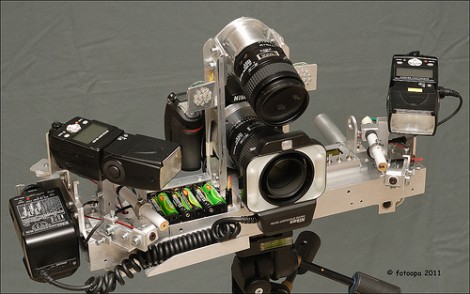
[Fotoopa] keeps churning out new iterations of his laser-triggered camera rig. This is his latest, which he calls the 2011 setup. Regular readers will remember that we just covered a different version back in November; that one was the 2010 rendition. It had two DSLR cameras offset by 90 degrees with mirrors to face forward. This time around he has gone back to the single camera setup which was what he used on the first and second versions seen way back in 2008.

Whew, that’s a lot of links to specialty DSLR hardware. Let’s bring it back to this newest model (the link at the top). The biggest improvement is the shutter delay between when the laser beam is tripped and the image is take. [Fotoopa] reports that he’s managed to reduce that time down to 3.3 milliseconds. This is thanks to an external shutter replacement which improves on the stock shutter’s 52 millisecond delay.

For those that are seeing this for the first time. [Fotoopa] uses this rig to photograph insects in motion. A laser trip wire is responsible for triggering the shutter, and it does so with stunning results!

More Laser Shooting Range Goodness; Now With Duckies

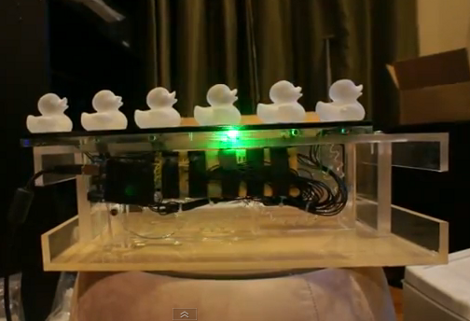
Here’s another project that reminds us of the shooting games at a carnival. This was actually inspired by the video game Duck Hunt, and was undertaken as a class project between four students at San Jose State University. It uses moving glass targets that look like rubber duckies. The player shoot sensors at their base with a laser-tipped gun. A direct hit is indicated by the duck glowing blue.

[Lananh Nguyen] is a Business Marketing major, but he’s also minoring in Studio Art and has been blowing glass for years. We think he’ll always have a side job making and selling glass because those ducks look fantastic. [Michael] and [Chris] worked together, building out the oscillating platform which moves the targets back and forth, as well as wiring up light sensors to the Arduino. A green laser diode was added to an acrylic gun to complete the project. Check out the game play video after the break to see how it all comes together.

If you missed the other laser shooting range when we featured it last week, you’ll want to revisit that project which uses tin cans as targets.

Continue reading “More Laser Shooting Range Goodness; Now With Duckies”

Full Color Laser TV

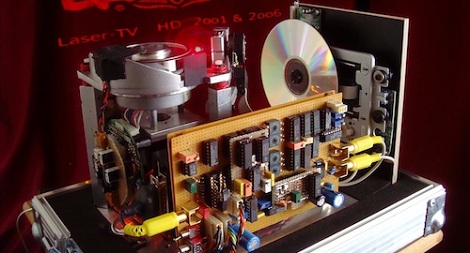
Back in 2001, [Helmar] made an awesome monochrome video display out of a red laser pointer and a spinning 18-sided mirror. Blue and green lasers are much less expensive than they were a decade ago, so [Helmar] decided to go full color with his laser projector. (In German, so fire up Chrome or get the Google translation)

The ancient website for [Helmar]’s green-only projector goes over the principles of operation. A single laser shines onto a multi-faceted polygonal mirror. This is reflected onto another mirror that provides the reflection for each line in a frame of video. Earlier this year, [Helmar] hacked up a red and blue laser to complement the preexisting green laser. The end result is an RGB projector powered by friggin’ lasers.

As far as we can tell, the projector only has composite input; the attached DVD player provides all the signaling for that. Amazingly, [Helmar] didn’t use a microcontroller for the circuitry. All the electronics are simple logic gates. Really amazing if you ask us.

Continue reading “Full Color Laser TV”

A Real, Laser-based 3D Display

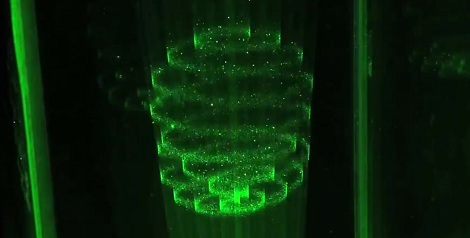
3D display technology is fairly limited. Most 3D displays out there rely on either prisms refracting light from a normal flat-panel display, or shooting lasers into some sort of space-filling device. A few researchers in Japan went with a more unconventional method of making a 3D display that actually lives up to the promises of the displays seen in Star Wars.

From the coverage of this display we’ve found, the green laser demonstration is a scaled-down version that uses water as the display medium. There’s a short clip that shows a red, green, and blue laser projecting a few white voxels into mid-air. The video of both these demonstrations is a bit jumpy, but that’s probably because of the difference in frame rate between the display and camera.

We’re not really sure how the “plasma excitations of air molecules with focused beams” actually work, or even how to control 50,000 of these dots at 15 frames per second. If you’ve got any idea how to build one of these guys, leave a note in the comments.

Continue reading “A Real, Laser-based 3D Display”

Laser Level Tripod Made From Recycled Parts

laser_level_tripod

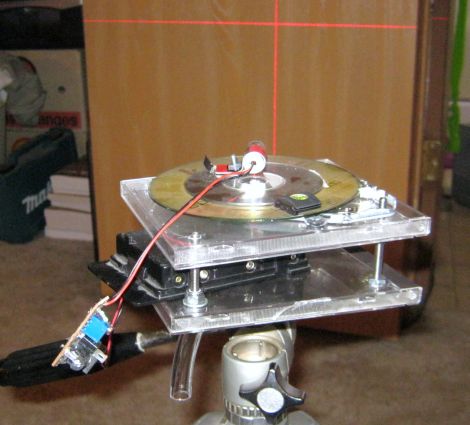
[msuzuki777] is a self-proclaimed “Lazy Old Geek” with way too much free time on his hands. He recently picked up a laser cross and figured that he would use some of that time to make a laser tripod for various projects around the house.

He pulled out an old camera tripod, and modified an unused CD jewel case so that it could be screwed onto the traditional camera mount. He added three bolts to the platform, on which he mounted another CD case, letting him adjust both the laser platform as well as the tripod.

He put together a simple power supply for the laser, and then mounted it on a pair of CDs sandwiched on top of one another. The CD platform was then popped onto the guts of an old CD player, allowing him to spin his laser pointer in any direction without having to re-level it.

The laser cross tripod certainly looks a bit complicated, but [msuzuki777] says it works a treat, allowing him to easily hang pictures and the like. He also mentions that he wants to throw an Arduino at it to automate the leveling process, which is something we’d love to see.

Win A Laser Cutter By Playing With Light

Buildlounge and Full Spectrum Laser have decided to give away a laser cutter to whoever comes up with the best project involving light.

The contest is in part sponsored by  adafruit industries. The focus of the contest is light – just design something around light, submit it, and you’re in the drawing for your own laser cutter. A solar oven, photophone, solar fiber-optic lighting and hacking apart an old overhead projector are suggested on the contest page, but the winning project will probably be much cooler.

Entries are due by January 1st. First prize is Full Spectrum Laser’s 40 Watt laser cutter, second is an awesome green laser pointer from Wicked Lasers, and third prize is an EL wire starter kit from Adafruit. Entries are due by January 1st, so we expect to see a lot of awesome submissions on the Hack A Day tip line between now and New Years.

Laser Trip Wire In An Easy-to-use Form Factor

[Rul] built a nice laser trip wire alarm for use in Airsoft matches. Just place the enclosure so that the beam crosses a doorway and it will sound an alarm when the beam is broken. The only problem with this setup is that you need a reflective surface on the opposite side that can be positioned to direct the beam of light back to a photoresistor. But wait, there’s a second option. [Rul] also added a leaf switch that can be connected to an actual trip wire instead of using the laser.

A PIC 16F688 controls the laser module and monitors the photoresistor and leaf switch. When power is first switched on the box goes into a setup mode where it waits until the laser is detected by the photoresistor, switching on an LED to signal that you’ve got the beam aimed correctly. One press of the push-button puts it in activate mode which will sound the hacked window-alarm inside when the beam is broken. A toggle switch lets the operator chose between laser or wire operation.

You certainly won’t miss the alarm when it’s set off. Watch it scare the life out of a poor house cat in the clip after the break.

Continue reading “Laser Trip Wire In An Easy-to-use Form Factor”