Automated CD Ripper Build From Lego And Other Parts

[Paul Rea] decided it was finally time to get rid his CD and DVD library by ripping the data onto a hard drive. He has a rather extensive collection of discs and didn’t relish the thought of ripping them one at a time. So he set to work building his own automatic CD ripper/duplicator.

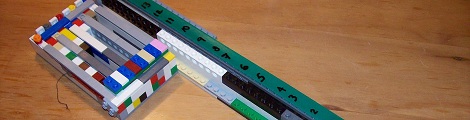
Right off the bat he had several specifications for the build. He wanted it to be platform independent, reliable, and cheap to build. We think he really hit the mark, but he does mention that he’s got a second duplicator build in mind already. This version makes heavy use of Lego parts for the arm and gearing. The base has a stepper motor which swings the arm in an arc which reaches the input pile, the optical drive try, and the output bin. The arm itself has a two-part wooden gripper that is positioned over a CD and uses a limiting switch to sense when the vertical orientation is at the proper point for gripping a disc. We enjoyed reading his log as he discusses the various building challenges he encountered and how each was overcome.

We’ve seen a few other builds like this before. One of our favorites is from way back.

Continue reading “Automated CD Ripper Build From Lego And Other Parts”

Genetic Testing With Lego

From the dark recesses of the Internet circa 2009 comes the BioBrick-A-Bot, a liquid handling system for molecular biologists.

The 2009 iGEM competition was a student competition to build devices for synthetic biology. The BioBrick-A-Bot’s goal is to build a simple, low-cost liquid handling system that sucks liquids out of petri dishes and into vials.

Like most lab equipment, the commercial version of this tech is insanely expensive – about 10 grand for a commercial liquid handling robot. The BioBrick-A-Bot is made nearly entirely out of LEGO parts, so the cost of the entire system was brought down to about $700.

There are two main parts to the BioBrick-A-Bot. The Alpha module holds four pipette on a delta platform We’ve seen this type of robot built out of LEGO before, but moving liquids is new territory. The Phi module contains all the mechanics to suck microliters of liquid into a pipette and spit them out into vials.

The BioBrick-A-Bot didn’t win the 2009 iGEM competition (that honor was taken by students from Heidelberg Cambridge), but we’d take a LEGO robot any day of the week. Check out the demo after the break.

Continue reading “Genetic Testing With Lego”

Turning Pixels Into LEGO Pieces

Looking to spice up his living room with some modular plastic pieces, [Quentin] came up with a way to take digital pixels and convert them to LEGO building plans. The end result is a coffee table top that uses a font complete with anti-aliasing.

The first thing he did was figure out physical dimension and color palettes available from the popular building blocks. His search yielded all of the answers after he spent some time on Brickipedia. Armed with that knowledge he started bargain hunting, settling on a brick size that yielded adequate resolution without breaking the bank (he budgeted 87 Euros or about $125 for materials). From there he used Photoshop, along with a custom color palate that matches the LEGO colors, to generate the design. Image in hand, he finished the planning stage by writing a program to count the pixels, convert them into LEGO bricks, and spit out an order list and build instructions. He’s saving others the trouble of doing the same by releasing his source code.

Of course the project wouldn’t be nearly as fun if he hadn’t made a fast-time build video. We’ve embedded it after the break.

Continue reading “Turning Pixels Into LEGO Pieces”

My First Robot: A Simple Demo To Get Kids Excited About Robotics

revoltlab_balloon_popping_robot

[Will] from Revolt Lab needed a project to get the summer campers he supervises interested in electronics, but when your audience is 5 years old, your subject matter had better be simple, yet interesting enough to hold their attention at length. He settled on using a Lego NXT robot to keep their little minds engaged, because who doesn’t like robots?

He picked up a basic Lego NXT kit and paged through the manual. The first “example” robot looked pretty cool so he decided to give it a shot, though he still hadn’t figured out exactly what he would have the robot do. Inspiration struck, and he decided that he could take advantage of the NXT’s color sensor as well as its proximity sensor to construct a balloon hunting robot.

He constructed a “balloon corral” to keep the balloons in place and the kids out of his thumbtack-wielding robot’s reach. He let his creation loose, and as you can see in the video below, the robot hunts down the blue balloon and pops it, much to the children’s delight.

If you’re in the position to introduce a group of young kids to electronics, this balloon popping robot paired with some conductive Play Dough would make for a fun and educational afternoon workshop.

Continue reading “My First Robot: A Simple Demo To Get Kids Excited About Robotics”

LEGO Mill Produces Sculpted Models With Fantastic Resolution

[Arthur Sacek] has really got something with the 3D Mill he built entirely from LEGO pieces. As you can see, it uses NXT parts to control the cutter head along three axes. The drill bit that acts as the mill’s cutting head is not a LEGO part, but that’s [Arthur’s] only transgression.

The demo sculpture seen above was cut into a block of floral foam. The model was processed by Autodesk Softimage before being fed into the mill, where it took about two and half hours to complete the job. The foam comes out still in block form looking like a piece of outdoor carpeting. That’s because there’s no debris removal during the milling process. But hit it with the shopvac and you’ll reveal a physical model with surprising detail. We don’t think it comes close to the light-cured resin printing we’ve seen, but it would be a great asset if you’re doing some mold making.

Don’t miss [Arthur’s] video of the milling process after the break.

Continue reading “LEGO Mill Produces Sculpted Models With Fantastic Resolution”

Two-axis Panning Time Lapse Rig Built From Lego

2_axis_lego_timelapse_dolly

[Jochem] wrote in to share a neat time lapse camera dolly he constructed out of Lego bricks. He is a big fan of the two-axis panning time lapse effect where the camera moves while recording images. He figured it would be easy enough to construct one of his own, so he dug out his pail of Lego and got to work.

The rig consists of a stationary motor platform which pulls a movable sled using a simple gear and string. The motor platform is controlled by an Arduino, which pulls the movable sled along every so often, snapping pictures along the way. [Jochem’s] Nikon D80 supports shutter release via IR, so he programmed the Arduino to send a quick IR pulse each time it has finished moving the dolly.

The rig looks like it works pretty well as you can see by the video below, but [Jochem] says that it still needs a bit of work. We just can’t wait to see what other time lapse movies he puts together once he finds an “interesting” time lapse subject.

Continue reading “Two-axis Panning Time Lapse Rig Built From Lego”

The Lego Synchro Drive

[M-byte] wrote in to tell us about the Lego Synchro Drive. Although not a new hack, this autonomous vehicle is quite amazing in it’s simplicity.  Using only one motor turning at a constant speed, this device is able to navigate obstacles by simply turning.

As [m-byte] was quick to point out, this is a simple task using modern electronics, but this drive is made using only Lego Technic parts. The machine’s motion is quite pleasing. When it hits an obstacle, the outer rotating ring stops, allowing the casters on the bottom to switch direction. One could see this invention coming out of Leonardo da Vinci’s notebook (minus the Legos).

Check out either of the embedded videos after the break to see this device in action. If you’d like to build one yourself, follow this link for very well illustrated directions. Continue reading “The Lego Synchro Drive”