
Native SMB3 Client Brings Modern NAS Access To 20-Year-Old PowerPC Macs

As software updates cease for operating systems, they eventually begin to lose access to parts of the LAN and internet due to out of date encryption features, as well as the inability to handle file sharing protocols like SBM3, which is somewhat of a necessity if you have e.g. a NAS on the LAN. Such too was the case with [watermark_hd]’s 20-year old PowerPC Macs and their installations of OS X Tiger and Leopard.

Cue Aqualink, a native SMB3 client for these older OS X versions that uses [Ronnie Sahlberg]’s libsmb2 server/client library for SMB2 and SBM3. The source code can be found over on GitHub, along with a Japanese translation. By using a local WebDAV server Tiger’s built-in mount_webdav feature can be used to mount these remote volumes.

While you can often still use SMB1 even on modern Windows and Linux/BSD via Samba, allowing even retro systems like these PowerMacs to speak SMB3 is at least a great boost for network security, even if the aforementioned encryption shortcomings mean that you cannot quite run encrypted file shares yet.

Although OS X eventually began to adopt modern SMB versions, some of us may remember how incredibly buggy they were, to the point that us OS X users often had to fall back to CIFS (SMB 1.0), so this is another potential use for this Aqualink application.
You’ve All Seen A Hackintosh, But Have You Seen One On A Wii?

The Intel era of Apple Macs led to so-called “Hackintoshes”, more normal PCs running x86 MacOS X. Now Bryan Keller proves that a Hackintosh isn’t restricted to the x86 era, not by doing it with a modern ARM version, but by going back to PowerPC, and the Nintendo Wii.

The Wii can be thought of in hardware terms as not too far from a Mac G3 with a little less memory, having a PowerPC 750-family processor, a close relative as those in the first generation of MacOS X capable Macs. Since the roots of MacOS X are shared with its open-source equivalent Darwin, he reasons it should be possible to port just enough Darwin to the Wii to enable the closed-source OS X to run on top of it. He’s running OS X 10.0, the earliest version from 2001.

The write-up is a fascinating path through writing a bootloader and running a patched kernel that flashes the Wii LEDs, and then the process of making the Wii’s very different hardware from a Mac, accessible to the OS. It boots from an SD card and uses a framebuffer for display so perhaps it’s not as fast as you might hope, but he gets it working. Even for someone not versed in MacOS or the Wii, it’s a good write-up that makes its points accessible.

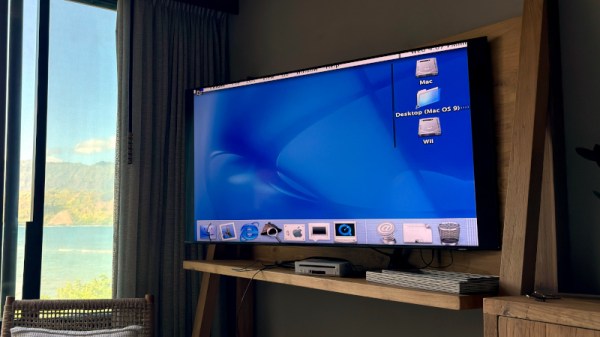
Something that makes us happy about this piece of work is its place in the greater picture, after all the Wii has found itself running classic MacOS too.

The End Of The Hackintosh Is Upon Us

From the very dawn of the personal computing era, the PC and Apple platforms have gone very different ways. IBM compatibles surged in popularity, while Apple was able to more closely guard the Macintosh from imitators wanting to duplicate its hardware and run its software.

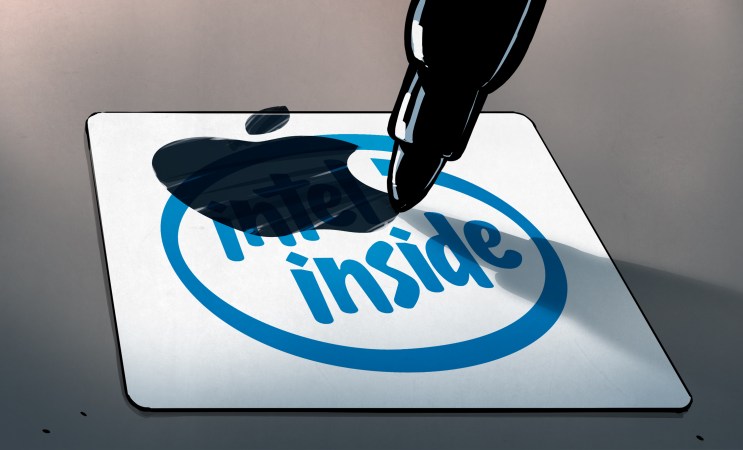
Things changed when Apple announced it would hop aboard the x86 bandwagon in 2005. Soon enough was born the Hackintosh. It was difficult, yet possible, to run MacOS on your own computer built with the PC parts your heart desired.

Only, the Hackintosh era is now coming to the end. With the transition to Apple Silicon all but complete, MacOS will abandon the Intel world once more.

Continue reading “The End Of The Hackintosh Is Upon Us”









