Low-cost, Low-bandwidth Wireless Arduino To Android Communications

android_nfc

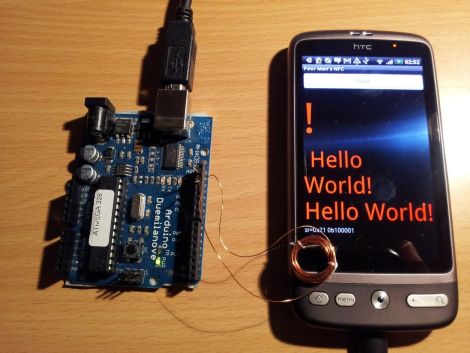
[Joe] was experimenting with his Arduino when he started thinking about how he could get it to communicate wirelessly with his Android phone. Bluetooth is an option, but it requires some extra components, and Google’s ADK works as well – just not wirelessly.

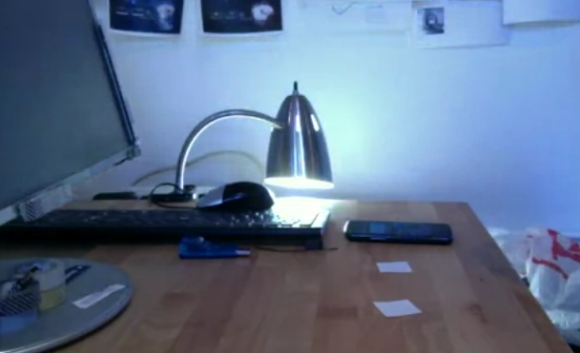
Instead, he thought it would be neat to see if he could get the two devices to communicate with a simple magnetic coil. He constructed a small 1cm diameter coil, connecting it to the Arduino via a resistor and diode. Using the Android Tricorder app, he was able to locate his phone’s magnetometer, after which he ran some tests to narrow down the best sample rate and frequency range for communications.

To transfer data between the two devices, he had to bit bang the signal in software, since the Arduino’s UART has a lower limit far faster than the 7 bps data rate he was able to achieve with the magnetometer.

While his wireless Arduino to Android bridge isn’t likely to win any awards for throughput, it is a great proof of concept project. Be sure to check out the video below to see his “poor man’s NFC” in action.

Continue reading “Low-cost, Low-bandwidth Wireless Arduino To Android Communications”

FareBot – Android NFC Proof Of Concept

farebot_logo

Upon learning that the Nexus S smartphone was equipped with a Near Field Communications NFC) radio, [Eric Butler] decided he would put the newly released Gingerbread SDK to good use.  Focusing initially on ORCA fare cards used by several Washington state transit systems, he built an open-source application he calls FareBot, which can read data from any MIFARE DESFire branded cards.  Utilizing the NFC radio in the Nexus S, he was able to dump all of the unprotected information from the fare cards, including  the remaining card balance and the last 10 locations where the card was used.

The author hopes that his proof of concept application encourages other developers to expand on his project and to explore the data stored on transit cards around the world. While it is in its early stages, [Eric] would ultimately like to see this project expanded to allow the use of NFC-enabled smartphones as transit cards themselves via downloadable apps.  He suggests that helping people understand the amount of data which can be freely obtained from these cards will eventually force the manufacturers to better inform consumers of the existing system’s shortcomings, which in turn might spur on smartphone-based transit initiatives.