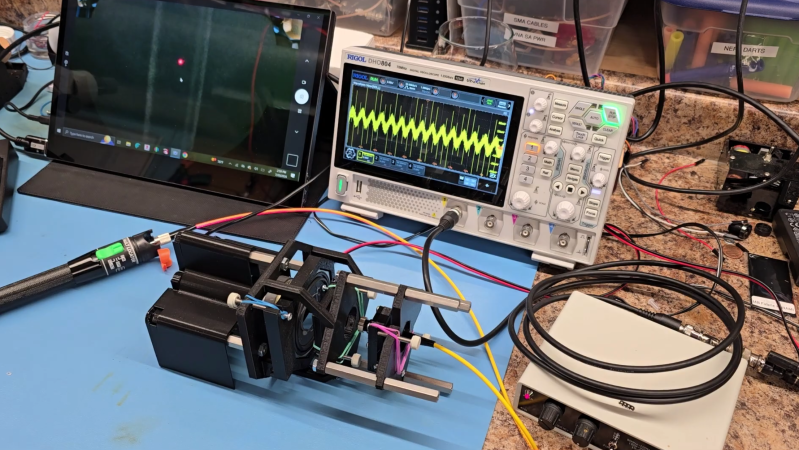
A plastic device sits on a desk, with a computer display and an oscilloscope behind it. A fiber-optic cable runs from the device to a laser diode source.

2026 Frikkin Lasers Challenge: Measuring Nanometer-Scale Displacements With An Optical Cavity

Optical cavities – two mirrors arranged to reflect light multiple times between them – form the basis of lasers and certain optical filters. Since any angle between the two mirrors results in light being scattered away, parallel alignment is essential, yet difficult to maintain. Nevertheless, [Timothy Giles] managed to 3D-print and align such an optical cavity, and used it to detect minute shifts in space and wavelength.

The cavity has two semi-transparent mirrors facing towards each other. One mirror is held in a 3D-printed mount, and the other is attached to the diaphragm of a speaker with a hole drilled through the center. The hole avoids the speaker coil, and allows light exiting the optical cavity through the semi-transparent mirror to appear on a paper target, which is monitored by a webcam. On the other side of the optical cavity, a laser diode coupled to a single-mode fiber shines in through the other mirror. Alignment is challenging, but the webcam makes it easier; as the mirrors tilt relative to each other, the pattern seen on the paper target changes, providing feedback for more precise adjustment.

Light reflected within the cavity can interfere constructively or destructively with incoming light, changing the brightness of the emitted beam. [Tim] used the speaker as a linear actuator to vary the cavity’s length, which, by counting the peaks in brightness, allowed him to measure the diaphragm’s displacement. This also demonstrated a laser diode’s wavelength instability: when the cavity was set to a constant length and the laser started up, the output brightness would cycle a few times. As the diode was warming up, its output wavelength was shifting, creating the same changing interference pattern.

To get a Gaussian beam distribution, [Tim] used a fiber-coupled laser; if you’d like to build one, we’ve seen a coupling mechanism built before. Most lasers are built around an internal optical cavity, but some instead use an external cavity.

Lasers Al Fresco: Fun With Open-Cavity Lasers

Helium-neon lasers may be little more than glorified neon signs, but there’s just something about that glowing glass tube that makes the whole process of stimulated emission easier to understand. But to make things even clearer, you might want to take a step inside the laser with something like [Les Wright]’s open-cavity He-Ne laser.

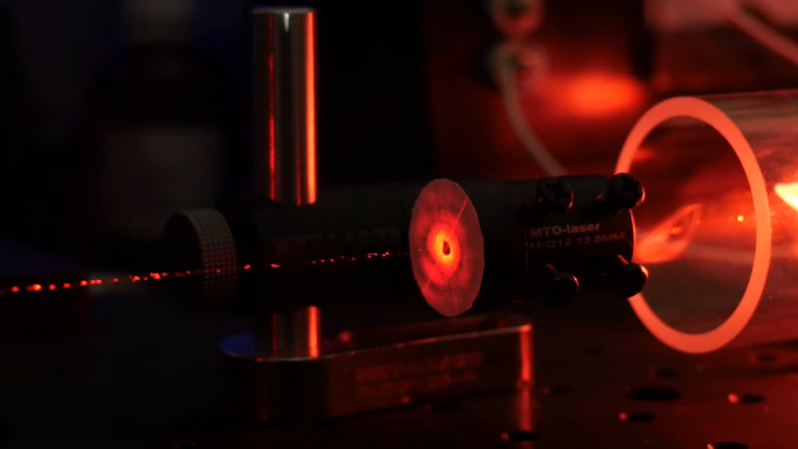
In most gas lasers, the stimulated emission action takes place within a closed optical cavity, typically formed by a glass tube whose ends are sealed with mirrors, one of which is partially silvered. The gas in the tube is stimulated, by an electrical discharge in the case of a helium-neon laser, and the stimulated photons bounce back and forth between the mirrors until some finally blast out through the partial mirror to form a coherent, monochromatic laser beam. By contrast, an open-cavity laser has a gas-discharge tube sealed with the fully silvered mirror on one end and a Brewster window on the other, which is a very flat piece of glass set at a steep angle to the long axis of the tube and transparent to p-polarized light. A second mirror is positioned opposite the Brewster window and aligned to create a resonant optical cavity external to the tube.

To switch mirrors easily, [Les] crafted a rotating turret mount for six different mirrors. The turret fits in a standard optical bench mirror mount, which lets him precisely align the mirror in two dimensions. He also built a quick alignment jig, as well as a safety enclosure to protect the delicate laser tube. The tube is connected to a high-voltage supply and after a little tweaking the open cavity starts to lase. [Les] could extend the cavity to almost half a meter, although even a waft of smoke was enough obstruction to kill the lasing at that length.

If this open-cavity laser arrangement seems familiar, it might be because [Les] previously looked at an old-school particle counter with such a laser at its heart. Continue reading “Lasers Al Fresco: Fun With Open-Cavity Lasers”

Measuring Nanometers At Home

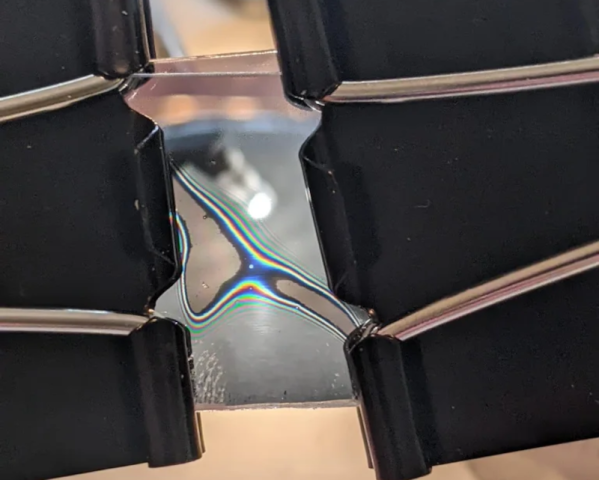
If someone asked you to measure a change in distance at about one ten thousandths of the diameter of a proton, you’d probably assume you would need access a high-tech lab. The job is certainly too tight for your cheap Harbor Freight calipers. [Opticsfan], though, has a way to help. You might not be able to get quite that close, but the techniques will allow you to measure a surprisingly small distance.

The technique requires a Fabry Perot cavity, an inexpensive spectrometer, and an online calculator to interpret the data. This type of cavity is two parallel mirrors facing each other with a slight gap between them. Light can only pass through the cavity when it is in resonance with the cavity. These have been around since 1899, so they aren’t that exotic. In fact, they are often used in laser communication systems, according to the post.

Continue reading “Measuring Nanometers At Home”