DIY Softboxes Light Your Photos On The Cheap

diy_softboxes

Softboxes are often considered a must-have piece of equipment when doing any sort of portrait or studio photography. While they are not the most expensive photography accessory, they can be built far cheaper than you would pay for an off the shelf model.

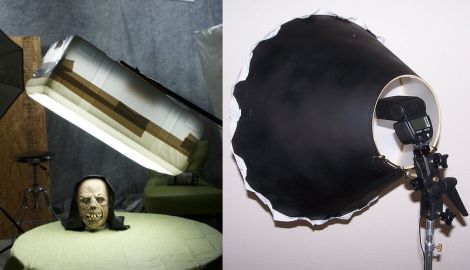
[Don] needed a softbox for his studio, and he ended up constructing a fairly nice one out of a styrofoam cooler. He mounted an outdoor light receptacle inside the cooler after laying down a reflective backing, bolting everything to a piece of plywood situated on the back of the cooler. He stretched some white cloth over the front to diffuse the light, and then mounted it on a light stand. You can see a video of the construction process below, as well as additional softbox-lit images on his site.

[Aud1073cH] had a similar need for a softbox, but went about his construction a bit differently. He grabbed a lampshade and a white dress shirt at a thrift store, stretching the shirt over the bottom opening before securing it with Velcro. He mounted the lampshade on a light stand, inserting his camera’s speed light through the smaller lampshade opening. As you can see in his photostream, the softbox does a great job at softening the shadows in his pictures.

Continue reading “DIY Softboxes Light Your Photos On The Cheap”

Build Your Own Panoramic Pinhole Camera

panoramic_pinhole_cam

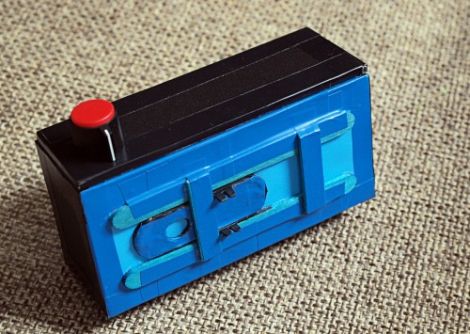
While it seems that the digital camera is king, some people still love shooting with good old 35mm film – [Costas Kaounas], a high school teacher and photographer certainly does. He recently published plans for a great-looking 35mm pinhole camera over at DIY photography that we thought you might enjoy.

[Costas] put together a set of simple hand-drawn plans for the camera, that you can easily replicate with a bit of free time. The camera is built mostly from card stock, both in 1mm and 3mm flavors, also incorporating popsicle sticks and an aluminum can. The popsicle sticks are used to create a manual shutter for the camera, while the pop can is used to form the pinhole aperture.

It’s a pretty simple hack as you can see, with nary an electronic part to be found. It will take you a bit of time to construct however, since you’ll need to let the glue dry between certain steps.

Love it or leave it, you’ve got to admit that the panoramic shots it takes are pretty nice!

If we’ve piqued your interest in pinhole cameras, be sure to check out this Lego pinhole camera as well as this beer can pinhole camera.

[via Lifehacker]

Dino’s 2 Axis Camera Dolly

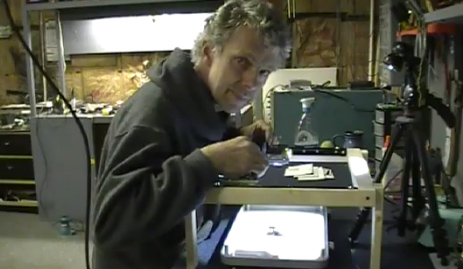
[Dino], who has become a regular face here on hackaday, sent us one of his weekly projects that we thought was pretty cool. He wanted to shoot some video of photographs to commemorate his late mother. The goal was to achieve the “Ken Burns Effect“, but in hardware instead of just doing it in software.  To do this, he built a 2 axis rig, very similar to many home made CNC machines we’ve seen. He used drawer rails and rollers and an old scanner for the parts.  We admit, at first glance we weren’t too impressed with the resulting effect. It is a bit shaky as he moves the camera and the zooms and slides don’t have that perfect smoothness that we have come to expect from modern video effects.  However, after a few minutes, it seemed so organic and pleasant that it won us over. This obviously isn’t what you would use for every project. This project, however, seems to fit perfectly.

If you still don’t like the effect, you could certainly find uses for this rig aside from video. You could use it (with backlight) for batch converting slides or other images to digital. It would work perfect as a 2 axis paper cutter. What other uses can you come up with for a 2 axis un-motorized frame?

You can watch the construction video after the break, and the result video on [Dino’s] page.

Continue reading “Dino’s 2 Axis Camera Dolly”

DIY Lightbox Repurposes Useless Scanner

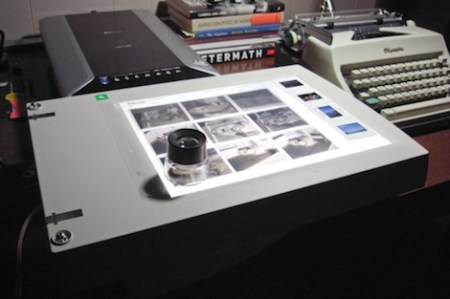
[James] didn’t like losing detail when scanning in photographic negatives, so he repurposed an old scanner and turned it into a lightbox.

The Flickr set of the build shows [James] installing a compact fluorescent bulb in the body of the scanner. Aluminum foil reflects the light, and the scanner glass is painted white for diffusion. [James] is quite happy with the result, and is amazed by the detail seen in the negatives under magnification instead of scanning.

We’re trying to figure out [James]’s though process in deciding to build a light box, and the best we can come up with is the hackaday mantra of, “Of course I can do that myself.” Even though he seems happy with his project, we’re wondering how hackaday readers would improve it. Maybe several dozen red, green, and blue LEDs to adjust the color temperature? Post your ideas in the comments.

Automatic Trigger For Lightning Photography

lightning_trigger

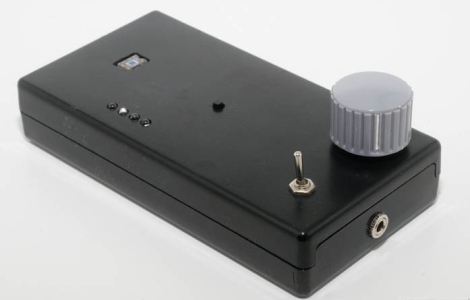
[Vicktor] has always been fascinated by photographs of lightning and decided to try his hand at capturing a few strikes on his camera. Every time he attempted it however, he didn’t have much success. Instead of trying to operate his camera manually to take the images, he decided to build a lightning trigger that would do it for him.

His circuit uses a large photodiode to sense when lightning strikes, triggering the camera via a hacked shutter release cable. A PIC micro controller is used to adjust the sensitivity of the device, as well as to send the actual trigger signal to the camera. His circuit is connected to the camera via a pair of opto couplers to ensure that his circuit cannot cause any harm to the camera.

When the box is powered on, it enters a calibration mode where the user can adjust the circuit to compensate for whatever amount of ambient light is present. Once armed, the box waits for a sudden change in ambient lighting, sending the exposure release signal to the camera.

A schematic is available on his site, and he will send you the code he use on request. There is currently no video of the trigger in action, but hopefully we’ll see one soon.

If you’re interested in seeing some other remote camera triggers, check out this one made from air freshener parts, and this one which uses lasers.

Is Your Camera Lying?

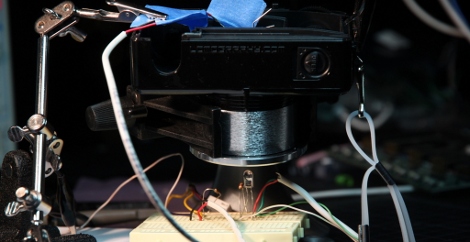
It is easy to rely on the ratings marked on different tools, whether it is a power supply, scale, or speedometer. However calibration is essential for any part that is relied upon either professionally or for a hobby. [Jeremy] wanted to see if his Lomography camera shutter really was only open for 1/100ths of a second when set to that. In order to test his rig, he set up an LED on one side of the shutter, and a high speed phototransistor to gauge the time spent open, using an oscilloscope to measure the time the reference point was pulled low. In his case, when the camera was set to 1/100, the shutter was actually open for closer to 1/150th of a second (the mean was 1/148ths of a second, with a standard deviation of 417 uSecs). This difference can make a large difference in picture brightness.

Be sure to check his blog for more pictures of the setup, as well as some useful part references and circuit diagrams.

Would You Entrust Your DSLR To This Diy Underwater Enclosure?

Next time you head off on that underwater adventure take your camera along with you. [Jkcobabe] shows us how to build a waterproof camera enclosure using just a few components. The box is meant to be used to keep your stuff dry while camping, and the lens housing is made using plumbing fittings from the a home building center. There is a rail system that allows you to mount the camera securely inside, with a flexible button on the outside to actuate the shutter. If anything this is well designed and built, but we might still stick to using disposable cameras under water. Then again, the pros build their own enclosures so we’ll keep our fingers crossed for that $2500 camera as you try to capture that perfect shot.

[Thanks Troy]