Beefy Rover Looks Like Tons Of Fun

mantis_six_wheeled_remote_control_robot

[Eric] and the crew over at The Tech Junkies, just put the finishing touches on a pretty powerful robot that they call “Mantis”.

The six wheel, chain-driven robot is pretty impressive at first glance. The robot is centered around a Netduino, which controls four 60 amp speed controllers. The speed controllers are tasked with driving four beefy CIM motors, which propel the robot along at a pretty decent tick.

For the project, the team designed their own controller application called IPGamepad, which allows the robot to be controlled by any Android device. The interface is pretty simple as you can see in the video below, making it quite easy to control the bot.

While the Mantis was not a cheap production by any means, it does look like a ton of fun to drive. The crew will be taking this robot along with 2 others out to Maker Faire Detroit, so be sure to swing by and say hello if you’re in the area.

Continue reading “Beefy Rover Looks Like Tons Of Fun”

Modded Wall-E Becomes A Real Robot

[DJ Sures] got his hands on a plastic Wall-E toy and decided to build a robot that includes a camera, voice recognition, and object tracking. The result is adorable so we’re putting this video before the break:

[youtube=http://www.youtube.com/watch?v=OJiMUzJHYFk&w=470]

Continue reading “Modded Wall-E Becomes A Real Robot”

Omniwheel Robot

Like all of us, [Jonathan Guberman] has a list of projects and builds that ‘will get done when I have time.’ His Kiwi drive robot is no exception. It’s intended to be one piece of a much larger project, but he decided to document it anyway (we think in the hope of getting is rear in gear).

The robot uses a holonomic drive to get around. A holonomic drive uses three fixed wheels placed 120 degrees apart. The wheels can be independently controlled and with some vector addition the robot can move in any direction and rotate 360º inside its own wheelbase. Of course the wheels will have to be able to roll in two dimensions, so an omniwheel is used. Everything is controlled with a Wiimote nunchuck, and the movement is very smooth.

[Jonathan] has had a few projects featured on Hack A Day before, like his Mechanical Pac-Man and his adorable Portal turret plushie. [Jonathan] really demonstrates his artistry and skill in his project, so we’re really wondering what his ‘larger project’ actually is. Take a guess in the comments section, that might get [Jonathan]’s rear in gear.

Check out the video of the omnidirectional robot after the break.

Continue reading “Omniwheel Robot”

Amazing Hemispherical Omnidirectional Gimbaled Wheel Robot

hemispherical_omnidirectional_gimbaled_wheel_robot

Bradley University grad student [Curtis Boirum] has built a robot which uses quite a unique drive system, one we’re guessing you have never seen before. The robot uses a single motor to drive its hemispherical omnidirectional gimbaled wheel, propelling it across the floor at amazing speeds with uncanny agility.

The robot uses a simple two axis gimbal for movement, which houses a small brushless RC airplane motor. The motor spins a rubber wheel at high speeds, which propels the robot in any direction at the flick of a switch, thanks to a pair of RC servos. When the servos tilt the gimbal, they change which side of the wheel is touching the ground as well as the gear reduction, eliminating the need for a mechanical transmission or traditional steering mechanism.

While he originally thought that he had invented the concept, [Curtis] found that this technology was nearly 100 years old, but that most people had forgotten about it. We’re pretty sure people will remember it this time around. How could you not, after watching the demo video we have embedded below?

We think it’s a great concept, and we can’t wait to see what other robot builders do with this technology.

[via Gizmodo]

Continue reading “Amazing Hemispherical Omnidirectional Gimbaled Wheel Robot”

Humanoid Robot Listens To Music, Plays Along On His Theremin

robot_playing_theremin

Researcher and YouTube user [mspetitegeek] along with her lab mate [Tatsuhiko Itohara] have been fortunate enough to spend some time working with the HRP-2 humanoid robot from Kawada Industries. Their research has seemingly been focused on using the robot to create real-time interactions with humans for entertainment purposes, at the very least.

The program they created allows the HRP-2 to listen and watch its human counterpart while he plays the guitar in order to recognize a beat pattern. Once the robot catches on, it plays along on his Theremin, matching both notes and rhythm perfectly. Since the human operator is clearly playing at a fairly relaxed pace, we are curious to see a demonstration where the robot required to match a snappier tune – it could be quite interesting.

In the meantime, we’re content to just sit back and enjoy the Mogwai-esque tones of the HRP-2 rocking the Theremin.

Keep reading to see a short video of the HRP-2 in action.

Continue reading “Humanoid Robot Listens To Music, Plays Along On His Theremin”

ArduDelta Would Make A Great Pick And Place Machine

[Bogdan] sent in a great build of a delta robot he originally posted on the Arduino forum, but he didn’t receive much feedback there. We think a build like this deserves a lot more credit.

After working for 7 months on his robot, [Bogdan] has a pretty stable (and very classy) platform made out of wood. The platform and arms in delta robots are usually extremely light to reduce the inertia of the tool so [Bodan] crafted these out of carbon fiber tubes and plexiglas. Everything is controlled by an Arduino Mega2560 encased in a plexiglas enclosure with a 20×4 LCD, status LEDs, and an infrared receiver.

Continue reading “ArduDelta Would Make A Great Pick And Place Machine”

Propeller-based Robot With Basic Object Avoidance

propeller_development_robot

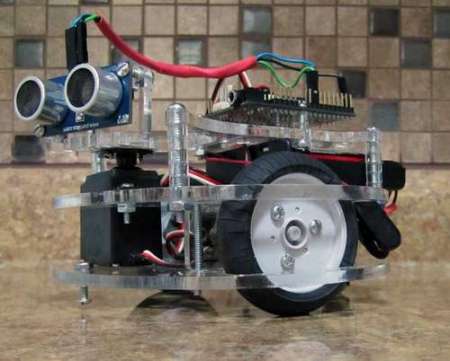
The Parallax Propeller is a pretty powerful MCU as [Dino] recently discovered in his latest Hack a Week installment. He wanted to build a simple robotics platform that he could use for testing out various sensors, and he figured he might as well learn about a different type of micro controller in the process.

He pieced together his robot using a pair of old Roomba motors he had sitting around, mounting them on a standard RadioShack project box. A Propeller MSR1 control board runs the show, and a Propeller PING sensor is used to get an idea of what the robot’s surroundings look like. He is an admitted newbie when it comes to using Propeller micro controllers, but [Dino] was able to give his robot some rudimentary object avoidance abilities fairly easily. A few small bugs aside, he had the robot up and running in short order, a testament to how easy it is to work with the Propeller platform.

Stick around to see a brief video covering the robot’s construction we have embedded below.

Continue reading “Propeller-based Robot With Basic Object Avoidance”