Wireless Animatronic Hand Control

animatronic_hand

[Easton] was looking to enter his local science fair and needed a project that would wow the judges. After considering it for a bit, he decided that an animatronic hand would be a sure winner. Many animatronic projects we have seen are connected to a computer for control purposes, but his is a bit different.

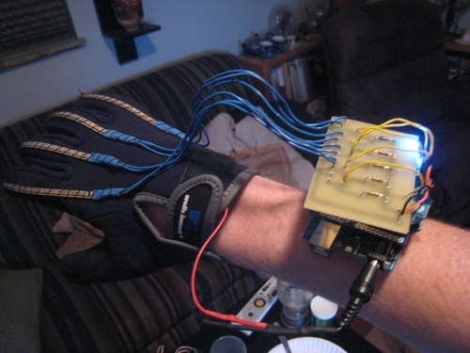
[Easton] wanted to be able to control the hand in real time with his own movements, so he sewed some flex sensors onto a glove and wired them up to a custom Arduino shield he built. The Arduino is also connected to an XBee radio, allowing it to interface with his animatronic hand wirelessly.

He built the hand after studying anatomical drawings to better understand where finger joints were located and how they moved. He cut up pieces of flexible wire tubing to build the fingers, reinforcing them with Lego bricks. He ran fishing wire from the finger tips to five independent servos to provide the hand’s motion. Another Arduino with an XBee shield was used to control the hand and receive wireless signals from the glove.

Check out the video below to see why this project won [Easton] first place in the science fair.

Continue reading “Wireless Animatronic Hand Control”

Kinect Two-fer: MoCap Movie And Robot Control

kinect_twofer

It’s no mystery that we like the Kinect around here, which is why we’re bringing you a Kinect two-fer today.

We have seen video hacks using the Kinect before, and this one ranks up there on the coolness scale. In [Torben’s] short film about an animation student nearly missing his assignment deadline, the Kinect was used to script the animation of a stick figure model. The animation was captured and built in Maya, then overlaid on a separate video clip to complete the movie. The overall quality is great, though you can notice some of the typical “jitter” that the Kinect is known for, and there are a few places where the model sinks into the floor a bit.

If you want to try your hand at animation using the Kinect, all of the scripts used to make the movie are available on the creator’s site for free. [via Kinect-Hacks]

Our second Kinect item comes in the form of a gesture driven Lego MindStorms bot. Using OpenNI along with Primesense for body tracking, [rasomuro] was able to use simple motions to drive his NXT bot around the house. His movements are tracked by the Kinect sensor which are translated into commands relayed to the robot via his laptop’s Bluetooth connection. Since the robot has two motors, he mapped couple of simple arm motions to drive the bot around. We’ll be honest when we say that the motions remind us of Will Farrell’s “Frank the Tank” scene in Old School, but [rasomuro] says that he is trying to simulate the use of levers to drive the bot.  Either way, it’s pretty cool.

Videos of both hacks are embedded below for your perusal.

If you are interested in seeing some more cool Kinect hacks be sure to check out this Minecraft interface trio, this cool Kinect realtime video overlay, and this Kinect-Nerf gun video game interface.

Continue reading “Kinect Two-fer: MoCap Movie And Robot Control”

Remote-controlled Tank Tread Robot Will Walk The Dog For You

remote_controlled_robot

Instructables user [IAMTHEBOT] recently finished building his robot which can be controlled by a human using an R/C transmitter, via a PC, or through its built-in object avoidance system. The robot doesn’t seem to have a name, though Johnny Five might be appropriate.

The robot was built using plenty of erector set parts, as well as a Lynx motion tank tread kit. The robot is crammed full of controllers, including a Propeller USB servo controller which operates the arms, and a pair of Parallax motor controllers to manage the tread movement. A pair of Parallax Stamp controllers are used to drive these controllers as well as to manage the remainder of the robot’s functions.

The robot’s head consists of a custom pan and tilt wireless camera system, which allows him to drive it around from the comfort of his home, while watching the video stream on his PC. The robot also has the ability to roam around autonomously, avoiding objects using a ping sensor that can be mounted where the camera is currently located. It seems all that’s missing is Steve Guttenberg.

As you can see in the videos below, the robot manages pretty well on all sorts of surfaces, and even walks this guy’s dogs.

Continue reading “Remote-controlled Tank Tread Robot Will Walk The Dog For You”

Simple Robot Knows Its Bounds

table_top_bot

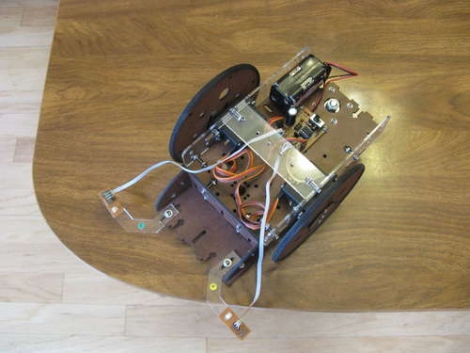
The [Dallas Personal Robotics Group] recently put together a set of tutorials for their members, including the build process of a table-top robot, they call the Tiny Wanderer. The bot can be constructed pretty easily, and is meant as an introduction to robot building.

The small servo-driven bot uses simple edge sensors to ensure that it doesn’t fall off a raised surface. The sensors were built using a small IR LED and photo transistor, which is partially isolated from the LED by a piece of shrink tubing. An ATiny micro-controller takes two measurements of the amount of IR light entering the photo transistor – one with the LED on, the other with the LED off. The difference of these measurements is compared to determine if the edge sensors are hanging off the side of the table. The logic used here is pretty simple – the difference will be high if the sensors are hovering over a surface, due to reflected light, and low if the sensors are hanging over open space.

The writeup contains templates for building the bot’s structure, as well as source code and schematics for all of the electronic bits.

Be sure to stick around to see a video of the robot in action.

Continue reading “Simple Robot Knows Its Bounds”

Domo Kun Robot Achieves Balance Sans Gyroscope

Every time it tips over, the FSM kills a kitten

Most self-balancing robots use some sort of circuitry like gyroscopes or accelerometers to keep them upright. Some bots however, can achieve nearly the same effect by far less complicated means.

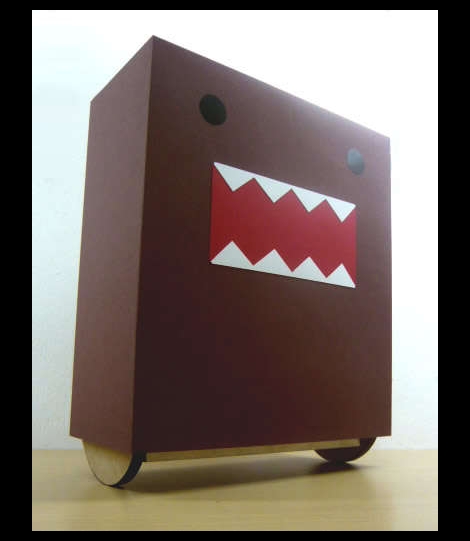
Meet the Domo Kun wobbly bot, created by [Chein]. The robot is essentially a pendulum, where the pivot point is even with the wheel axle. The base of the robot is loaded with batteries, motors, and weights, all of which keep the robot relatively steady while zooming about the room. A light balsa wood frame was fitted to the top of the metal chassis, and a thin cardboard Domo Kun shell was mounted on top of that. The robot is driven using the remote control circuitry that he stripped from a toy car. He also mentions that the positioning of the batteries and weights is key to getting the robot to balance and roll properly – something that took several attempts to get just right.

Now if he could only program it to autonomously chase kittens…

Be sure to check out the pair of videos we have below of the robot chassis in testing as well as the final product.

[via HackedGadgets]

Continue reading “Domo Kun Robot Achieves Balance Sans Gyroscope”

Automatic Lock Cracker Makes Breaking And Entering A Breeze

automatic_lockcracker

For most people, forgetting the combination on a lock means breaking out the bolt cutters and chopping off the lock. Some students at the [Olin College of Engineering] decided there was a far more elegant way to do the job, so they built an automated lock-cracking machine.

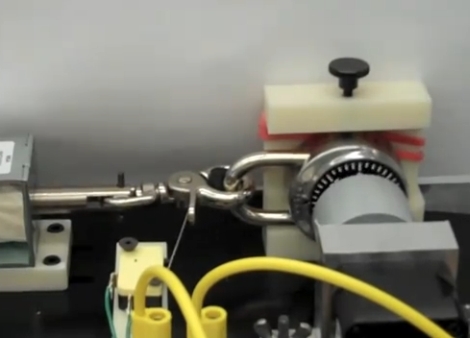
The machine consists of a clamp to hold the lock, a solenoid to pull the lock open, and a stepper motor to run through the combinations. Most of the processing is done on the attached computer, using software they created. The application will brute-force all of the possible combinations if you request it, but it also allows you to enter the first, second, or third numbers of the combination if you happen to remember them.

Once the machine is started, the motor begins spinning the lock and the solenoid yanks on the latch until the combination is discovered, which takes a maximum of about two hours to complete. The opening of the latch trips a limit switch and causes the mechanism to stop. A simple button press then returns the lock’s combination to the user.

Be sure to check out the video embedded below of the lock cracker in action.

[via Wired]

Continue reading “Automatic Lock Cracker Makes Breaking And Entering A Breeze”

Lightweight Robosuit Is Like Stilts On Steroids

What would you do if you were a foot or two taller? How about if you had an arm span two times as wide as you have now?

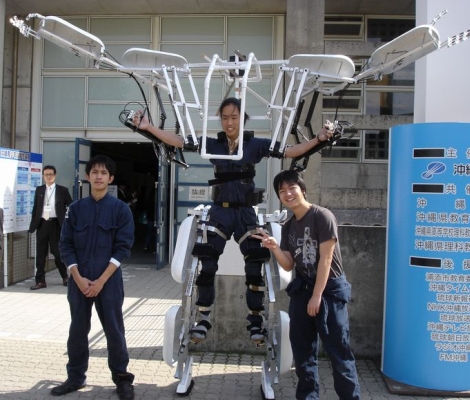
A group of Japanese engineering students asked themselves the same question and built a wearable chassis that does just that. Their project is called “Sukerutonikusu”, which we believe roughly translates to: “This is freaking awesome, we’ll take two!”. [Thopter] however informs us that it translates to “Skeletonics”, a fusion of the words “skeleton” and “mechanics”.

The suit is comprised of lightweight aluminum pipes and sheeting, allowing for it to be powered solely by the person wearing it. Stepping inside the chassis looks like it lifts the wearer about a foot and a half off the ground, while increasing their wingspan by nearly 6 feet! In the video embedded below you can see that while in the suit, the wearer is quite agile, and even has the ability to run at a decent tick.

If this ever comes to market, you can bet we will buy one in a heartbeat – until then, we will have to settle for making RoboCop sounds as we walk about the office.

Continue reading “Lightweight Robosuit Is Like Stilts On Steroids”