Exploring Hidden JPEG Features

The lossy compression algorithm used by JPEG was useful for those on the early Internet not only because it enabled pictures to be shared easier, but because it allows a low-resolution version of the image to load first. This meant that users could make out the gist of an image before it finished downloading. This was a great feature for those on slow connections, but it hides some other capabilities of this image format as well.

Rather than effectively splitting up the image into chunks, each with successive amounts of detail, [maurycyz]’s project shows that this can be exploited to load more than one picture. The first is loaded into this lower-resolution area, with a second unrelated picture showing up once the higher-resolution information is available. Essentially this makes a one-way .gif of sorts. Though this method is only capable of loading about nine frames, which is not enough for much animation. Further limiting things is that there’s no way to encode timing data, so on fast computers with fast connections the animation could load faster than a user could see.

Still, it’s an interesting quirk of this older image standard, one which still is in widespread use today. And it’s also true that it’s hard to say in what ways various technologies will be used in the future. JPEG images have also been the subject of some artistic projects that might not have been possible without the JPEG standard itself, and even as other formats have tried to supplant it, it still maintains its firm grip on the images on the Internet. More JPEG, please!
Game Cube Hot Tub Animation Brought Into Real World

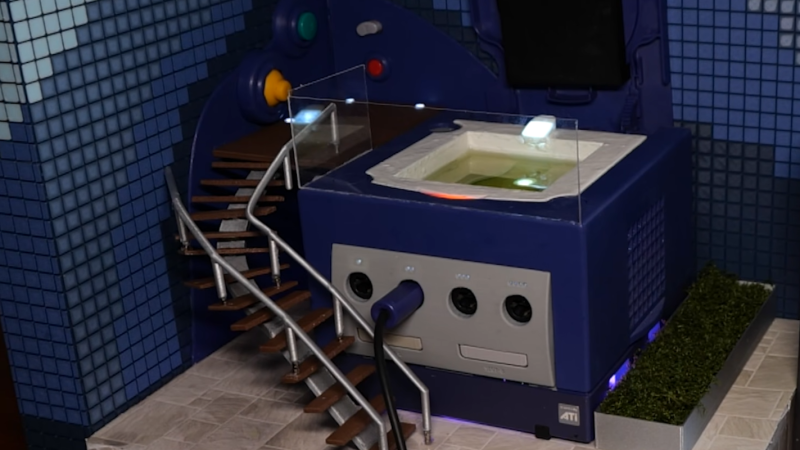
Unlike the current era where most consumer electronics are black rectangles, or the early 90s where most consumer electronics were black rectangles, we got a brief glimmer of color, light, and hope in the 2000s. Cell phones had all kinds of shapes and sizes, laptops came in bright colors, and even video game consoles got in on the fun. The Nintendo GameCube not only featured its namesake shape but came in several vibrant colors, most famously a bright purple. In fact, its design was such a hit that it continues to inspire artists and console modders alike. An animator named [kidd.gorgeous] recently envisioned a GameCube as a hot tub, and [BigRig Creates] set out to make this animation a reality.

Of course, this won’t be a life-sized hot tub capable of holding a human, but [BigRig Creates] did want it to be a usable, playable Game Cube with all of the features from the animation present in the final version. Since the lid won’t be operational with a hot tub model on the top lest all of the water spill out every time a game is changed, he’s modified it with some modern tools to hold his games inside the console itself. With the case open he’s also added the LED accent lighting featured in the animation as well as added the 3D-printed hot tub to the top. The hot tub is filled with mineral oil for electronics safety, and has a small pump built in to give the appearance of a working hot tub.

The buttons around the outside are functional as well, toggling the various lighting features and hot tub operation. And of course, the console diorama is fully playable, with the staircase railing able to easily detach in order to access the leftmost controller ports. It’s a faithful adaptation of the original animation, and [BigRig Creates] has a few games on queue that are properly themed for the new hot tub addition like Wave Race 64, Super Mario Sunshine, and Pool Paradise.

Continue reading “Game Cube Hot Tub Animation Brought Into Real World”

Design Scanimations In A Snap With The Right Math

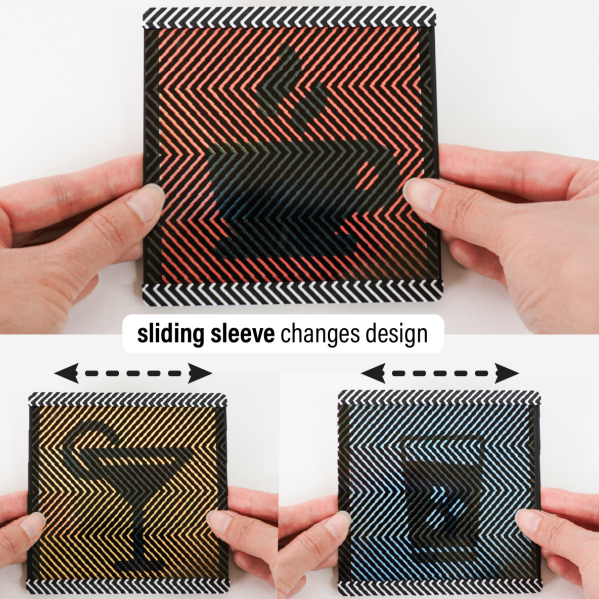
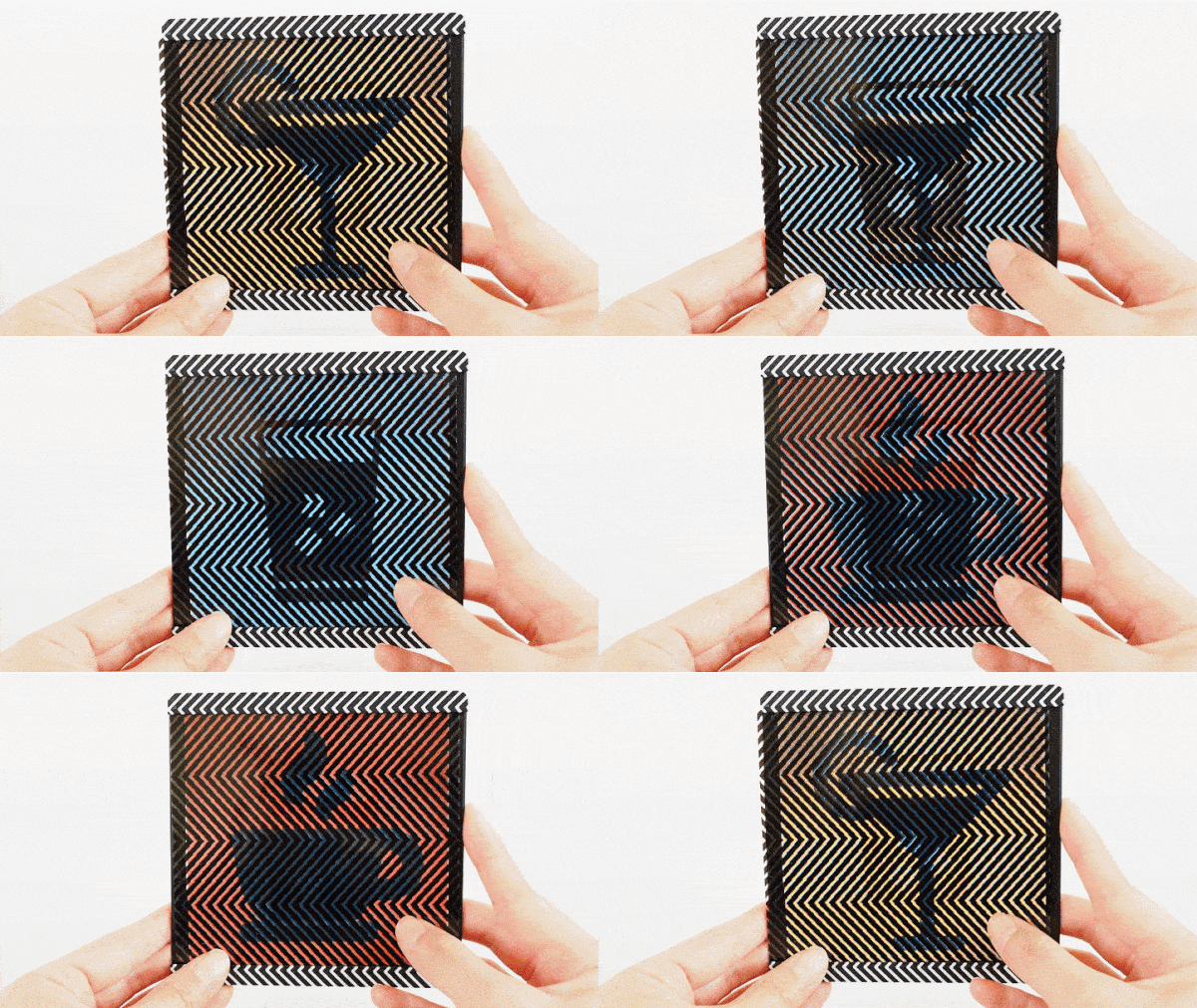
Barrier-grid animations (also called scanimations) are a thing most people would recognize on sight, even if they didn’t know what they were called. Move a set of opaque strips over a pattern, and watch as different slices of that image are alternately hidden and revealed, resulting in a simple animation. The tricky part is designing the whole thing — but researchers at MIT designed FabObscura as a design tool capable not only of creating the patterned sheets, but doing so in a way that allows for complex designs.

The barrier grid need not consist of simple straight lines, and movement of the grid can just as easily be a rotation instead of a slide. The system simply takes in the desired frames, a mathematical function describing how the display should behave, and creates the necessary design automatically.

The paper (PDF) has more details, and while it is possible to make highly complex animations with this system, the more frames and the more complex the design, the more prominent the barrier grid and therefore the harder it is to see what’s going on. Still, there are some very nice results, such as the example in the image up top, which shows a coaster that can represent three different drink orders.

We recommend checking out the video (embedded below) which shows off other possibilities like a clock that looks like a hamster wheel, complete with running rodent. It’s reminiscent of this incredibly clever clock that uses a MoirĂ© pattern (a kind of interference pattern between two elements) to reveal numerals as time passes.

We couldn’t find any online demo or repository for FabObscura, but if you know of one, please share it in the comments.

Continue reading “Design Scanimations In A Snap With The Right Math”

Hackaday Links Column Banner

Hackaday Links: October 13, 2024

So far, food for astronauts hasn’t exactly been haute cuisine. Freeze-dried cereal cubes, squeezable tubes filled with what amounts to baby food, and meals reconstituted with water from a fuel cell don’t seem like meals to write home about. And from the sound of research into turning asteroids into astronaut food, things aren’t going to get better with space food anytime soon. The work comes from Western University in Canada and proposes that carbonaceous asteroids like the recently explored Bennu be converted into edible biomass by bacteria. The exact bugs go unmentioned, but when fed simulated asteroid bits are said to produce a material similar in texture and appearance to a “caramel milkshake.” Having grown hundreds of liters of bacterial cultures in the lab, we agree that liquid cultures spun down in a centrifuge look tasty, but if the smell is any indication, the taste probably won’t live up to expectations. Still, when a 500-meter-wide chunk of asteroid can produce enough nutritionally complete food to sustain between 600 and 17,000 astronauts for a year without having to ship it up the gravity well, concessions will likely be made. We expect that this won’t apply to the nascent space tourism industry, which for the foreseeable future will probably build its customer base on deep-pocketed thrill-seekers, a group that’s not known for its ability to compromise on creature comforts.

Continue reading “Hackaday Links: October 13, 2024”

Oh, The Places You’ll Go With Stop Motion Animation

Robots made of broken toy parts, stop-motion animation, and a great song to tie it all together were not on our bingo card for 2023, but the results are perfect. [Mootroidxproductions] recently released the official music video for I Fight Dragons 2019 song “Oh the Places You’ll Go”.

The song was written by lead vocalist [Brian Mazzaferri] with inspiration from the classic Dr. Seuss book. [Brian] wrote it for his newborn daughter, and we’re pretty sure it will hit any parent right in the feels.

[Mootroidxproductions] isn’t a parent themselves, but they expanded on the theme to create a video about sacrificing oneself to save a loved one. With a self deprecating wit, they take us through the process of turning broken Bionicle parts, bits of Gundam, Lego, and, armature wire to make the two robots in the film. He also explains how he converted garbage into sets, greebles, and lighting effects.

The robots had to be designed so that they could fulfill their roles in the film. From the size of their hands down to their individual walking gaits, he thought of everything. His encyclopedic knowledge of Bionicle parts is also on full display as he explains the origin of the major parts used to build “Little Blue” and “Sherman”

Click through the break for both the main video and the behind-the-scenes production.

Continue reading “Oh, The Places You’ll Go With Stop Motion Animation”

Hackaday Links Column Banner

Hackaday Links: July 2, 2023

Members of Pixelbar woke up to shocking news on Wednesday morning this week as they learned that a fire had destroyed the building housing their Rotterdam hackerspace. Pictures of the fire are pretty dramatic and show the entire building ablaze. We’re not familiar with Pixelbar specifically, but most hackerspaces seem to share space with other businesses in repurposed warehouses and other industrial buildings, and it looks like that was the case here. Local coverage doesn’t indicate that a cause has been determined, but they do say that “large batches of wood” were stored in or near the structure, which likely contributed to the dramatic display. There don’t seem to be reports of injuries to civilians or first responders, so that’s a blessing, but Pixelbar seems to have been completely destroyed. If you’re in a position to help, check out their GoFundMe page. As our own Jenny List, who currently lives in The Netherlands, points out, spaces suitable for housing a hackerspace are hard to come by in a city like Rotterdam, which is the busiest port in Europe. That means Pixelbar members will be competing for space with businesses that have far deeper pockets, so anything you can donate will likely go a long way toward rebuilding.

Continue reading “Hackaday Links: July 2, 2023”

Smooth Animations, Slick Bar Graphs, But No Custom Characters On This 16×2 OLED

Sometimes, finding new ways to use old hardware requires awesome feats of reverse engineering, software sleight of hand, and a healthy dose of good fortune. Other times, though, it’s just as simple as reading the data sheet and paying attention to details.

Not that we’re knocking [upir]’s accomplishment with these tricked-out 16×2 OLED displays. Far from it, in fact — the smoothly animated bar graph displays alphanumerics look fantastic. What’s cool about this is that he accomplished all this without resorting to custom characters. We’ve seen him use this approach before; this time around, the hack involves carefully shopping for a 16×2 OLED display with the right driver chip — a US2066 chip. You’ll still need a few tricks to get things working, like extra pull-up resistors to get the I2C display talking to an Arduino, plus a little luck that you got a display with the right character ROM.

Once all that is taken care of, getting the display to do what you want is mainly a matter of coding. In the video below, [upir] does a great job of walking through the finer points, and the results look great. The bar graphs in particular look fantastic, with silky-smooth animations.

Continue reading “Smooth Animations, Slick Bar Graphs, But No Custom Characters On This 16×2 OLED”