
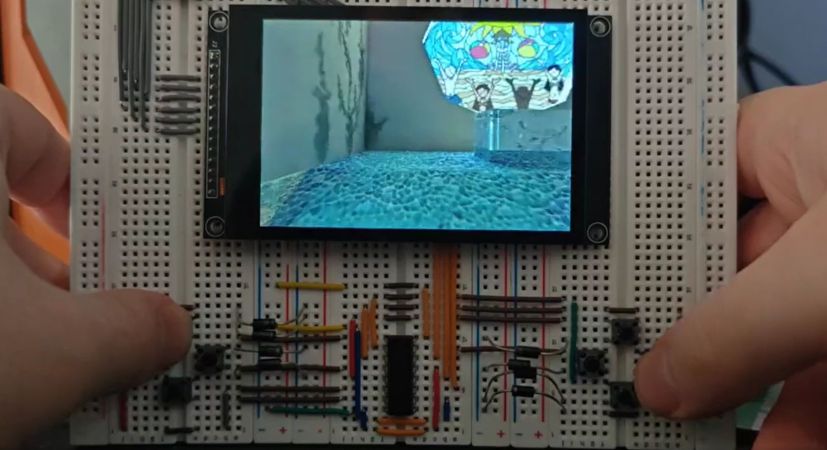
Jet Megatextures Demo For ESP32-S3

Mipmapping is a good way to add a lot more detail to a 3D scene without overburdening the rendering hardware with detail that won’t be seen by the user. This level-of-detail rendering technique was demonstrated on the N64 console hardware a few years ago by [James Lambert] with [Michael Biggins], also known as [PhonicUK], now demonstrating it on the ESP32-S3 using his own Jet rendering engine.

Although level-of-detail rendering really speeds things up, it does also require far larger texture sizes, with [James]’s N64 demo taking up 40 MB of a 64 MB cartridge. To fit it on an ESP32-S3 with 16 MB of PSRAM and no SD card expansion or such the textures were further compressed to use 8-bit indexing, resulting in a mere 5.01 MB of textures.

There’s a demonstration video over on the associated Reddit thread, which shows the camera moving through the scene. Even if not as exciting as theĀ Wipeout port by [Michael] that we previously covered, it does make clear that even without a proper 3D GPU the ESP32-S3 is already a pretty capable gaming machine that can go toe-to-toe with some 1990s consoles.
Continue reading “Jet Megatextures Demo For ESP32-S3” →

Image-Generating AI Can Texture An Entire 3D Scene In Blender

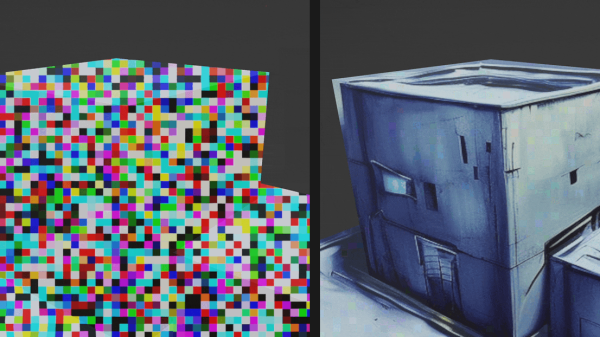
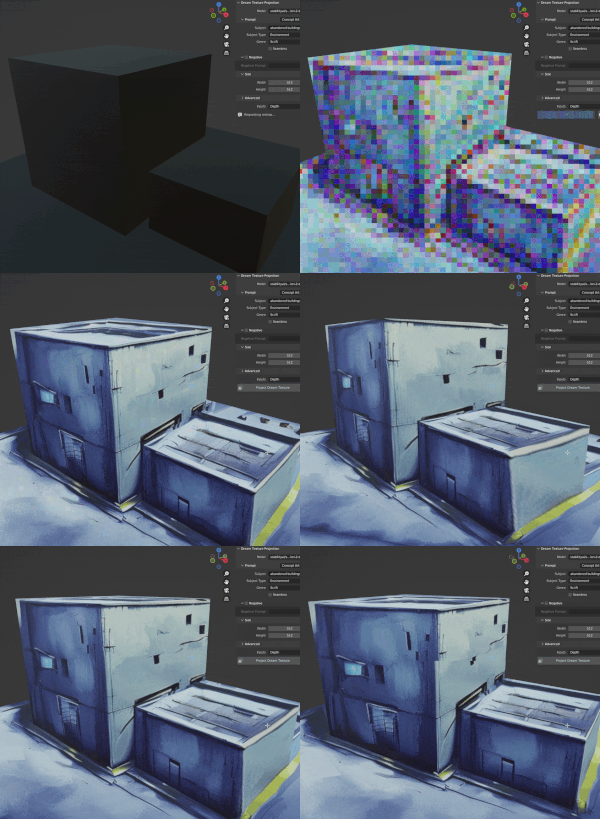
[Carson Katri] has a fantastic solution to easily add textures to 3D scenes in Blender: have an image-generating AI create the texture on demand, and do it for you.

It’s not perfect — the odd door or window feature might suffer from a lack of right angles — but it’s pretty amazing.

As shown here, two featureless blocks on a featureless plain become run-down buildings by wrapping the 3D objects in a suitable image. It’s all done with the help of the Dream Textures add-on for Blender.

The solution uses Stable Diffusion to generate a texture for a scene based on a text prompt (e.g. “sci-fi abandoned buildings”), and leverages an understanding of a scene’s depth for best results. The AI-generated results aren’t always entirely perfect, but the process is pretty amazing. Not to mention fantastically fast compared to creating from scratch.

AI image generation capabilities are progressing at a breakneck pace, and giving people access to tools that can be run locally is what drives interesting and useful applications like this one here.

Curious to know more about how systems like Stable Diffusion work? Here’s a pretty good technical primer, and the Washington Post recently published a less-technical (but accurate) interactive article explaining how AI image generators work, as well as the impact they are having.









