Water Use Feedback Changes Behavior

How much water do you use when showering, or washing your hands, or washing the dishes? Not how much does the average person use, but how much to you use? That’s what the team over at Teague Labs set out to find with this water usage feedback system. The sensor used is a Koolance flow meter which is intended to measure coolant flow in PC liquid cooling systems. At $20, it makes a nice low-cost sensor which was paired with a WiFi enabled Arduino. In the image above they’re using an iPad as a screen so that you can see how much water you’re using (or wasting) as you wash your hands. This resulted in saving 1/2 gallon of water every time someone washed their hands.

The project code, schematic, and board files are all available for download. Along with the hardware build there’s some nice server-side software that gathers and graphs the data over time. We’ve seen a lot of power-meter hacks, but it’s nice to have the option to track water usage, even if this is tailored to just one tap at a time.
Hydropower Generator

[Paul] wanted to have access to renewable energy at his cabin. It’s a relaxing place, nestled in a tall forest that shelters him from the sun and wind. This also means that solar and wind energy aren’t an option. But there is a stream running through the property so he decided to build his own version of a small water-powered generator.

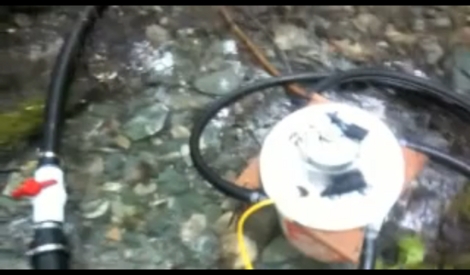
He tapped into a reservoir about 200 feet upstream, split the flow into four smaller hoses, and channeled that into a five-gallon bucket. Inside the bucket you’ll find a Pelton wheel he built which turns a low-RPM generator. He manages to generate 56 VDC at 10 A with this setup, more than enough to charge a bank of batteries.

He does a great job of explaining his setup in the video after the break. If you’re looking for other ideas of how to cut down on your environmental impact check out this compost-powered water heater.

Continue reading “Hydropower Generator”

Laminar Water Jet Explained

[youtube=http://www.youtube.com/watch?v=Ijn98G0I99E]

[Dave] has put together this laminar water jet, mainly from PVC and drinking straws. There isn’t a project page, but he does go into a little depth explaining how it works. The water enters at the bottom and is slowed down by a series of sponges, then forced through a column of drinking straws. It then pools at the top before being forced through a perfectly smooth and sharp nozzle. We did manage to find this other video, making one for $15 that has a ton of information and links. How long before we see a submission of a complete music synchronized fountain in one of our readers yard?

Hacked AC And Ash Filter

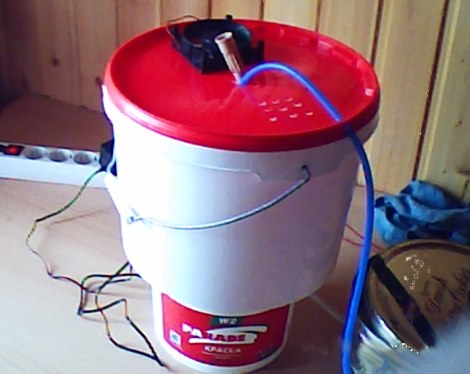
Moscow is in a bit of a hot spot right now, dealing with a heat wave and enormous wildfires. The combination of smoke, ash, and heat was driving Andrew up a wall so he built a contraption to provide some relief. It has two chambers, the bottom houses ice water, the top is an air baffle. A small DC fan pumps air into the upper chamber where it encounters the water being sprayed in from the lower reservoir. What results is a heat exchange similar to other diy AC setups we’ve seen. But Andrew also notes that after running the device for a while the smell of smoke and ash is gone. Can this setup be seen as an effective way to trap airborne smoke particles?

Multi-layer Display Uses Water Instead Of Screen

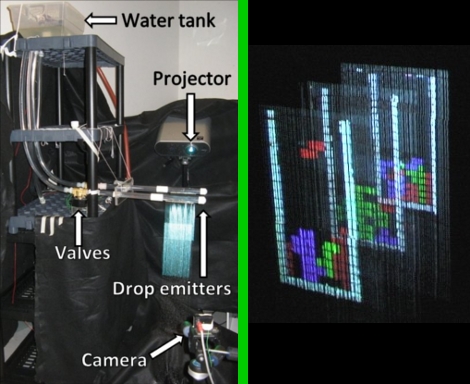
This multi-layer display uses droplets of water as a projection medium. This way, several different projected areas can be seen for a not-quite-3D layering effect. The trick is in syncing up all aspects of the apparatus. There are three manifolds, each with 50 stainless steel needles for water drop production. A solenoid valve actuates the drops, a camera images them mid-air, and a computer syncs the images of the dots with a projector. In the video after the break you can see the SIGGRAPH 2010 presentation that includes a description of the process as well as action shots including a 3-layer version of Tetris.

Continue reading “Multi-layer Display Uses Water Instead Of Screen”

Tomato Irrigation

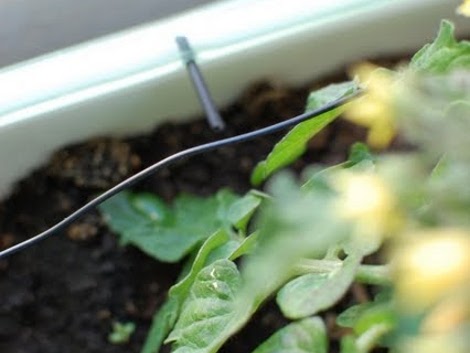
No hack will be more readily accepted by the significant other more than an automated vegetable watering system. [Jouni’s] homemade rig keeps those tomatoes happy with just the right amount of moisture. A bucket serves as the reservoir, a submersible pump gets the water to the soil through a bit of plastic hose. An Arduino monitors the soil sensor, watering and tweeting about it when things dry out too much. Don’t miss the soil moisture sensor post if you need some tips on how to get that end of things working. The rest is pretty straightforward.