
ESP32 As Your Raspberry Pi’s Linux Wireless Co-processor

A laptop with no wireless connectivity feels like a rarity – but when you shop for powerful Linux single-board computers (SBCs), it is pretty common to see one skimp on WiFi. At the same time, current wireless cards can leave much to be desired. A mess of proprietary firmware, ephemeral or even binary blob drivers, weird glitches never resolved, and sometimes entirely source-less blobs with an expiration date. Maybe the SBC doesn’t have a free USB port for a plug-and-play WiFi chip, or you don’t want to design for an obscure hard-to-source castellated module.

What if I told you there’s a unique solution to the problem, as long as the SBC has an SDIO or SPI to spare? There’s a wireless card we can all try to get behind, and it’s certainly not flawless but gives us way more room to grow – it’s got somewhat open-source firmware, it comes from a respectable company, and it’s nigh-guaranteed to be easy to source. I am, of course, talking about esp-hosted – using ESP32 modules as your WiFi/BT card, over SDIO or SPI.

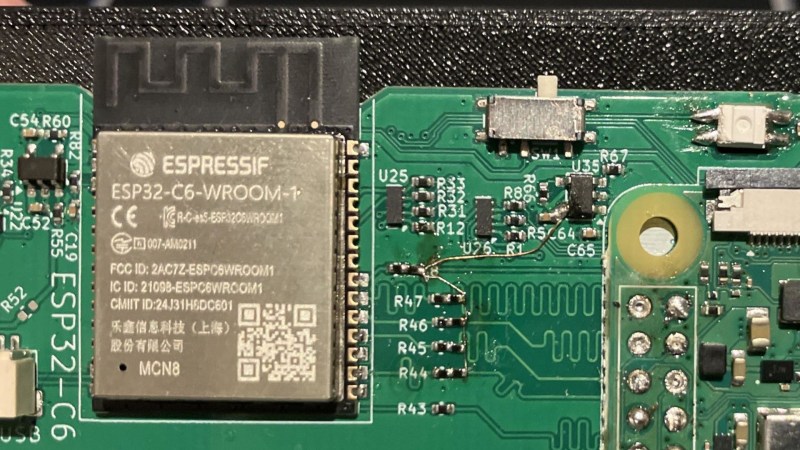
I’ve recently added an ESP32-C6 into my project, and setting up esp-hosted wasn’t ultra straightforward – so here’s a guide, and a discussion on what makes esp-hosted so cool and so incredibly promising. Spoilers: it works with privacy switches that cut out power, it could be hacked into a coprocessor for mesh protocols, and it could potentially help us build a fully open-source SDIO WiFi card.

Continue reading “ESP32 As Your Raspberry Pi’s Linux Wireless Co-processor” →
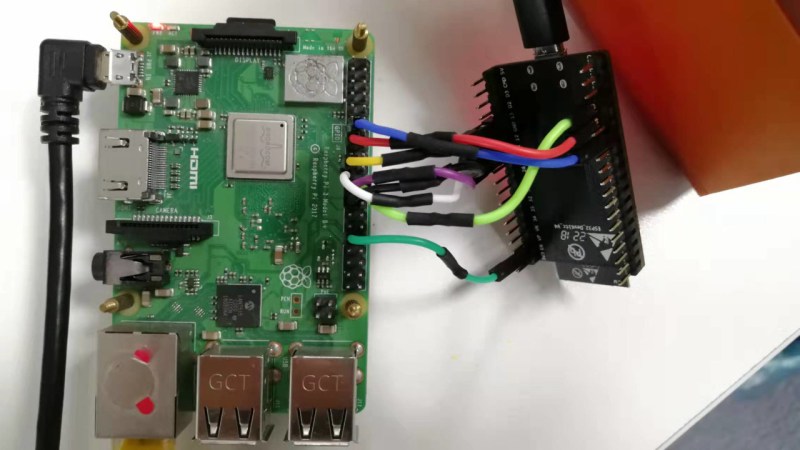
Showing a Raspberry Pi 4 board connected to an ESP32 devboard using jumper wires for the purposes of this project

ESP-Hosted Turns ESP32 Into Linux WiFi/BT Adapter

While we are used to USB WiFi adapters, embedded devices typically use SDIO WiFi cards, and for good reasons – they’re way more low-power, don’t take up a USB port, don’t require a power-sipping USB hub, and the SDIO interface is widely available. However, SDIO cards and modules tend to be obscure and proprietary beyond reason. Enter ESP-Hosted – Espressif’s firmware and driver combination for ESP32 (press release)(GitHub), making your ESP32 into a WiFi module for either your Linux computer (ESP-Hosted-NG) or MCU (ESP-Hosted-FG). In particular, ESP-Hosted-NG his turns your SPI- or SDIO-connected ESP32 (including -S2/S3/C2/C3/C6 into a WiFi card, quite speedy and natively supported by the Linux network stack, as opposed to something like an AT command mode.

We’ve seen this done with ESP8266 before – repurposing an ESP8089 driver from sources found online, making an ESP8266 into a $2 WiFi adapter for something like a Pi. The ESP-Hosted project is Espressif-supported, and it works on the entire ESP32 lineup, through an SDIO or even SPI interface! It supports 802.11b/g/n and even Bluetooth, up to BLE5, either over an extra UART channel or the same SDIO/SPI channel; you can even get BT audio over I2S. If you have an SPI/SDIO port free and an ESP32 module handy, this might just be the perfect WiFi card for your Linux project!

There are some limitations – for instance, you can’t do AP mode in the NG (Linux-compatible) version. Also, part of the firmware has blobs in it, but a lot of the firmware and all of the driver are modifiable in case you need your ESP32 to do even more than Espressif has coded in – this is not fully open-source firmware, but it’s definitely way more than the Broadcom’s proprietary onboard Raspberry Pi WiFi chip. There’s plenty of documentation, and even some fun features like raw transport layer access. Also, of note is that this project supports ESP32-C6, which means you can equip your project with a RISC-V-based WiFi adapter.

Title image from [zhichunlee].









