
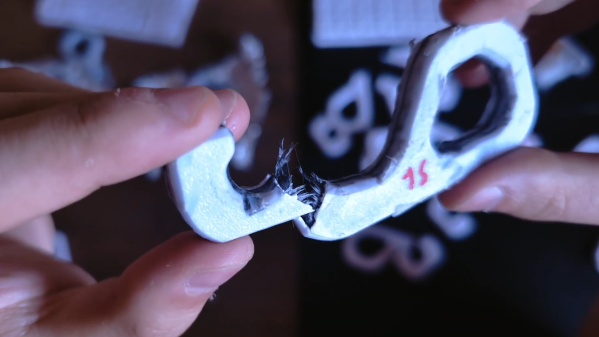
A man's hands are shown holding a broken 3D-printed hook. The hook has a loop and hook, in a number 9-shape. The hook portion has broken, exposing carbon fibers.

Strengthening 3D Prints With A Carbon-Fiber Epidermis

As strong and light as carbon fiber-epoxy composites are, the same can’t always be said of carbon-fiber reinforced 3D printer filaments. Of those that do improve over stock filament, the best performance comes from long, continuous strands, but the printers that can embed these are quite expensive. [MagicLAG], looking for a cheaper method, made something even stronger: prints reinforced with subsurface carbon-fiber cloth.

They tried a few other methods first, including pausing the print and manually embedding carbon fiber strands, ironing strands into the finished part, and ironing carbon fiber cloth into the bottom layer. For the main method, though, he printed the test part in three pieces: a core part, and two outer shell layers. Between the core and the shell is a small gap, into which carbon-fiber cloth can be epoxied. Under good conditions (not using quick-setting epoxy), this mostly preserves the outer surface and dimensional accuracy.

To test the various strengthening methods, [MagicLAG] printed hooks and tensioned them on a load cell until failure. None of the methods using single-stranded fiber showed any improvement; the fiber simply bent and let the surrounding plastic break. As a control for the epidermal cloth parts, they printed shells and cores and epoxied them together. These controls performed better than the standard parts, but not nearly as well as the carbon-fiber cloth composites. With only a few layers of cloth, these more than tripled the yield strength of the basic hook.

If you’d rather use a carbon-fiber filament, the type of plastic matters; carbon fiber makes PLA, at least, weaker. Regardless of form, some caution is called for whenever handling carbon fiber, since it seems to show some asbestos-like effects.

Torque Testing 3D Printed Screws

Unless you’ve got a shop with a well-stocked hardware bin, it’s a trip to the hardware store when you need a special screw. But [Sanford Prime] has a different approach: he prints his hardware, at least for non-critical applications. Just how much abuse these plastic screws can withstand was an open question, though, until he did a little torque testing to find out.

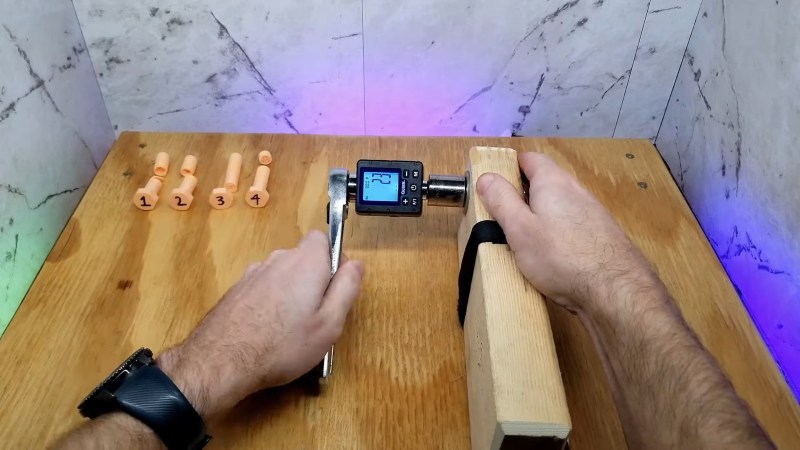
To run the experiments, [Sanford]’s first stop was Harbor Freight, where he procured their cheapest digital torque adapter. The test fixture was similarly expedient — just a piece of wood with a hole drilled in it and a wrench holding a nut. The screws were FDM printed in PLA, ten in total, each identical in diameter, length, and thread pitch, but with differing wall thicknesses and gyroid infill percentages. Each was threaded into the captive nut and torqued with a 3/8″ ratchet wrench, with indicated torque at fastener failure recorded.

Perhaps unsurprisingly, overall strength was pretty low, amounting to only 11 inch-pounds (1.24 Nm) at the low end. The thicker the walls and the greater the infill percentage, the stronger the screws tended to be. The failures were almost universally in the threaded part of the fastener, with the exception being at the junction between the head and the shank of one screw. Since the screws were all printed vertically with their heads down on the print bed, all the failures were along the plane of printing. This prompted a separate test with a screw printed horizontally, which survived to a relatively whopping 145 in-lb, which is twice what the best of the other test group could manage.

[Sanford Prime] is careful to note that this is a rough experiment, and the results need to be taken with a large pinch of salt. There are plenty of sources of variability, not least of which is the fact that most of the measured torques were below the specified lower calibrated range for the torque tester used. Still, it’s a useful demonstration of the capabilities of 3D-printed threaded fasteners, and their limitations.

Continue reading “Torque Testing 3D Printed Screws”








