Building a Strandbeest

flexing-jansen-mechanism

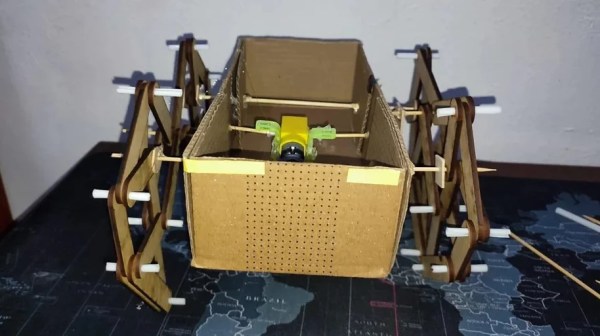
[Jeremy] may have given up on his big hexapod project, but that doesn’t mean he’s out of the world of legged robots just yet. He’s embarked on another project, much more elegant and beautiful than a simple hexapod. This time, he’s building a Strandbeest, the same machine designed by walking machine extraordinaire [Theo Jansen].

Coming up with the correct lengths and joints of a Strandbeest leg linkage isn’t something you can just pull out of your head, so after [Jeremy] found the inspiration for his new project he dug into the related literature on Strandbeest legs. He found the work of [Dominique Studer] and set to work making his own mechanical legs.

Right now, [Jeremy] has a prototype of the Strandbeest leg linkage made out of wood. It still needs a little bit of work, but soon enough there will be a PVC pipe Mountainbeest trolling the backwoods near [Jeremy]‘s house.

[Read more...]

3D printed Strandbeests made to order

strandbeest

If you love Strandbeests but don’t have the patience to build your own, Dutch artist [Theo Jansen] has you covered. You might remember him from a story we ran last year, detailing his awesome beach-going strandbeest creations.

His beach walkers are typically built out of PVC conduit and plastic tubing, towering over their creator. For the time being however, he is focusing his work on a much smaller scale. [Theo] has recently teamed up with a 3D printing shop in order to offer miniature working replicas of his creations to the public. The current models can be had for $105, which seems like a pretty steep price to us. Then again, these models come fully assembled and are composed of 76 individual pieces, which is nothing to sneeze at.

That said, considering how easily a Strandbeest can be created with a stack of thick paper and some free time, we imagine that an enterprising individual could build one using readily available plastics at a fraction of the cost. Anyone out there up for giving it a shot?

Continue reading to see a video of the Strandbeest creation process.

[via Gizmodo]

[Read more...]

Papercraft strandbeest is a great rainy day project

papercraft_strandbeest

Here in the Midwest it sometimes seems like Spring will never, well…spring. We get that “April showers bring May flowers”, but nearly all of the last month has been cold and rainy around these parts. While things are improving, we think it’s always good practice to have a few fun projects at the ready, just in case your plans with the kids get rained out.

We think that Hackaday reader [Dombeef’s] papercraft strandbeest is a perfect idea for a rainy afternoon. The supply list is pretty short, requiring little more than some scissors, pliers, paperclips, and glue in addition to the thick paper that makes up the body of the strandbeest. The paper is cut into pieces according to the PDF template he includes in his Instructable, secured to one another via small pieces of paperclip.

Once the legs are all constructed, a main axis is built from one of the remaining paperclips, and everything is joined together under the main portion of the strandbeest’s body.

As you can see in the video, the legs work quite well, though the strandbeest can probably benefit from a hand crank in the short term. [Dombeef] plans on adding a small motor to his creation, which should get the strandbeest moving about quite rapidly once completed.

If you are looking for more fun projects to do with the kids, look no further than this papercraft gyroscope or these squishy circuits.

[Read more...]

Hamster Powered Strandbeest

hamster_strandbeest

Gakken magazine featured a miniature wind-powered Strandbeest recently, converting it to run on everything from rubber bands to solar power. [Crabfu] thought it would be worthwhile to hack the Strandbeest kit that shipped with the magazine as well, so he started to brainstorm.  Well-known for his steam powered hacks previously featured here, he did originally consider adding a steam plant to the walker.  In the end, he scrapped that idea due to concerns about heat and weight.  Thinking about it further he settled on something he considered ridiculous, even stupid: A hamster powered Strandbeest.

[Crabfu] added a few components including a hamster ball and a simple chain drive from a Meccano building set before testing the device with a toy train as the power source.  Once he was certain that he had the proper gear ratio set, in went a friend’s hamster.  The device worked wonderfully, much to the delight of his nieces, as you can see in the video on his site.

Theo Jansen: like the professor from Gilligan

[Theo Jansen] is building lifeforms that will live and thrive on the beach. He calls them StrandBeest and uses PVC electrical conduit, plastic tubing, and lemonade bottles as building material. The many-legged creations are amazingly advanced, able to count steps, sense and flee from the water’s edge, and protect themselves from high wind. He gave a TED talk back in 2007 that we’ve embedded after the break; it’s uncanny. See examples of his creations using fans and sails to store wind energy as compressed air in the lemonade bottles, then use that pressure for locomotion. He also demonstrates a binary step counter and water sensor. [Read more...]