Conways’ Wall Of Life And Whiteboard Emporium

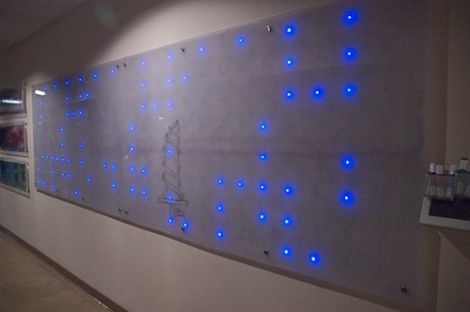
White board beats chalk board, LED marquee beats white board, and an LED white board trumps them all.

This hybrid lets you draw on the surface with dry erase markers while Conway’s game of life plays out underneath. [Bert] sent us this tip after seeing yesterday’s office marquee. This version is quite similar in appearance but the guts are very different. Inside you’ll find a Parallax SX28 microcontroller doing the heavy lifting. The display is multiplexed but they didn’t go with a common 595 shift register, but a beefier MAX6979 LED driver. We’re not too familiar with this part but it does have a lot of nice features like constant current, and automatic shutdown if serial data stalls for more than 1 second. This is a low-side driver so transistors are used to connect voltage to the rows; the opposite from the setup we looked at yesterday. This was built several years ago and is still working happily even though its permanent home is a breadboard. Source code can be found on this page.

Exploding An AVR

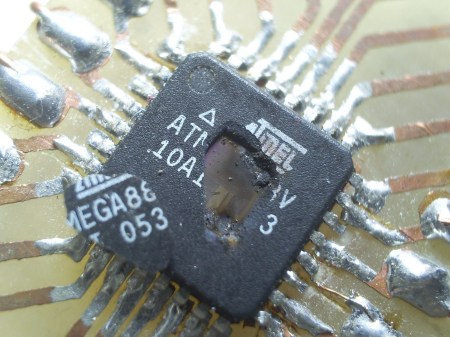
Unfortunately [manekinen] wrecked a couple of AVRs during his tinkering. Not letting this get him down he decided to blow them up to see what would happen. In exchange for their precious magic smoke the AVRs revealed a good portion of their silicon die.

While the details are a little sparse it seems like he hooked them up to a high (and possibly reverse) source to blow open the chips casing. From the pictures it looks like he was able to reveal some of the flash or SRAM (the big multi colored rectangles) and what could possibly be the power supply. Be sure to checkout the videos after the break for some silicon carnage.

Continue reading “Exploding An AVR”

Official Hackaday Forums

Yes, finally, we have a forum. We get regular requests, both in the comments and in our email for a hackaday forum.  We put it in operation a few days ago and started letting people trickle in and it hasn’t completely blown up in our faces. Please join us there and help build our community. Also, notice there is a button for it over on the right column now.

Some items of interest or common answers to common questions:

  • No illegal activities allowed. Yes, we have the word “hack” in our name. That does not mean that we will hack a website for you. (we get that request weekly).
  • Keep it moderately clean. Sure you can cuss, this isn’t a kids site, but no pronography/gore please.
  • No personal threats.
  • There will be google ads. We are trying really hard to balance the business with the fun, so bear with us. So far, they aren’t in the way. We have no plans on going overboard.
  • This will be readable without a login. You must register to post.
  • We’re working out the kinks. Please report any problems to caleb@

That’s it, enjoy and be civil.

Plug And Prey: Malicious USB Devices

This very informative talk given at Shmoocon 2011 has been posted over at IronGeek. Covering all kinds of angles that a person could attack someones computer through the USB port, this should be read by anyone who is security minded at all. No matter which side of the port you tend to be on, this article has great information. They cover some common attack methods such as keyloggers and fake keyboards as well as some common methods of securing your system against them. We’ve actually seen this in the news a bit lately as people have been using the keyboard emulation method in conjunction with android phones to hack into systems.

[thanks Adrian]

The Pirate Box

One of the most fun aspects of a LAN party was exploring the shared files of all the other users on the network. There were people that would show up, solely for the file swapping. That is exactly what this project is about. From the projects wiki, the Pirate box is a mobile p2p sharing and collaboration platform. Basically it is a wireless hotspot with a slick interface and a shared folder. It doesn’t connect to the internet, and it doesn’t log any connections. You can have a file swapping session simply by flipping it on and sharing its space with other people. They’ve included a step by step guide to setting up your own, but if you’re going to do some subversive file swapping we might suggest putting it in a less conspicuous enclosure. Imagine this as a portable verion of dead drops.

Disguise Your Acura NSX As A Ferrari F50

We know what you’re thinking. “I have this Acura NSX, but my friends just won’t think I’m cool unless I have a Ferrari F50.” You know what? You’re right. To save yourself from that kind of ridicule, you can simply carry out a ridiculous body mod to make your poor NSX live up to your friends expectations. It only took massive amounts of fiberglass, foam, and bondo to get this NSX looking the way the guy wanted it. We have to wonder if there was any performance hit with the additional weight, then again, he may have removed enough metal panels to compensate.  While we may joke about it, we really do have some respect for the amount of work he put into this thing. The finished job is simply amazing, in terms of reproduction of the original. Kudos crazy car modder guy.

Make Presents: The Multimeter

This video falls under the category of things we want to send people when they ask “how do I get started with electronics”, and we get asked that a lot. For those of you who have been working with electronics for years at all, you can skip this entire video. That is, unless you really want to watch an instructional video on multimeters. In the video, which we’ve included after the break, they talk about the differences between different meters, the common uses and how to actually use the meter to get the results you need. Stuffed full of useful information, this video will get those of you who are still reading up to snuff pretty quickly. Now go use your multimeter to do some hacking!

Continue reading “Make Presents: The Multimeter”