We passed through Tulsa Oklahoma the first day we were traveling, but it was very early in the morning, so we skipped the Fablab. On the way home though, the timing was perfect for a quick visit. [Blixa] was happy to show me around and explain how the fablab works.
Year: 2012
Buying Cheaper Electronics And Not Saving Money
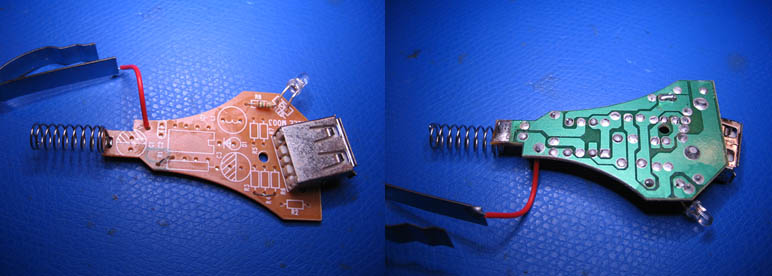
As an engineer at Spectrum Design in Minneapolis, [Carl] works with clients to get their product out to the masses. When designing a new USB-powered device, one client thought it would be a great idea to include a USB car charger with the device. The client promptly ordered a few thousand car chargers from China and everything was going swimmingly.
Everything was fine, of course, until [Carl] decided to test the Chinese car chargers with the client’s device. The USB PHY burnt out in short order, and the likely culprit was a shorted 12 volt regulator. This demanded a closer inspection, so after cracking open the charger [Carl] was amazed at what he found.
Yes, what you see on that circuit board is accurate. The manufacturer of these car chargers never even populated the switched mode regulator for this car USB charger. Amazing, considering a single 10 cent 7805 DC regulator would have almost worked for this application.
If there was ever an example of being careful when purchasing the cheapest possible product to increase profit margins, this would be it.
Ever the engineer, [Carl] sent this into the tip line as a Word document. That’s available here, along with a slide show of the pictures [Carl] snapped.
Continue reading “Buying Cheaper Electronics And Not Saving Money”
Toorcamp: Bliplace 2.0
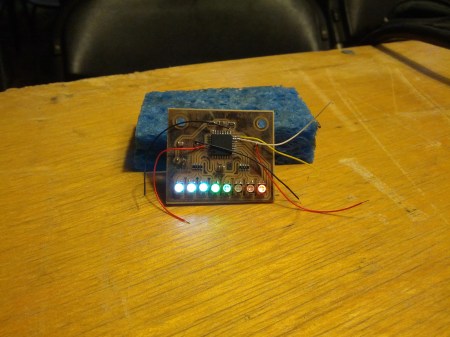
We’ve shown [Tanjent]’s Bliplace 1.0 in the past. He handed out a few hundred of the open source audio toys at Burning Man. At Toorcamp, he’s been showing off an improved 2.0 version of the project. This one has a more powerful microcontroller and many more RGB LEDs.
The device uses the ATMega328 and an electret microphone to sample ambient noise. It the processes the sound into a light pattern which is displayed on the line of RGB LEDs. The demo that I saw showed the LEDs synchronized to bass frequencies, which it could pick up at a range from the large sub-woofers at Toorcamp. It’s powered by a CR2032 coin cell battery, which means it can be worn as a neat audio toy.
This prototype version was etched in his kitchen but [Tanjent] is working on making a production version of the PCB. He plans to release it as a surface mount soldering kit.
Hackaday Links: August 15, 2012
An Octopart for RC equipment

When [Zach] started building a quadcopter he found it very difficult to source the required parts. Thus was born CompareRC, an aggregation of several online RC retailers. There’s over 150,000 parts in the database, all searchable and sortable by lowest price.
Segway iPad Skype teleconferencing robot

It’ll be a while until robots completely eliminate the need for any human interaction, but until then there’s Double. It’s a two-wheeled balancing robot with an iPad dock, controllable via a remote iPad.
Free electronic design

In case you weren’t aware, Fedora has an electronic design distro that includes just about everything needed to build electronic circuits called Fedora Electronic Lab. FEL has PCB designers, circuit simulators, editors for just about everything, and support for PICs, AVRs, and 8051 micros. Thanks for sending this in, [Simon].
Make your own Megadrive ROMs

Last month, [Lee] sent in a build where he connected an Arduino Mega to an old Sega Genesis/Megadrive cartridge. He’s figured out how to read the contents of the cartridge now, allowing you to preserve your 100% complete Sonic & Knuckles / Sonic 3 save for time immemorial.
A surprising amount of graphics tutorials

Khan Academy, every autodidacts best friend, is now teaching computer science. Right now, there is a heavy focus on drawing graphics, and everything is coded in the browser (using Javascript…), but at least it’s a start. The fundamentals of programming are platform and language agnostic, so this looks to be a great way to learn programming.
Here’s a blog post from the lead dev of the Khan CS project.
Toorcamp: Quadcopter Controlled By A TI-84+
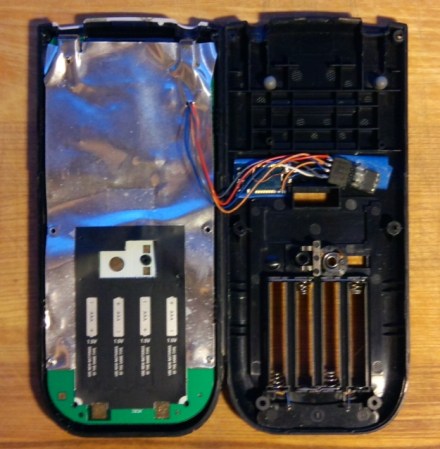
What happens when you combine a TI-84+ graphing calculator with an added bluetooth module, a 1 Watt Alfa wifi dongle, and a Parrot Wifi Quadcopter? You get a long range quadcopter that’s controlled from the TI-84+ directional pad.
This TI-84+ looks like a standard issue school calculator, but [Owen] added an ATTiny13 microcontroller and a bluetooth module which sniffs the I/O port of the calculator. This allows for bi-directional communication with a laptop. He wrote a few Python scripts on the laptop to receive data from the calculator and send commands to the Parrot Quadcopter. The high-powered wifi module allowed for pretty good range with the Quadcopter, which was flown across the Toorcamp grounds.
Of course, having an innocent looking calculator with wireless communications has some other uses. Data could be displayed on the calculator from a phone over bluetooth. How about accessing Wikipedia or WolframAlpha from your calculator? Despite the possibilities, [Owen] did say that he’s never used it to cheat on tests.
Toothbrush Timer

This toothbrush holder will make sure you’re brushing your pearly whites for an appropriate length of time. The three cups serves as tootbrush storage, and detect when one has been removed. Once you start brushing your teeth the lights on the front and bell in the back count down the process automatically.
The counting sequence starts when a weight sensor in the base detects a change caused by picking up a toothbrush. The ATmega328 — which is programmed with Arduino-style code — then turns on all of the incandescent lamps mounted on the front portion of the base. Each of these are switched with a 2N3904 transistor in order to sink enough current for the bulb. As a two-minute timer decrements, the bulbs are extinguished one by one. But there is also an auditory feedback mechanism. On the back of the base is a small bell. A hammer on a servo strikes the bell every 30 seconds to let you know how you’re doing. The entire thing is driven by an internal Li-ion battery which lasts about three weeks between charges. Don’t miss the demo video found after the break.
Donation Meter Raises Alarm When Not Plugged With Coins
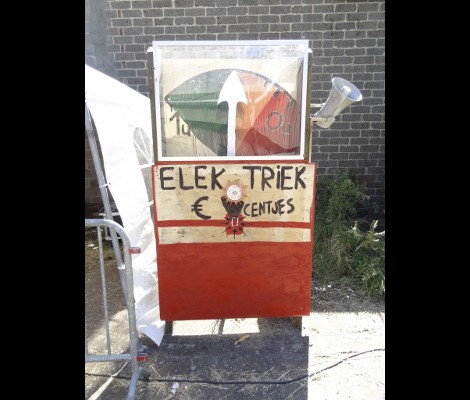
This is something of a mandatory donation meter. If you don’t feed it with coins it sounds a very loud alarm continuously.
[Piet De Vaere] built the device for a free festival in Ghent, Belgium. The intent is to help raise awareness that although free of an admission price, the success of the event depends on donations. It works much like a parking meter. When you feed it coins time is added to the meter. When it runs all the way down that large loudspeaker on the right side of the case sounds the alarm.
In the video after the break [Piet] walks us through a demonstration, followed by a tour of the hardware. The pointer on the meter is a piece of cardboard connected to a servo. An Arduino board controls the servo, adding time in two-minute intervals whenever a coin enters the chute and passes by an optical sensor. There is no distinction between types of coins.
The use of a pizza box as a prototyping board shows that you don’t have to be fancy to build something neat.
Continue reading “Donation Meter Raises Alarm When Not Plugged With Coins”