Heliowatcher Positions Solar Panels For Highest Efficiency

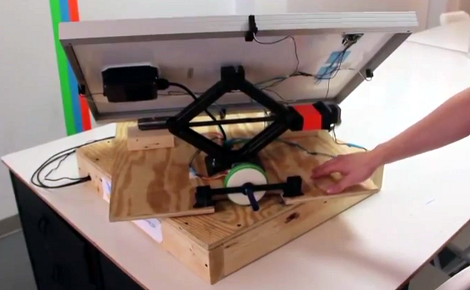
[Jason Wright] and [Jeremy Blum] are showing off the project they developed for their Designing with Microcontrollers course at Cornell University. They call it the Heliowatcher, and if you know your Greek mythology we’d be you figured out this watches the movement of the sun and adjust a solar panel to follow it.

Their design is simple and effective. The base is mounted like a Lazy Susan, able to pivot on the horizontal plane. The bottom edge of the solar panel is mounted with two door hinges, with a motorized screw jack used to raise and lower it. The system uses a GPS to provide geographical position, day, and time feedback. This is used in conjunction with an array of four LEDs to determine the best position of the panel. Those LEDs are acting as light sensors; when the top and the bottom detect similar levels, the panel is at its most efficient orientation. The left and right LED sensors work the same way.

Now if we can just work out a self-cleaning system to keep the panels free of the dirty film that builds up over time we’d be set!

Continue reading “Heliowatcher Positions Solar Panels For Highest Efficiency”
FTA Dish Used To Receive L-band Amateur Radio

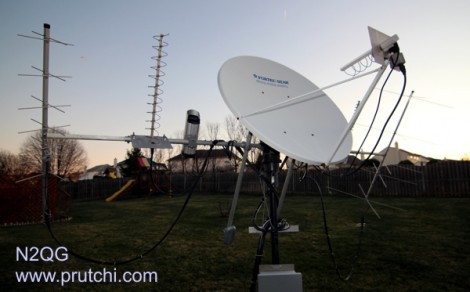
[David Prutchi] has an FTA (free-to-air) satellite dish. This means he can tune and watch freely available satellite television feeds. But this sounds much better than it actually is. There isn’t much that’s broadcasted unecrypted from satellites with the exception of a collection of religious channels. But he still uses the dish by using the FTA satellites to calibrate the alignment, then repositioning it to receive L-Band radio transmissions with his own add-on hardware. In the image above it’s the spiral of wire attached to the dish’s collector.

The satellite transmissions are picked up on the KU-band by an aftermarket horn that [David] purchased for this purpose. To add his own helix receiver he cut a square mounting plate that fits around the horn. This plate serves as a reflector and ground plane, and also hosts the helix connector which picks up the L-band transmissions. He had to be creative with routing the first few inches of the helix but it looks like he manages to get some pretty good performance out of the hardware.

[via Hacked Gadgets]

Hackerspace Intro: STGO Makerspace In Santiago, Chile

[Roy MacDonald] sent in a few links to all the cool stuff his home base – the StgoMakerSpace (Google translation) in Santiago, Chile – is putting together. They’re a new hackerspace that’s only been open for two months or so, but already they’re put together a great assemblage of tools, hosted a few awesome workshops, and even gotten a good bit of local media exposure.

The StgoMakerSpace found its first bit of fame with a very in-depth article in Qué Pasa, a Chilean magazine (Google Translate). There’s a lot of very, very talented people at StgoMakerSpace that includes [macapola], an industrial designer who spent a year in China learning all about modern, global  manufacturing processes.

StgoMakerSpace has a few workshops coming up, including a Kinect hacking workshop, and Arduino workshop, and a welding workshop. If you’re around Santiago, it’s worth checking out. In addition to very, very smart people and a whole bunch of tools, StgoMakerSpace also has a retro video game museum and FREE BEER brewed in-house.

As a small aside, [Roy] tells us the word ‘hacker’ has a negative connotation in Spanish, and it immediately associated with cybercrime; that’s the reason it’s the Santiago Makerspace. In our experience, the same connotation sometimes applies in English, something that hasn’t stopped all the Hackerspaces around the US.

Salvaged LCD Screen Hacking

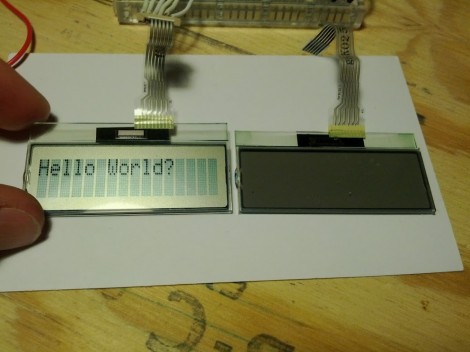
You can find all kinds of LCD screens in broken electronics. But it’s often a chore to figure out how they are controlled if you don’t have a working device that can be used to sniff the communications protocol. [Justin] grabbed this character LCD screen from an old Brother printer and decided to see if he could reuse it in his own projects. Luckily the driver card still worked so he patched into the LCD’s control lines and sniffed the signals when the printer is powered on.

He used the OpenBench Logic Sniffer for this project. It easily captured the data, and also provided analysis tools. The SPI analyzer managed to decode the command signals and message of “Please wait” that pops up at power up. After a bit of folly with the pin out of the display, he is now able to control it thanks to an Arduino library which he wrote. Check out the demo after the break to seem him scrolling through a bunch of different functions for the device.

Continue reading “Salvaged LCD Screen Hacking”

Prototyping An Advanced Inductive Charger

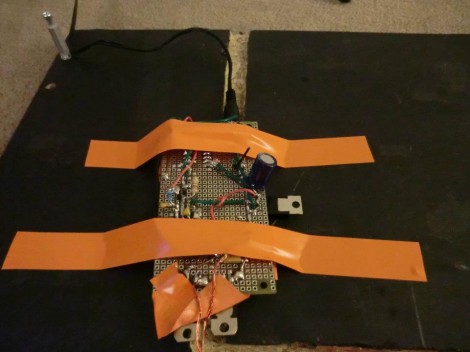
This is an advanced inductive charging system into which [David McIntosh] has put a lot of hard work. It uses the same coil-based concepts that we’ve seen in other DIY systems, but the game changer is a communications function that just isn’t found in home brew versions of the hardware. It lets the receiver (device being charged) give feedback to the transmitter by rolling another signal into the EM field being generated.

Do why would you need feedback? Well, if the two coils are not positioned well, the power produced on the receiving end can vary greatly. For instance, you may have the wrong voltage because the coils are not balanced. Or there may not be enough current to properly start charging. The feedback system is designed to let the sending unit change frequency to try to account for physical orientation, or to shut itself off if the charge is just not possible. This is done in expensive commercial devices, and that’s what [David] used as his model.

A DSLR Shutter Cable For Android

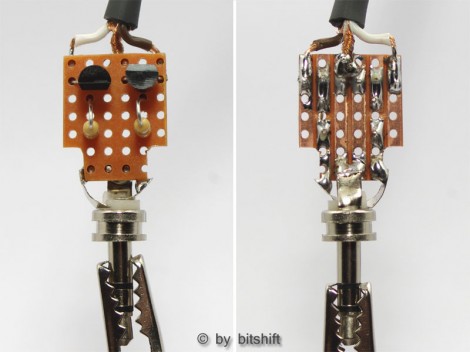
Here’s a very easy way to trigger your DSLR camera using an Android device. It’s a similar method used with IR triggered cameras, in that all you need to do is assemble some simple hardware to plug into the headphone jack. The app that triggers the camera simply plays back a well crafted audio file to do so. The thing that this cable adds is the ability to use the focus feature, since the cable has two data lines.

The hardware is dead-simple. A pair of NPN transistors and a pair of resistors are hosted by this small chunk of strip board. The audio jack for Android uses left and right audio channels to drive the base of these transistors. On the camera side of things the transistors are pulling the focus, and shutter contacts to ground. Once this is covered with shrink tubing it’ll be pretty rugged, and ready to be thrown in your camera bag for use on short notice.

[Thanks Hannes]

Player Guitar Sounds Wonderful; Makes Us Drool Because Of The Complexity

It becomes obvious when you listen to this player guitar that it’s not a human being playing. But the only reason for that is the unrelenting precision with which the songs are played. In addition to that accuracy, it’s interesting to note that this tune is normally played by a group of guitarists but here the machine manages to do it on one instrument. And we think it sounds fantastic!

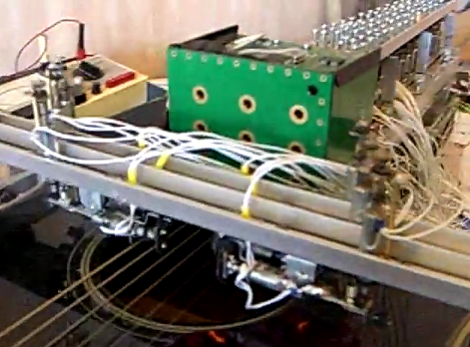
This comes from [Vladimir Demin], a maker who previously built an automatic Bayan (like an accordion but with buttons where the keyboard is normally found). This time around it’s the six strings and many frets of a guitar that have been outfitted with one solenoid each. In the image above you can see the strumming mechanism mounted near the tone hole. Six picks are held in place, and it appears that each has two solenoids. From what we can observe in the video, one of the solenoids is used to strum the sting, the other tilts the pick mount so that there won’t be a second strumming when the pick is returned to its starting position.

Continue reading “Player Guitar Sounds Wonderful; Makes Us Drool Because Of The Complexity”