Making The Codec Communicator From Metal Gear Solid

[3DSage] likes building replicas of hardware from movies and video games, often with a functional twist. His latest build aimed to bring the Codec from Metal Gear Solid to life.

If you haven’t played the Metal Gear games, the Codec has been modelled somewhat like an advanced walkie talkie at times, but has often been kept off-screen. Thus, [3DSage] had a great deal of creative latitude to create a realistic-feeling Codec device that provided voice communications and some simple imagery display.

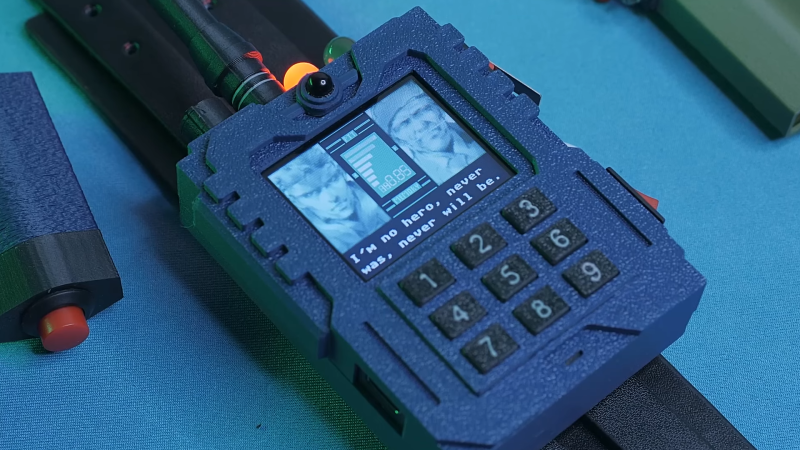
The resulting build relies on an RP2040 microcontroller to run the show. It’s paired with an MPU6050 3-axis gyroscope and accelerometer for motion control of the device’s functionality, and features a small LCD screen to mimic the display in the games. A kids walkie-talkie kit was leveraged for audio communication, but kitted out with a better microphone than standard. Power is via a rechargeable 9V battery, which is really a lithium-ion and USB charging board packed into the familiar 9V form factor.

Where the build really shines, though, is the aesthetic. [3DSage] managed to capture the military-like look and feel as well as authentically recreate the graphics from the games on the screen. The simulated noise on the display is particularly charming. Beyond that, the 3D-printed enclosures leverage texture and multi-color printing really well to nail the fit and finish.

Ultimately, the Codec isn’t much more than a glorified walkie talkie. Even still, [3DSage] was able to create an impressive prop that actually does most of what the device can do in game. If you’ve ever coveted a PipBoy or tricorder, this is one project you’ll be able to appreciate.

Continue reading “Making The Codec Communicator From Metal Gear Solid”

Adaptive Optics Take Clearest Pictures Of The Sun Yet

It’s sometimes easy to forget that the light in the sky is an actual star. With how reliable it is and how busy we tend to be as humans, we can take that incredible fact and stow it away and largely go on with our lives unaffected. But our star is the thing that gives everything on the planet life and energy and is important to understand. Humans don’t have a full understanding of it either; there are several unsolved mysteries in physics which revolve around the sun, the most famous of which is the coronal heating problem. To help further our understanding a number of scientific instruments have been devised to probe deeper into it, and this adaptive optics system just captures some of the most impressive images of it yet.

Adaptive optics systems are installed in terrestrial telescopes to help mitigate the distortion of incoming light caused by Earth’s atmosphere. They generally involve using a reference source to measure these distortions, and then make changes to the way the telescope gathers light, in this case by making rapid, slight changes to the telescope’s mirror. This system has been installed on the Goode Solar Telescope in California and has allowed scientists to view various solar phenomena with unprecedented clarity.

The adaptive optics system here has allowed researchers to improve the resolution from the 1000 km resolution of other solar telescopes down to nearly the theoretical limit of this telescope—63 km. With this kind of resolution the researchers hope that this clarity will help shine some light on some of the sun’s ongoing mysteries. Adaptive optics systems like this aren’t just used on terrestrial telescopes, either. This demonstration shows how the adaptive optics system works on the James Webb Space Telescope.

Thanks to [iliis] for the tip!

Portal 2 Becomes An Impressively Capable Web Server

Portal 2 is mostly known as the successful sequel to Valve’s weird physics platformer, Portal. It’s not really known for being a webserver. That might change, though, given the hard work of [PortalRunner].

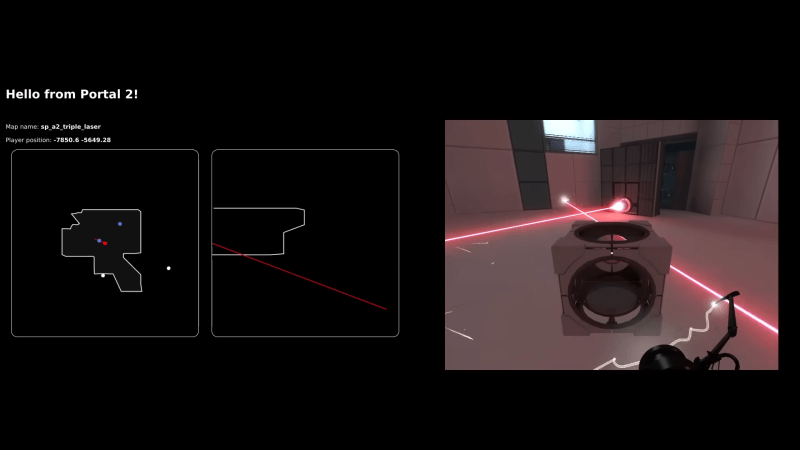
Quite literally, [PortalRunner] hacked the Source engine and Portal 2 to actually run a working HTTP web server. That required setting up the code to implement a TCP network socket that was suitable for web traffic, since the engine primarily functions with UDP sockets for multiplayer use. This was achieved with a feature initially put in the Source engine for server management in the Left 4 Dead games. From there, the game engine just had to be set up to reply to HTTP requests on that socket with the proper responses a visiting browser expects. If the game engine responds to a browser’s connection request with a bunch of HTML, that’s what the browser will display. Bam! You’ve got a web server running in Portal 2.

From there, [PortalRunner] went further, setting things up so that the status of in-game objects effects the HTML served up to visiting web browsers. Move objects in the game, and the served web page changes. It’s pretty fun, and the complexity and features [PortalRunner] implements only get more advanced from there. When he gets into stacking companion cubes to write HTML in visual form, you’ll want to applaud the Minecraftian glory of it all.

The devil is really in the details on this one, and it’s a great watch. In reality, making Portal 2 into a simple web server is far easier than you might have thought possible. Valve’s physics masterpiece really is popular with hackers; we see it popping up around here all the time. Video after the break.

Continue reading “Portal 2 Becomes An Impressively Capable Web Server”