Accidental Climate Engineering With Disintegrating Satellites

For many decades humankind has entertained the notion that we can maybe tweak the Earth’s atmosphere or biosphere in such a way that we can for example undo the harms of climate change, or otherwise affect the climate for our own benefit. This often involves spreading certain substances in parts of the atmosphere in order to reflect or retain thermal solar radiation or induce rain.

Yet despite how limited in scope these attempts at such intentional experiments have been so far – with most proposals dying somewhere before being implemented – we have already embarked on a potentially planet-wide atmospheric reconfiguration that could affect life on Earth for centuries to come. This accidental experiment comes in the form of rocket stages, discarded satellites, and other human-made space litter that burn up in the atmosphere at ever increasing rates.

Rather than burning up cleanly into harmless components, this actually introduces metals and other compounds into the upper parts of the atmosphere. What the long-term effects of this will be is still uncertain, but with the most dire scenarios involving significant climate change and ozone layer degradation, we ought to figure this one out sooner rather than later.

Continue reading “Accidental Climate Engineering With Disintegrating Satellites”
Simple D-STAR Transceiver Uses Inexpensive Hardware

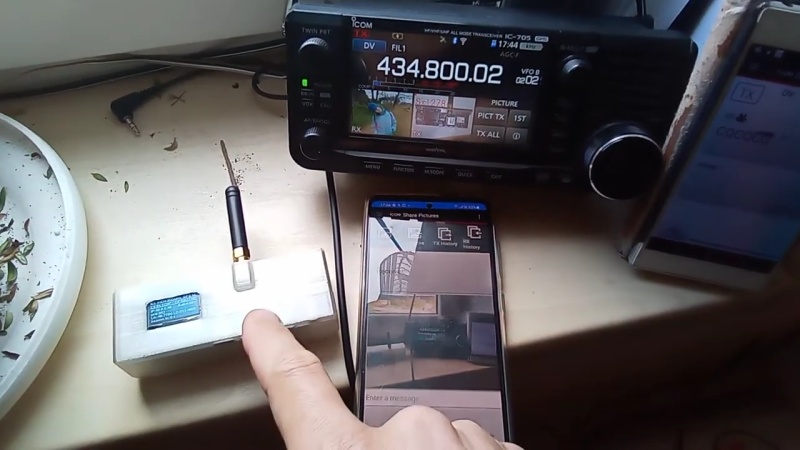
[Yeckel] recently put the finishing touches on an ambitious implementation of a simple D-STAR (Digital Smart Technologies for Amateur Radio) transceiver using some very accessible and affordable hardware. The project is D-StarBeacon, and [Yeckel] shows it working on a LilyGO TTGO T-Beam, an ESP32-based development board that includes a SX1278 radio module and GPS receiver. It even serves a web interface for easy configuration.

What is D-STAR? It’s a protocol used by radio operators for voice that also allows transmitting low-speed data, such as short text messages or GPS coordinates. While voice is out of scope for [Yeckel]’s project (more on that in a moment) it can do all the rest, including send images. That makes beacon-type functions possible on inexpensive hardware, instead of requiring a full-blown radio.

As mentioned, voice is a big part of D-STAR. While [Yeckel] was able to access the voice data, attempts to decode it were unsuccessful. A valiant effort, but we suppose voice decoding isn’t terribly relevant to beacon-type operations like transmitting APRS (Automatic Packet Reporting System).

So far as [Yeckel] is aware, D-StarBeacon is currently the only open-source implementation of a D-STAR radio available on the internet, which is pretty interesting. We’ve seen projects that touch indirectly on D-STAR, but nothing like this.

Watch it go through its paces in the video embedded below. Since the T-Beam is just a microcontroller development board, the user interface comes from an Android app on a mobile phone, which is why you see a phone in the video.

Continue reading “Simple D-STAR Transceiver Uses Inexpensive Hardware”

Examining A World’s Record From The Age Of Steam

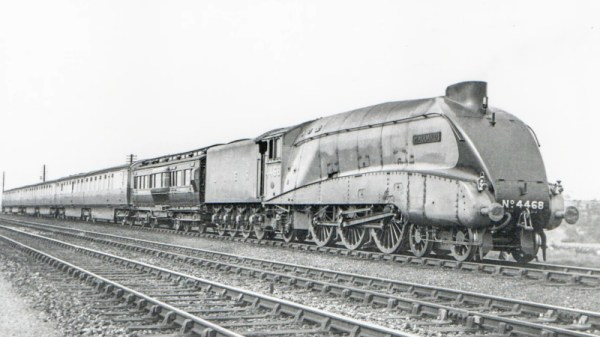
There aren’t many speed records that remain unbroken for the greater part of a century, but one of them is that of the fastest steam locomotive. As with so many such things, there’s a bit of controversy and more than one contender, but the one in the record books is the A4 Pacific, Mallard. In 1938, this locomotive thundered down an incline on the London & North Eastern Railway’s mainline in the north of England at 126 MPH. But can that number be taken as reliable? The Institute of Mechanical Engineers has a video in which they investigate.

It’s a fascinating look at the science of railway speed measurement as it existed in 1938, the record itself, and the paper dynamometer roll which recorded it. We’ve placed the video below the break, and in it, we see an in-depth analysis of the noise and inconsistencies in the recording, and see them come to the conclusion that a safer figure to quote would be 124 MPH.

Our assessment is that, of course, the LNER wanted to squeeze every morsel of publicity from it in a game of one-upmanship with their arch-rivals in the London Midland and Scottish railway, so it’s likely that their use of a momentary figure makes sense in that light. Even the best-laid 1930s jointed track would have been bumpy compared to modern continuous rail, and we are guessing that the ancient clerestory dynamometer car would hardly be as smooth-riding as a modern express coach. The achievement of measuring at all with mechanical instruments in such an environment at those speeds would have been tricky, to say the least. It leaves us wondering whether 1930s electronics could have produced some kind of trackside measurement device, but perhaps the LNER trusted their mechanical instruments more. Perhaps the Pennsylvania Railroad should have followed its example.

Continue reading “Examining A World’s Record From The Age Of Steam”