
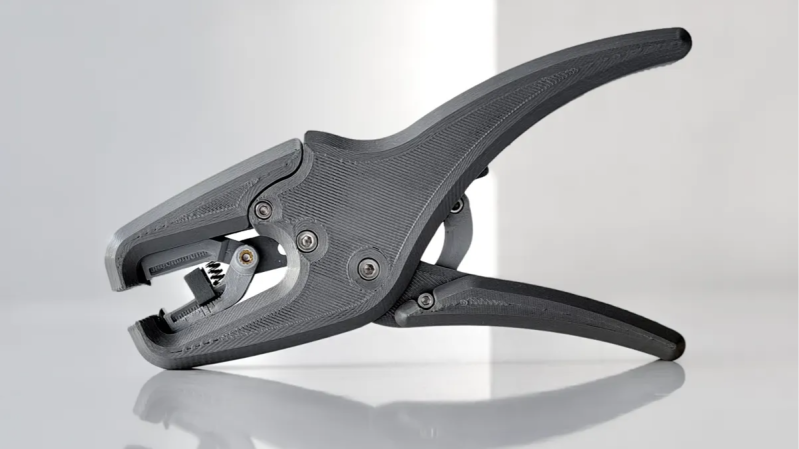
One might think that [Da_Rius]’s mostly 3D printed wire stripper would count its insulation-shearing blades among the small number of metal parts required, but that turns out to not be the case. The blades are actually printed in PLA, and seem to work just fine for this purpose. (We imagine they need somewhat frequent replacement, but still.)
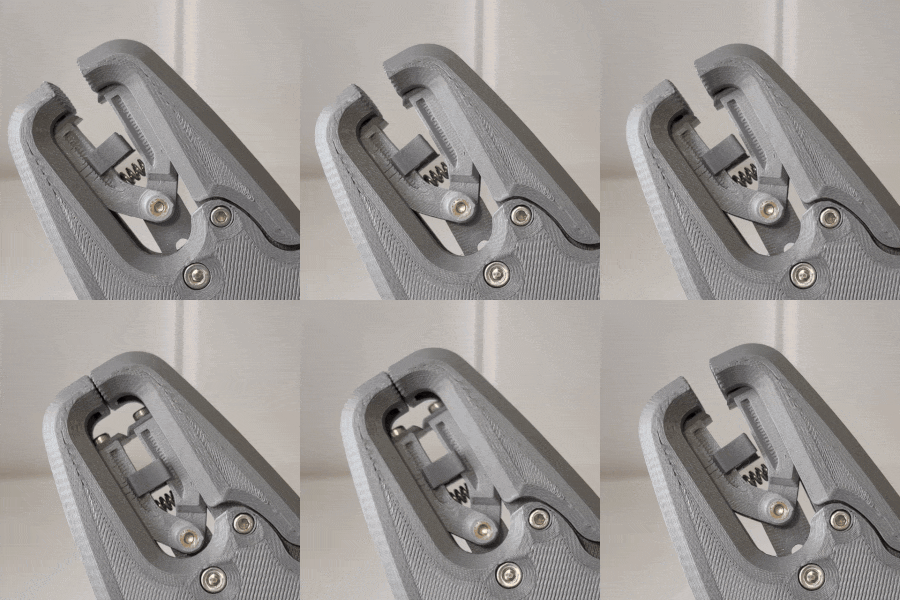 Proper wire strippers are one of the most useful tools for a budding electronics enthusiast, because stripping hookup wire is a common task and purpose-built strippers make for quick and consistent results.
As far as tools go they are neither particularly expensive nor difficult to source, but making one’s own has a certain appeal to it. The process of assembling the tool is doubtless a rewarding one, and it looks like it results in a pretty good conversation starter if nothing else.
As mentioned, the tool is mostly 3D printed and does require some metal parts: fasteners, heat-set inserts, and a couple springs. Metal nuts and heat-set inserts are easy enough to obtain, but springs of particular size and shape are a bit trickier.
It is perfectly possible to make custom springs, and as it happens [Da_Rius] already has that covered with a separate project for using a hex key and printed jig to make exactly the right shapes and sizes from pre-tempered spring wire.












The price for a wire stripper (from China, obviously) is lower than the plastic price used to print it. And it’ll be in metal.
I just loaded up the model, looks like it’ll take ~$1.70 in plastic using PETG. Seems unlikely that you’d find an automatic wire stripper shipped for that price.
but you will learned nothing from buying it.
Professor Boots was ROBBED and that is all that matters. You’d learn a lot more from his RC vehicle designs than crap 3d printed wire strippers that cost less than a kg of filament.
Yes, but building it teachs you a lot of informations.
I love those mechanical things…
“You wouldn’t download a wire stripper that uses PLA bla— oh, I guess you would.”
Actually, no I wouldn’t. I have the Knipex version of this stripper, and already had to change the metal blade assy when it stopped stripping properly. So if metal blades didn’t last forever, I’m not even considering PLA blades.
I agree; I though it was using metal blades… I guess it could be modified so.
Print the body, buy the nice Knipex blades to go in it.
Excellent! Now make it a compliant mechanism 😊
Aah yes, let’s make a PLA can opener.
Bonus: PLA blades can’t nick copper wires!
True. That’s why I hate the ones like this with straight blades. Work gave me a brand new Knipex to use but it’s in a drawer somewhere and I use this old DDR version with a bunch of holes for different sizes. The new Knipex has two straight blades and I just can’t use it without cutting a few strands no matter what I do and I don’t want to spend time messing with it when working. The old DDR version never gives me issues. It’s stamped DDR so it’s likely made pre 89 (although my 2025 storm lantern still has a western Germany stamped into it so I can’t be sure).
When the Germanys reunited all of Europe was discussing what to call it.
Except Germany, they were discussing what to call France and Poland.
Straight bladed strippers (aka toenail clippers) are fine for solid core wire.
We don’t use solid core wire, only stranded. We got entire racks filled with boxes of different wire colors and sizes, but none of that is solid core.
When I weigh making the whole thing vs ordering one… making it loses.
But if I didn’t already have a wire stripper.. maybe.. just maybe.. if it performs a lot better than it sounds it might be a good idea.
I feel that the first time you make it you lose in the time and effort vs cost of just buying one comparison. But if you can make it new again indefinitely by replacing just individual pieces as necessary that might, just might be a worthwhile strategy in the long run.
Perhaps, but still a time and a place with times when making is just better – for instance one quick project I’ll be doing now my lathe is back together is adding a scalpel blade holder to the beam compass I already own – I could get something else to cut and score the circles I’ve found I needed to cut more than once, but that is then a whole new tool, adding yet more relatively rarely needed junk to my draws making keeping the tools organised and findable even more impossible. Where adding some nice new bits to the already very handy beam compass kit..
Another case where making can win is just that repetitive problem you have – you have a batch problem and there just isn’t a tool that really does it reliably. And of course as you point out if you can just keep it going changing parts indefinitely easily, which is especially handy if this tool isn’t something you can get at the local hardware store or delivered next day.
Ordering tools is of course fine, often gets you a perfectly useable tool much faster as that R&D to get the fit, finish and working action reliable could take you a few goes. Though I would also recommend MODIFYING tools as well over entirely building your own – for instance to rebuild that lathe I really needed a circlip piler that was able to work in a much narrower space, and way way tougher than the pliers I had – managed to get it done with a new set, but even that barely fitted, so now the lathe is back together so i can I’ll also be making a new set of teeth for my pliers that will fit that space easily, just in time to never need them again of course…