
With Affordable Storage Options Dwindling, Where To Store Our Data?

These days our appetite for more data storage is larger than ever, with video files larger, photo resolutions higher, and project files easily zipping past a few hundred MB. At the same time our options for data storage are becoming more and more limited. For the longest time we could count on there always being a newer, roomier, faster, and cheaper form of storage to come along, but those days would seem to be over.

We can look back and laugh at low capacity USB Flash drives of the early 2000s, yet the first storage drive to hit 1 TB capacity did so in 2007, with a Hitachi Deskstar 7k100, only for that level of capacity in PCs to not really be exceeded nineteen years later.

We also had Blu-ray discs (BD) promise to cram the equivalent of dozens of DVDs onto a single BD, with two- and even four-layer BDs storing up to a one-hundred-and-twenty-eight GB. Yet today optical media is dying a slow death as the sole remaining cheap storage option. NAND Flash storage has only increased in price, and the options for those of us who have large cold storage requirements would seem to be decreasing every day.

So what is the economical solution here? Invest in LTO tapes using commercial left-overs, or give up and sign up for Cloud Storageā„¢ for the low-low price of a monthly recurring fee?

Continue reading “With Affordable Storage Options Dwindling, Where To Store Our Data?”
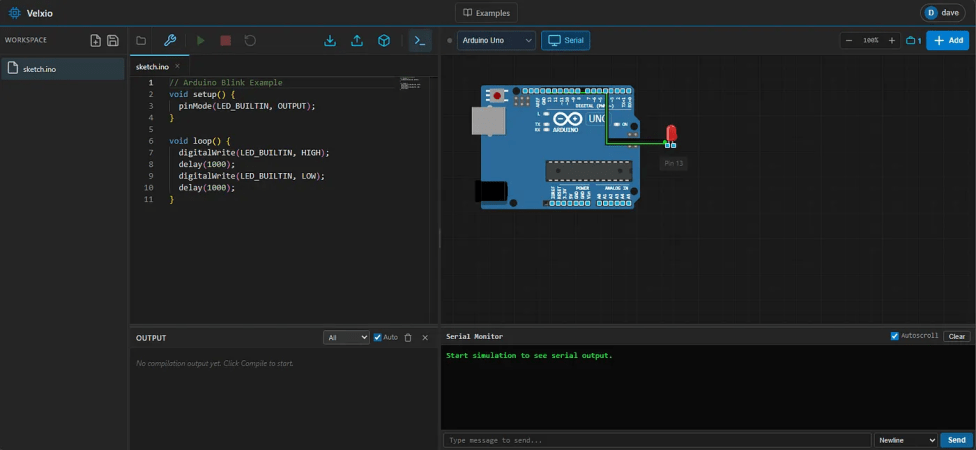
Simulating The AVR8 For A Browser-based Arduino Emulator

It’s always nice to simulate a project before soldering a board together. Tools like QUCS run locally and work quite well for analog circuits, but can fall short with programmable logic. Tools like Wokwi handle the programmable side quite well but may have license issues or require the cloud. The Velxio project by [David Montero Crespo] is quite an excellent example of an (online) circuit simulator with programmable logic and local execution!

It’s built largely around Wowki’s AVR8JS library for Arduino simulation. All CPU simulation occurs on the local computer, while sketch compilation happens on the backend using official Arduino tools. But this was certainly not the most impressive aspect of the project. Likewise, Velxio features RP2040 execution using the rp2040js library. It also features the execution of some ESP32 derivative boards built around the RISC-V architecture using the RiscVCore.ts library.

Continue reading “Simulating The AVR8 For A Browser-based Arduino Emulator”

Flying Cell Towers For Lower-Latency

When the inevitable Kessler Syndrome cascade sweeps Starlink and its competitors from Low Earth Orbit in what will doubtless be a spectacular meteor shower of debris, the people behind Sceye and its competitors are going to be laughing to the bank. That’s because they’re putting their connectivity rather lower than orbit — in the stratosphere, with high-altitude dirigibles.

The advantages are pretty obvious: for one, the dirigible isn’t disposable in the way the very-low-orbit satellites Starlink and its planned imitators use. For another, the time-of-flight for a signal to get to a dirigible 20 km up is less than a tenth of the time it takes to get 480 km up — and that affects latency. Thirdly, the High Altitude Platform System (HAPS) concept won’t require any special transmitters. Regular cellular modems using ordinary 4G and 5G bands and speeds are usable, which eliminates a big barrier to rollout.

Continue reading “Flying Cell Towers For Lower-Latency”