
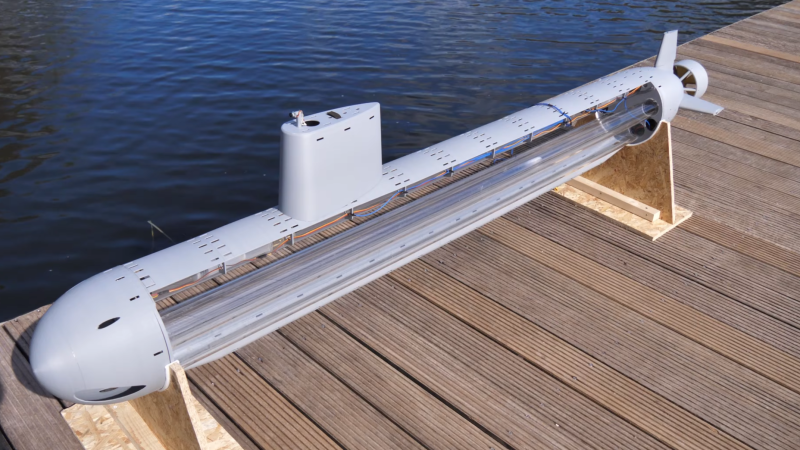
Of all the remote-control vehicles one can build, a submarine is possibly the hardest: if something goes wrong with almost any other vehicle, it’s easy to recover and repair, but a submarine is a very different affair. This nearly lost [James] of [ProjectAir] his latest project, a 2.7-meter long RC submarine, but it survived to make a few test sails.
Before building the full version, [James] made a test prototype. These submarines use large syringes as ballast tanks, pulling water in and out of the submarine body. The plungers are driven by a lead screw, and have a linear potentiometer for feedback. This can be wired in the same way as a servo motor, making it compatible with the RC controller. The controller receives its signal from an antenna in a buoy tethered to the submarine. Since initial tests worked well, [James] moved on to the full-scale model.
This was made out of radially-arranged acrylic tubes, with all but the top tube left open to the water. At the back of the submarine there were servo-actuated fins and a propeller, which would allow it to steer, ascend, and descend underwater. To waterproof the servo motors, [James] sealed them as much as possible, then filled them with oil. The other water-exposed electronics were either potted in epoxy or coated with a waterproofing compound. During testing, the submarine descended without issue, but was reluctant to resurface. Most of the external components had been 3D printed, and water infiltrated the infill below a certain depth. [James], however, managed to recover it before it was permanently lost, and managed to make a few other dives at a very limited depth.
On the other end of the spectrum from an RC submarine, we’ve also seen a rubber band-powered submarine. We’ve also seen a smaller, but more dive-ready RC submarine.
Thanks to [H Hack] for the tip!












I think [James’] employee (or partner?) [Emma] deserves to be named too!
I’m thinking of an emergency flotation device: vinegar in a small balloon, inside larger balloon with baking soda. The vinegar balloon is pinched shut magnetically from the outside with a bit of steel and an electromagnet on the sub. The onboard micro turns off the magnet if an emergency command is received, no commands are received within some time, or power is lost.
or just tether the device with a fishing line for easy recovery during tests.
A simpler and probably more reliable approach would be magnetically attached steel ballast. That’s similar to what’s done on most deep sea bathyscaphes. They use hoppers full of ballast with an electromagnetically held door on the bottom which can be commanded to open, but will also automatically open on power loss.
Not recyclable, posibble pollution generating, not very energy efficient, one shot usable only. For extreme use maybe acceptable. Huf:)
That’s why it’s am Emergency solution.
The airbags in my car are very expensive, damage the interior and might even be polluting the environment, so I try to avoid using them.
You’re not wrong.
Steel rings with strings attached to the sub?
The strings are long enough that even hitting the bottom the sub would still surface?
You can retrieve everything,.
The simplest version doesn’t even need electronics. A compressed air cartridge is attached to a valve with a mechanical timer. When it reaches 0, the path is opened so the compressed air blows all the water out of the dive tanks.
This is just the inverse of the system I always install on my gas grills because I’m too forgetful to turn them off. (A mechanical timer that seals off the gas line when it reaches 0).
What if you forget to install the system?
Or a balloon and a c02 cartridge and valve may be a good way that is less messy and likely to go wrong. Or have one of the water filled tubes have a plunger and the c02 cartridge so it can forcefully eject some water.
In some experiments with 3D printed underwater stuff I’ve done I’ve actively used the internal structure of prints to effect buoyancy. If you use a gyroid infill then the internal structure remains one complete continuous void and as such if you add holes to the external walls you can flood entire 3D print sections on purpose. It’s a similar idea to seaperch concepts where they flood the PVC tubing in the vehicle frames. Obviously you still need some waterproof sections etc.
Magnets to drive the propellers so it’s waterproof and use a small CO2 cartridge with a screw valve servo motor into a rubber bladder
it strikes me that giving the entire outer hull a simple coat of wax would help waterproof it by filling in the microscopic holes and gaps.
Or you could print the outer parts out of ABS and then vapour smooth them, or even just lightly pouring on some acetone might be enough to smooth them, I have done that before for repairing a non 3d printed ABS part, it made it very smooth and shiny.
I mean, make it slightly lighter than required for balance (floats by default) and add a respective weight that gets dropped on connectivity loss or command, no?
I wouldn’t trust layer lines to be water proof, at least not with out a layer of sealant. There’s several waterproof varnishes on the market that can fill the spaces and even make it food safe within reason.
this video could be titled: things you shouldn’t use 3d printing for. it’s a lot more than just the water proofing, every aspect of the 3d printed components is carefully chosen to be best performed by another process.
Criticism without offering alternatives isn’t very helpful. What would have been better to build the prototype?
I watched the whole video – it was great! I also thought there was too much reliance on 3D printing. Eg. I would have made the rudders out of 2mm stainless steel sheet – there’s no need for the elaborate fluid friendly shapes IMO.
BTW …. it was nice that the video wasn’t littered with super annoying and irrelevant ads. The hardwired ad for PCBWay was ok as i could skip it fairly easily and it was actually fairly relevant.
dude printed longitudinal beams. dude used several rolls of filament for one project. i know this sort of crap is popular but if you’re using 3d printing like that, it’s always gonna expose you to more downside than upside. it’s not just a question of what else he could have used, it’s more like, why do you only use a single process and don’t even know what it’s good for?
i mean, the answer is clear, it’s a rational optimization for the clicks
RC subs are a thriving corner of the RC universe and while not at all solved entirely, many of the problems are mitigated significantly.
Most systems use either a “wet hull” or a dry hull. For 3d printed, a “wet hull” design where the outside doesn’t have to be waterproof would be best. All the electronics, guts, etc live in a smaller sealed pressure hull and there are commercial versions of this. admittedly not as fun as roll your own though. Waterproofing one thing much easier (not easy.. easier) than waterproofing many things, and fixing something is easier instead of cased in epoxy, oil, whatever.
.
Deadman switches, auto-inflating buoys etc also exist and are a thing. Backups that simply blow ballast .. lots of way to avoid a lost sub. But driving your sub in a shallow lake or pond where you can wade or kayak out for retrieval … if you can find it, ounce of prevention pound of cure. Once below periscope depth in anything but a swimming pool and you can’t see it anyway.
.
Used to be older FM radios were best and penetrated lake water well enough were used. No surface antenna (via buoy) needed. Modern GHz digital transmitters don’t penetrate water at all. Very recently digital lower frequency transmitters were developed that I haven’t messed with.
Rub it down with surf wax. Mr Zog’s stickers on the big holes. Works for me :)