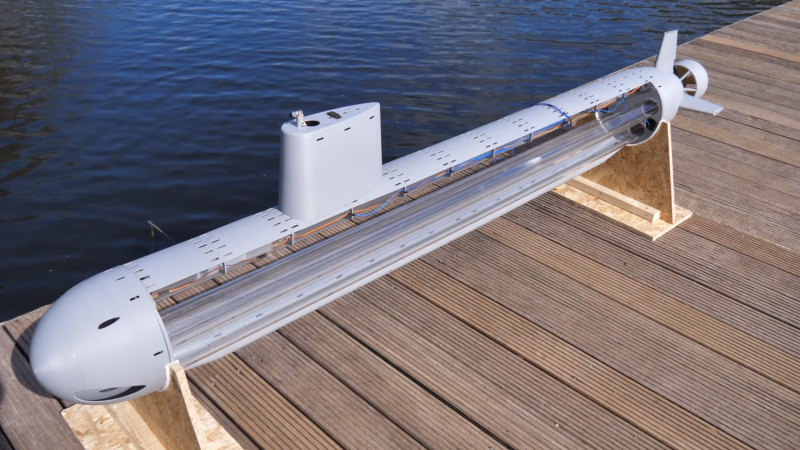
A model submarine is shown on a dock. The body of the submarine is made out of a series of acrylic tubes, with other parts made out of grey plastic.

3D-Printed Parts Nearly Sink RC Submarine

Of all the remote-control vehicles one can build, a submarine is possibly the hardest: if something goes wrong with almost any other vehicle, it’s easy to recover and repair, but a submarine is a very different affair. This nearly lost [James] of [ProjectAir] his latest project, a 2.7-meter long RC submarine, but it survived to make a few test sails.

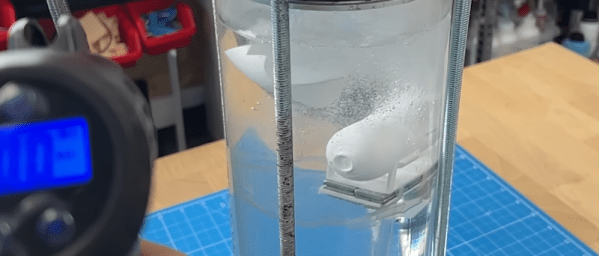
Before building the full version, [James] made a test prototype. These submarines use large syringes as ballast tanks, pulling water in and out of the submarine body. The plungers are driven by a lead screw, and have a linear potentiometer for feedback. This can be wired in the same way as a servo motor, making it compatible with the RC controller. The controller receives its signal from an antenna in a buoy tethered to the submarine. Since initial tests worked well, [James] moved on to the full-scale model.

This was made out of radially-arranged acrylic tubes, with all but the top tube left open to the water. At the back of the submarine there were servo-actuated fins and a propeller, which would allow it to steer, ascend, and descend underwater. To waterproof the servo motors, [James] sealed them as much as possible, then filled them with oil. The other water-exposed electronics were either potted in epoxy or coated with a waterproofing compound. During testing, the submarine descended without issue, but was reluctant to resurface. Most of the external components had been 3D printed, and water infiltrated the infill below a certain depth. [James], however, managed to recover it before it was permanently lost, and managed to make a few other dives at a very limited depth.

On the other end of the spectrum from an RC submarine, we’ve also seen a rubber band-powered submarine. We’ve also seen a smaller, but more dive-ready RC submarine. Continue reading “3D-Printed Parts Nearly Sink RC Submarine”
Powering A Submarine With Rubber Bands

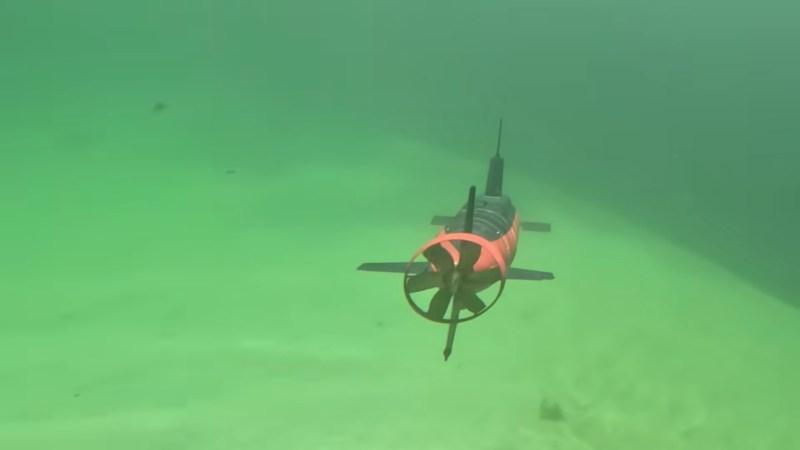
A look underneath the water’s surface can be fun and informative! However, making a device to go under the surface poses challenges with communication and water proofing. That’s what this rubber band powered submarine by [PeterSripol] attempts to fix!

The greatest challenge of building such a submersible was the active depth control system. The submarine is slightly negatively buoyant so that once the band power runs out, it returns to the surface. Diving is controlled by pitch fins, which will pitch downward under the torque applied by the rubber bands. Once the rubber band power runs out, elastic returns the fins to their natural pitch up position encouraging surfacing of the submarine. However, this results in uncontrolled dives and risks loss of the submersible.

Continue reading “Powering A Submarine With Rubber Bands”

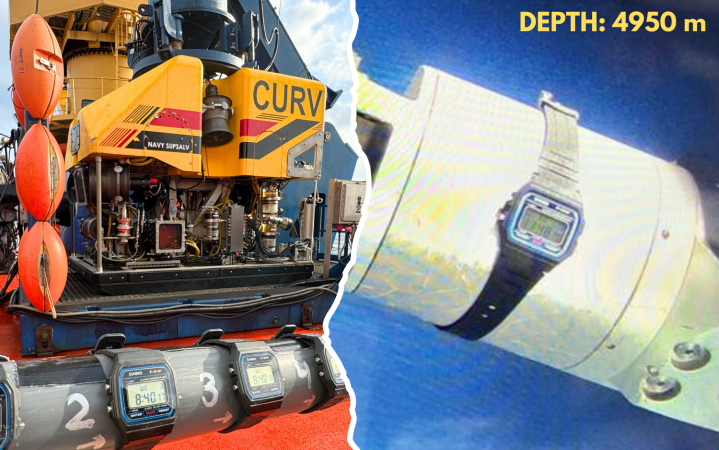
Taking A $15 Casio F91W 5,000 Meters Underwater

When considering our favorite spy movies and kin that involve deep-sea diving, we’d generally expect to see some high-end watch that costs thousands of dollars and is specially engineered to withstand the immense pressures kilometers below the ocean’s surface. Yet what about a humble Casio F91W that can be bought for about $15 if it’s the genuine article and not one of the millions of fakes? Over at the Watches of Espionage site they figured that they’d dress up one of these famous watches to give it the best possible shot at surviving the crushing pressures at a depth of 5 km.

The actual modification to the F91W was pretty mild, involving nothing but a ‘hydro-mod’ whereby oil is used to replace the air inside the watch case. Since oil is incompressible, nothing bad should happen to the watch. Theoretically at least. The Watch-Under-Test (WUT) was strapped to a US Navy’s CURV 21 remotely operated vehicle and dunked into the ocean before starting its descend into the inky darkness of the deep sea.

Although only hitting a measly 4,950 m, the watch survived just fine, showing that even if you’re a secret US operative on a deep-dive espionage mission, all you really need is one of these Casio watches.

Extreme Waterproof 3D Prints

Since the crew at [CPSdrone] likes to build underwater drones — submarines, in other words — they need to 3D print waterproof hulls. At first, they thought there were several reasons for water entering the hulls, but the real reason was that water tends to soak through the print surface. They’ve worked it all out in the video below.

Since the printer is an FDM printer, it isn’t surprising that the surface has tiny pores; even the tiniest pores will let water in at high pressure. They tried using epoxy to seal the prints, which worked to some degree. They did tests using an example submersible hull that you can try yourself if you like.

Continue reading “Extreme Waterproof 3D Prints”

Flying Submarine Documentary Is A Story Of Defied Assumptions

Donald Reid had a passion for applying himself to challenging problems, and in many ways his life’s work was that of developing a prototype submersible aircraft — or flying submarine — for which his son Bruce was a test pilot. [Jesse Moody] brought to our attention a fantastic documentary he created (with a short teaser trailer here) in which he interviews Bruce, and in the process teaches us all about a story that spanned decades and formed an important part of aviation history. Bruce experienced his share of hair-raising moments while testing the craft, but still has all of his fingers and limbs. Still, in his own words, “you wouldn’t be doing that kind of testing today!”

In many ways, the story revolves around defying assumptions. Without context, a “flying submarine” project might sound like a lone kook’s obsession, but Donald Reid was nothing of the sort. He was a brilliant engineer who was able solve problems by applying his skill and intellect with a laser-like focus. And it turns out that getting a submerged vehicle to successfully transition from waterbound craft to airborne is a source of numerous and novel problems that were not trivial to solve. In fact, these problems needed to be solved in order to develop the Tomahawk cruise missile, which is launched by submarine. And that brings us to the lawsuit that bookended it all.

Continue reading “Flying Submarine Documentary Is A Story Of Defied Assumptions”

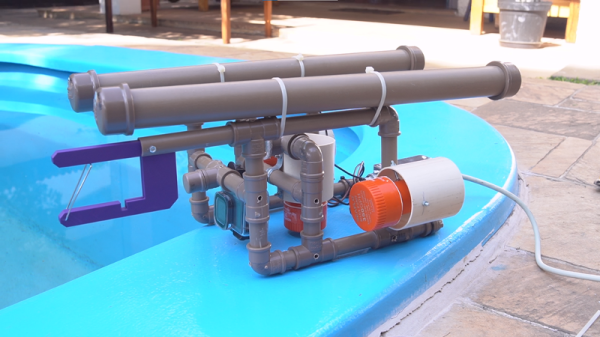
We All Live In A PVC Submarine

We doubt you could really live in [Pena’s] PVC submarine, but now the song’s stuck in our head anyway. Although the post is in Portuguese, you can get a pretty good idea of how it works, and translation software is better than ever. Transcending the language barrier, there are videos of just about every step of the construction. We didn’t, however, find a video of the vehicle in the water.

The plumber’s delight has modified motors for thrusters, and a camera as well. Epoxy potting keeps things waterproof. We’ve seen candle wax used for the same purpose in other builds.

Continue reading “We All Live In A PVC Submarine”

Build Your Own Submarine

If you are tried of building things that fly, why not try a submarine like [DIYPerks] did? As you can see in the video below, the key is to control buoyancy, and the mechanism used is impressive. The sub has two giant syringes fore and aft to compress or decompress water. The plungers are now 3D-printed actuators that travel on a lead screw. Two high-torque motors and some batteries sandwiched in acrylic disks make up the rest. This is a big vessel — you won’t be trying this in your bathtub and maybe not even your pool unless it is a big one.

Of course, everything needs to be watertight. Instead of trying to waterproof a power switch, this sub uses a reed switch so that a nearby magnet can turn it on. Not an original idea, but we always think it is more elegant than seals and potting compounds.

Continue reading “Build Your Own Submarine”