
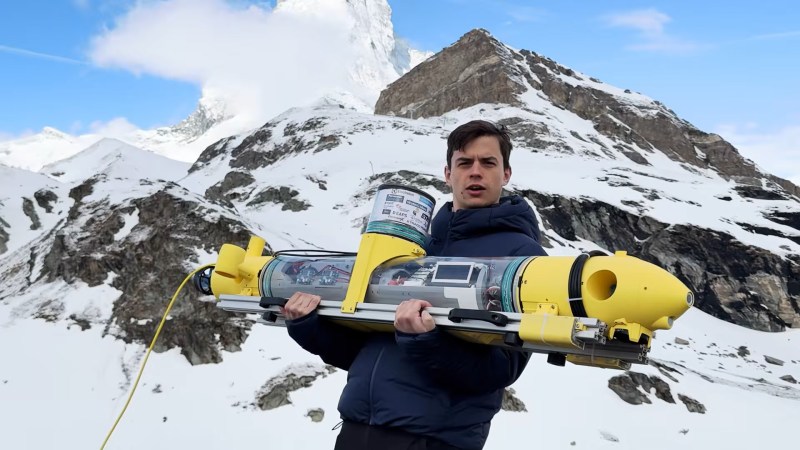
Submersible Drone Analyzes Ice

Doing anything on a frozen lake can carries some amount of risk. Nevertheless, every year events ranging from car racing to ice skating are held on them. As such, proper safety precautions are needed, the most important of which is ensuring the ice is thick enough to withstand the weight of whatever may be on it. This is done by cutting holes into the ice and measuring its depth in several locations. But this is a dangerous and imperfect process only giving a rough picture of actual thickness. So to solves these problems, a team of students at ETH Zurich made an ice measuring submersible drone. 

The concept of ice measurement employed is, on paper, reasonably simple. When a sonar pulse is sent out, some of the energy will return off the bottom of the ice sheet, but some of it will pass through creating a second return. By measuring the difference in these two returns, the thickness can be calculate with a high degree of precision. Attach the sonar to a submersible and give it a positioning system and you can simply get a thickness map, right? Well, employing theory in practice is a far more complicated prospect as the students soon found out.
Continue reading “Submersible Drone Analyzes Ice”
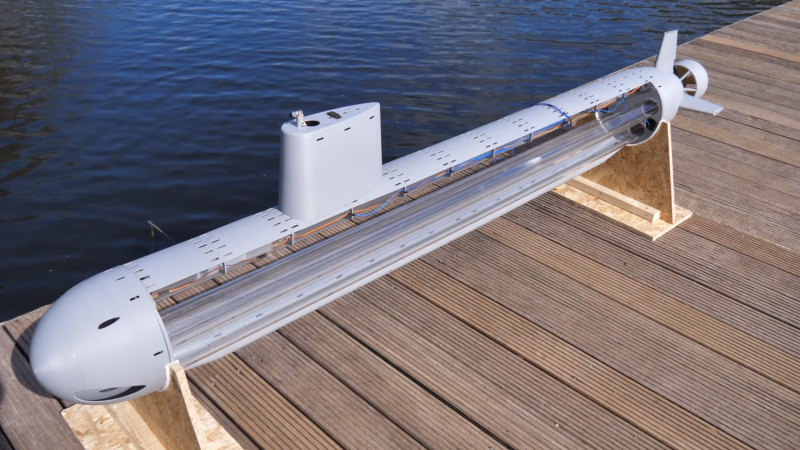
A model submarine is shown on a dock. The body of the submarine is made out of a series of acrylic tubes, with other parts made out of grey plastic.

3D-Printed Parts Nearly Sink RC Submarine

Of all the remote-control vehicles one can build, a submarine is possibly the hardest: if something goes wrong with almost any other vehicle, it’s easy to recover and repair, but a submarine is a very different affair. This nearly lost [James] of [ProjectAir] his latest project, a 2.7-meter long RC submarine, but it survived to make a few test sails.

Before building the full version, [James] made a test prototype. These submarines use large syringes as ballast tanks, pulling water in and out of the submarine body. The plungers are driven by a lead screw, and have a linear potentiometer for feedback. This can be wired in the same way as a servo motor, making it compatible with the RC controller. The controller receives its signal from an antenna in a buoy tethered to the submarine. Since initial tests worked well, [James] moved on to the full-scale model.

This was made out of radially-arranged acrylic tubes, with all but the top tube left open to the water. At the back of the submarine there were servo-actuated fins and a propeller, which would allow it to steer, ascend, and descend underwater. To waterproof the servo motors, [James] sealed them as much as possible, then filled them with oil. The other water-exposed electronics were either potted in epoxy or coated with a waterproofing compound. During testing, the submarine descended without issue, but was reluctant to resurface. Most of the external components had been 3D printed, and water infiltrated the infill below a certain depth. [James], however, managed to recover it before it was permanently lost, and managed to make a few other dives at a very limited depth.

On the other end of the spectrum from an RC submarine, we’ve also seen a rubber band-powered submarine. We’ve also seen a smaller, but more dive-ready RC submarine. Continue reading “3D-Printed Parts Nearly Sink RC Submarine”

The Hunt For Red October In A Bathtub

Anything can be a remote controlled airplane, and ‘copters – quad or not – simply beat the air into submission. Remote controlled cars are easy, and RC tanks can even shoot their guns. One type of vehicle has eluded remote control hobbyists to a large extent; building a remote control submarine is hard. Not only do you have buoyancy to worry about, but you also need a way to keep the dry parts dry, all while operating in an environment where radio doesn’t really work well.

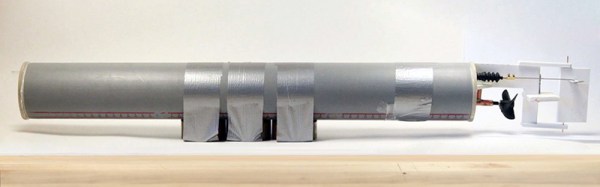
[Ivan] has already built RC planes, but wanted to tackle a new challenge. He built an RC submarine, and he did it using the simplest household materials.

Continue reading “The Hunt For Red October In A Bathtub”









