
Reverse-Engineering An Amazon Blink Gen 3 Camera

After some water intrusion apparently killed one of [electronupdate]’s Amazon Blink Gen 3 cameras he took this opportunity to do a full teardown and analysis of all the major components. Spread across its three PCBs there are no fewer than two wireless ICs and a custom ASIC for all the major processing. There’s also a blog post with easy-to-ogle pictures.

The most basic PCB is effectively just a PCB antenna for the Silicon Labs EZR32 IC on the main PCB, using which the ~915 MHz connection with the central hub is maintained. The other smaller PCB is a bit surprising in that it contains a Cypress CYW43438 W-Fi b/g/n and BT 5.1 chip. This would seem to be used for the setup process, but considering that it also uses a central hub it is a bit of a mystery as to what it is used for exactly.

Finally, the main PCB contains all the major parts, with the custom Amazon Immedia ASIC that’s an integral part of this very low-power camera. Given that two AA cells being enough to run the camera for about two years, using off-the-shelf parts probably wasn’t good enough without some serious customization.

As for why this outdoors-rated camera failed after a few years in the outdoors, the reason appears to be water intrusion via the speaker opening. As for why a camera needs a speaker and not just the microphone is left as an exercise to the reader, but maybe it could be useful for yelling at the local kids to get off your darn lawn?

Continue reading “Reverse-Engineering An Amazon Blink Gen 3 Camera”
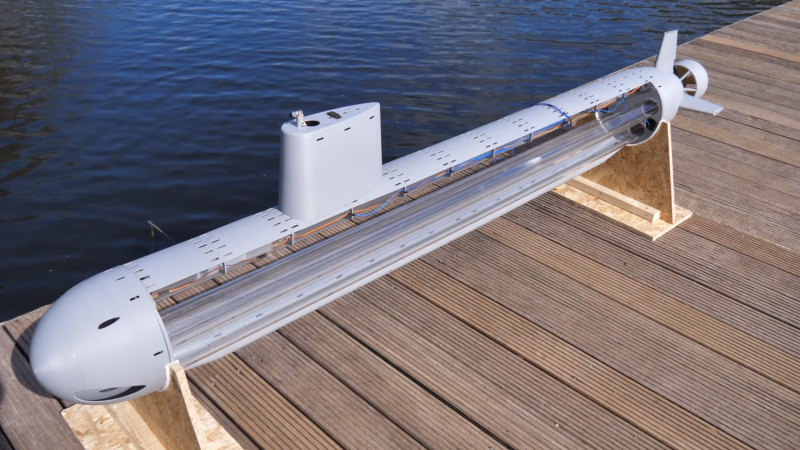
A model submarine is shown on a dock. The body of the submarine is made out of a series of acrylic tubes, with other parts made out of grey plastic.

3D-Printed Parts Nearly Sink RC Submarine

Of all the remote-control vehicles one can build, a submarine is possibly the hardest: if something goes wrong with almost any other vehicle, it’s easy to recover and repair, but a submarine is a very different affair. This nearly lost [James] of [ProjectAir] his latest project, a 2.7-meter long RC submarine, but it survived to make a few test sails.

Before building the full version, [James] made a test prototype. These submarines use large syringes as ballast tanks, pulling water in and out of the submarine body. The plungers are driven by a lead screw, and have a linear potentiometer for feedback. This can be wired in the same way as a servo motor, making it compatible with the RC controller. The controller receives its signal from an antenna in a buoy tethered to the submarine. Since initial tests worked well, [James] moved on to the full-scale model.

This was made out of radially-arranged acrylic tubes, with all but the top tube left open to the water. At the back of the submarine there were servo-actuated fins and a propeller, which would allow it to steer, ascend, and descend underwater. To waterproof the servo motors, [James] sealed them as much as possible, then filled them with oil. The other water-exposed electronics were either potted in epoxy or coated with a waterproofing compound. During testing, the submarine descended without issue, but was reluctant to resurface. Most of the external components had been 3D printed, and water infiltrated the infill below a certain depth. [James], however, managed to recover it before it was permanently lost, and managed to make a few other dives at a very limited depth.

On the other end of the spectrum from an RC submarine, we’ve also seen a rubber band-powered submarine. We’ve also seen a smaller, but more dive-ready RC submarine. Continue reading “3D-Printed Parts Nearly Sink RC Submarine”









