
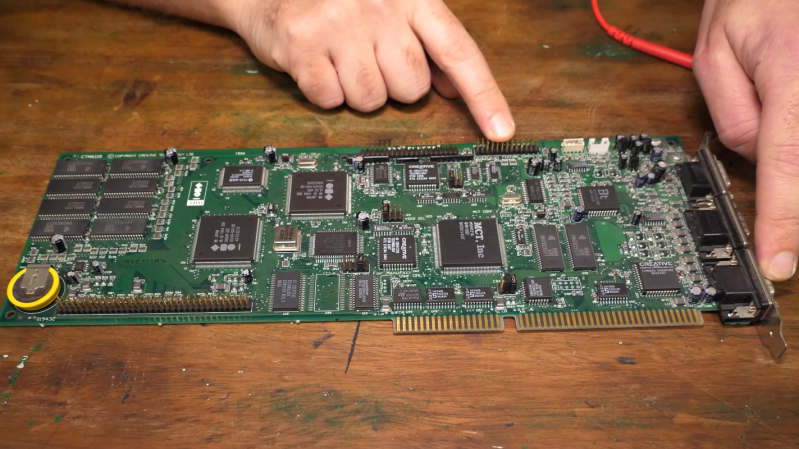
Before the modern trifecta of video game giants came to dominate the market around two decades ago, the world was awash in video game consoles. Many of these retro platforms have largely been forgotten outside of the enthusiast communities, and an average gamer today might not have ever heard of brands like ColecoVision or TurboGrafx. Among these unusual, rare, or forgotten systems was the 3DO which wasn’t strictly a console but rather a specification that manufacturers could use to make consoles on their own. But even more unusual was that this standard could be used to build 3DO-compatible expansion cards for PCs as well.
In this video, [The Retro Collective] received one of these boards to add to their museum, but like much retro hardware of this era it wasn’t working exactly like it would have out-of-the-box. After adding it to one of their period-correct 386 machines of the time, they found that it would only work properly with weight applied at one of the corners. This led to the discovery of some disconnected pins on the PCB, and a repair of that and some other issues brought the card back to life again.
The video also discusses the platform itself and shows how it would connect to a PC from that time. The PC would have needed a Sound Blaster card, a CD ROM drive with a particular proprietary interface, and a few other hardware requirements, but with everything up and working the player would have a console that theoretically competed with the original Playstation or Nintendo 64. It also illustrates an alternative path video games might have taken where expansion cards added console compatibility to any modern PC, but unfortunately the 3DO never really caught on.












Thank you very much for featuring our video! The 3DO Blaster will be put through its paces by visitors to the Retro Collective this weekend.
3DOA as Space Quest 6 eloquently put it.
These cards were available starting sometime in 1993 to 1994… a 386 is not a period-correct system for that year range. Yes, they were still being widely used, but the 386 was severely outdated by 2 generations at that time. the Intel Pentium (aka 586/P5, the successor of the 486, which was the successor of the 386) released in 1993 as well. In other words, a period-correct rig for the target consumer would have most-likely been a first generation (486SX/DX from 25MHz to maybe 40MHz) or mid-generation 486 (most likely some variant of a DX2/SX2/66MHz or possibly an overclocked DX2/80MHz, either being on the high-end), and if you knew/are Daddy Warbucks (which you most likely are if you bought a 3DO expansion card, these cards were somewhere around $500-$700 at the time, IIRC), you would’ve used a first generation Socket 5 Pentium 60MHz or 66MHz, complete with F00F and FDIV bugs! Apologies to the historians – my dates and numbers are best-IIRCs.
Also, mad-props to rasz_pl’s Space Quest 6 reference! Just did a playthrough last month using a new-to-me MT32 for music on a 1st gen Pentium 60MHz rig (Packard Bell Force 341CD). Strangely, I got nearly every possible “crash” the game can have – the Deepship86 transporter crash, Sydney’s Shuttle FMV crash, Delta Burksilon V FMV crash…. yikes!
I dunno, personally I would say a 386 would be fine as far as being period correct, during this time frame the majority of people did not own a 486 let alone a Pentium, they were incredibly expensive during the 93-94 time frame. The 3DO card was $399 at release, didn’t have one but I remember seeing them in the catalogs at the time.
Pentium system back then was in the $3-4k range at minimum and they went up a lot from there if it was more than bare bones, and 486 systems were not usually substantially cheaper. At todays prices (AI related inflation aside) this would be like someone buying well spec’d Thread-ripper or Mac Pro system.
Something like a 386DX/40 was competitive with a low end 486 and a lot more affordable.
Hi, I think there was a lot of diversity in the 90s.. Technology evolved so fast.
Many users assembled their first PCs from whatever parts they could find.
Personally, I even noticed late 286 PCs, still.
In early 90s, they still had been advertised in catalogs of mail order companies in my country.
With VGA graphics, MS-DOS 5/Windows 3 and 40 MB IDE HDDs or so.
And 286 pizza box systems had a second life as disk less PCs in Novell networks, I think.
Anyway, the site DOS Days has a “per year” category for PCs and graphics cards.
It lists low, mid and high-end PC systems, from an UK perspective mainly, of course.
https://www.dosdays.co.uk/topics/typical_pc_per_year.php
https://www.dosdays.co.uk/topics/graphics_cards_per_year.php
True. In late 91 our first PC was a 286 with VGA graphics. My parents could not afford anything more expensive. Later we had it running Windows 3.1!
The 386DX-40 system definitely was period-correct for early to mid-90s, I think.
At the time, very compact Baby-AT motherboards had been made.
Windows 95 RTM ran fine on them, too.
Here’s a fine review about the 386DX-40: https://www.redhill.net.au/c/c-4.php
Hi! The 386DX-40 system was definitely period-correct for early to mid-90s, I think.
It attracted mainly non-gaming people who looked for a solid alternative to an entry-class 486.
The money saved could then be invested into RAM expansion or a CD-ROM drive etc.
At the time, the current 386 motherboards were very modern, very compact Baby AT models, I remember.
These 386 systems usually ran very stable and didn’t get as hot as 486 systems did.
Many plastic versions of the am386 CPU had the Windows 3.1 logo printed on it. Windows 95 RTM ran on them, too.
Here’s a fine review about the 386DX-40: https://www.redhill.net.au/c/c-4.php
I was glad to have my 8086/8087 in the early 90’s :)
Smoking at ~10MHz….HA
Running Hamcom with my homebrew 741 opamp modem on the ol Alda 103A….
Doing RTTY and AMTOR/SITOR. Ohhhh…those were the days.
Ohhh….Grayscale monitor :)
A Turbo XT? Cool! The XT technology was still in use in embedded sector and in ultra portable handheld PCs (Poqet PC, HP 200LX, Olivetti Quadermo etc).
They’ve used NEC V30 to V60 processors, I think.
Compact XT motherboards with NEC V20 (or V30 sometimes) were still usable by the time.
With a NEC chip, there was limited 80286 compatibility.
DOS software that ran in Real-Mode and didn’t touch the AT keyboard controller worked on both NEC V20/V30 XTs and 80286 ATs.
VGA/SVGA card was the main upgrade needed by late XT owners, I think.
Followed by an AdLib/SB card and an EMS/UMB card (due to lack of XMS and EMM386).
While many early 90s applications/games supported “EGA/VGA”, simply having a bog standard VGA card was less of a hassle.
Being able to use all modes on a cheap VGA monitor (even mono) alone was worth it, I think.
Last but not least, CGA and Hercules were still better supported at the time than deserved. ;)
There were special builds of games for CGA users, I remember.
The CGA version either was on a separate floppy or had to be ordered.
Or it had to be downloaded separately (Commander Keen CGA comes to my mind).
And we had the SIMCGA to run CGA programs on a Hercules.