Restoring A 3DO Blaster Card From The Early 90s

Before the modern trifecta of video game giants came to dominate the market around two decades ago, the world was awash in video game consoles. Many of these retro platforms have largely been forgotten outside of the enthusiast communities, and an average gamer today might not have ever heard of brands like ColecoVision or TurboGrafx. Among these unusual, rare, or forgotten systems was the 3DO which wasn’t strictly a console but rather a specification that manufacturers could use to make consoles on their own. But even more unusual was that this standard could be used to build 3DO-compatible expansion cards for PCs as well.

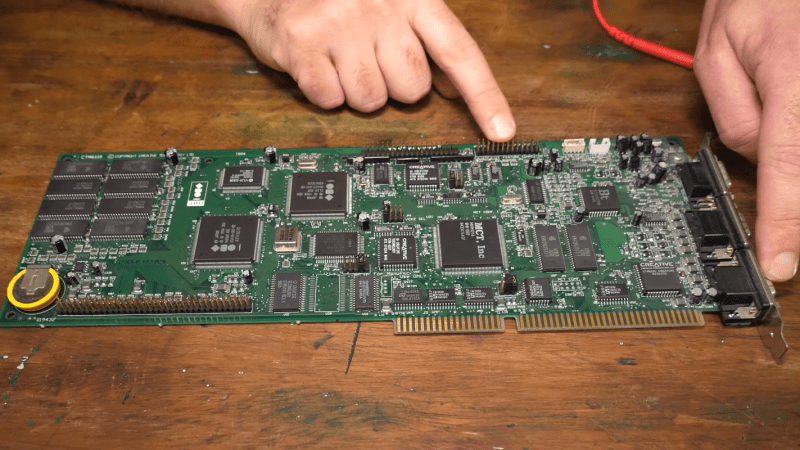
In this video, [The Retro Collective] received one of these boards to add to their museum, but like much retro hardware of this era it wasn’t working exactly like it would have out-of-the-box. After adding it to one of their period-correct 386 machines of the time, they found that it would only work properly with weight applied at one of the corners. This led to the discovery of some disconnected pins on the PCB, and a repair of that and some other issues brought the card back to life again.

The video also discusses the platform itself and shows how it would connect to a PC from that time. The PC would have needed a Sound Blaster card, a CD ROM drive with a particular proprietary interface, and a few other hardware requirements, but with everything up and working the player would have a console that theoretically competed with the original Playstation or Nintendo 64. It also illustrates an alternative path video games might have taken where expansion cards added console compatibility to any modern PC, but unfortunately the 3DO never really caught on.

Continue reading “Restoring A 3DO Blaster Card From The Early 90s”
Left: old and busted. Right: New hotness.

Game Of Theseus Gets Graphics Upgrade, Force Feedback 30 Years On

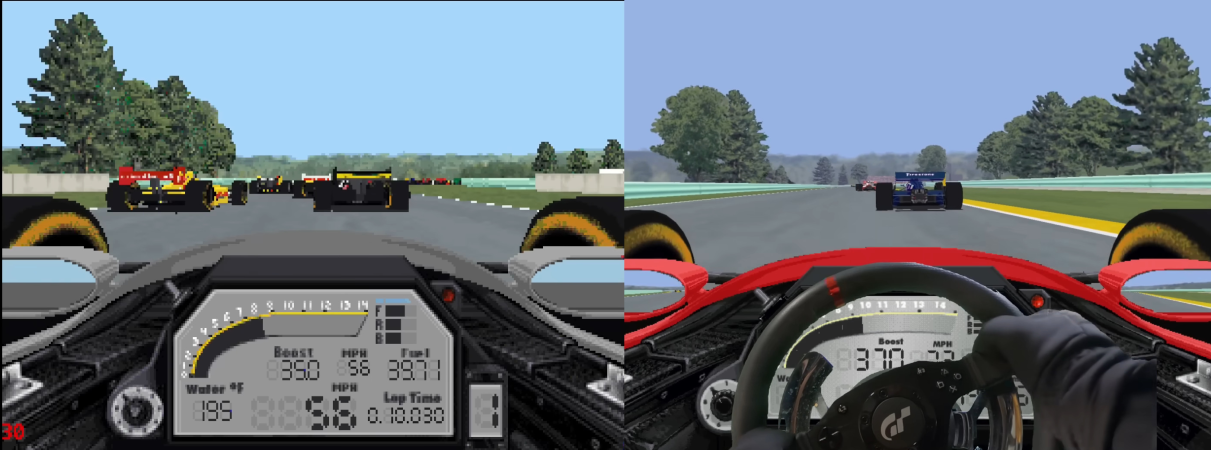
Indycar Racing 2 was a good game, back in 1995; in some ways, it was the Crysis of the Clinton years, in that most mortals could not run it to its full potential when it was new. Still, that potential was surely fairly limited, as we’re talking about a DOS game from 30 years ago. Sure, it was limited– but limits are meant to be broken, and games are made to be modded. [TedMeat] has made a video showing the updates. (Embedded below.)

It turns out there was a 3D-accelerated version sold with the short-lived Rendition graphics cards. That version is what let the community upscale everything to the absurd resolutions our modern monitors are capable of. Goodbye SVGA, hello HD. Specifically, [sharangad] has created a wrapper to translate the Rendition API to modern hardware. It doesn’t sound like higher-res textures have been modded in, in which case this looks spectacular for graphics designed in 1995. It’s not the latest Forza, but for what it is, it impresses.

The second hack [TedMeat] discusses is a mod by [GPLaps] that pulls physics values from game memory to throw to a modern force-feedback wheel, and it shows just how good the physics was in 1995. You really can feel what’s going on– stopping a skid before it starts, for example. That’s normal these days, but for the kids playing with a keyboard in 1995, it would have been totally mind-blowing.

As tipster [Keith Olson] put it: “What can I say? Fans gonna fan!” — and we’re just as grateful for that fact as we are for the tipoff. If you’re in a fandom that’s hacked its way to keep old favourites alive, we’d love to hear about it: submit a tip.

Continue reading “Game Of Theseus Gets Graphics Upgrade, Force Feedback 30 Years On”

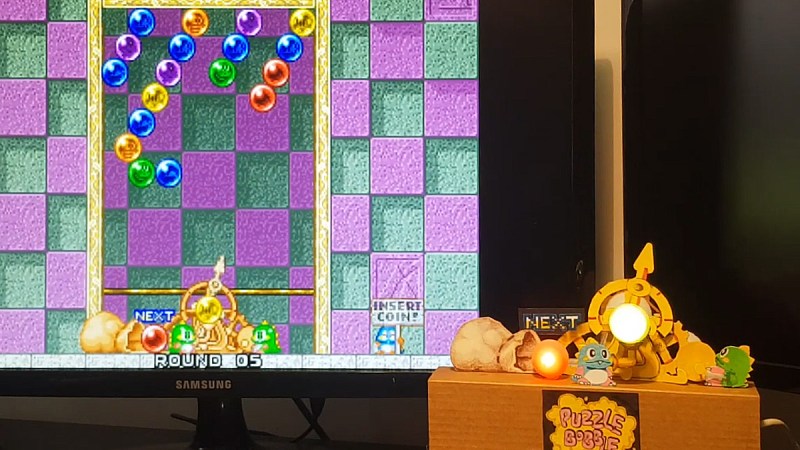
Puzzle Bobble on a screen with a physical gadget in front

Crafting A Cardboard Tribute To Puzzle Bobble

What do you get when you cross cardboard, deodorant rollers, and a love for retro gaming? A marvel of DIY engineering that brings the arcade classic Puzzle Bobble to life—once again! Do you remember the original Puzzle Bobble aiming mechanism we featured 12 years ago? Now, creator [TomTilly] has returned with a revamped version, blending ingenuity with a touch of nostalgia. [Tom] truly is a Puzzle Bobble enthusiast. And who could argue that? The game’s simplicty makes for innocent yet addictive gameplay.

[Tom]’s new setup recreates Puzzle Bobble’s signature aiming mechanic using surprising materials: deodorant roller balls filled with hot glue (to diffuse LED colours), bamboo skewers, and rubber bands. At its heart is an Arduino UNO, which syncs the RGB LED ‘bubbles’ and a servo-driven aiming arm to the game’s real-time data. A Lua script monitors MAME’s memory locations to match the bubble colours and aimer position.

But this isn’t just a static display. [Tom] hints at a version 2.0: a fully functional controller complete with a handle. Imagine steering this tactile masterpiece through Puzzle Bobble’s frantic levels!

Need more inspiration? Check out other quirky hacks like [Tom]’s deodorant roller controller we featured in 2023. Whether you’re into cardboard mechanics or retro gaming, there’s no end to what clever hands can create.

Continue reading “Crafting A Cardboard Tribute To Puzzle Bobble”

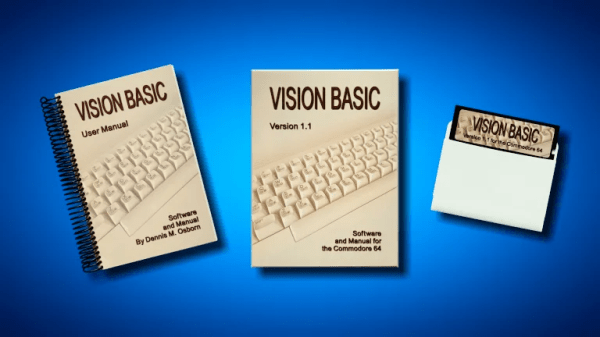
New Release Of Vision Basic: Hot New Features!

As the Commodore 64 ages, it seems to be taking on a second life. Case in point: Vision BASIC is a customized, special version of the BASIC programming language with a ton of features to enable Commodore 64 programs to be written more easily and with all sorts of optimizations. We’ve tested out both the original 1.0 version of Vision BASIC, and now with version 1.1 being released there are a whole host of tweaks and updates to make the experience even better!

One of the only limitation of Vision BASIC is the requirement for expanded RAM. It will not run on an unexpanded C64 — but the compiled programs will, so you can easily distribute software made using Vision on any C64. A feature introduced in version 1.1 is support for GeoRAM, a different RAM expansion cartridge, and modern versions of GeoRAM like the NeoRAM which has battery-backed RAM. This allows almost instantaneous booting into the Vision BASIC development environment.

Continue reading “New Release Of Vision Basic: Hot New Features!”

Air Hockey Table Embraces DOOM, Retro Gaming

[Chris Downing] recently finished up a major project that spanned some two years and used nearly every skill he possessed. The result? A smart air hockey table with retro-gaming roots. Does it play DOOM? It sure (kind of) does!

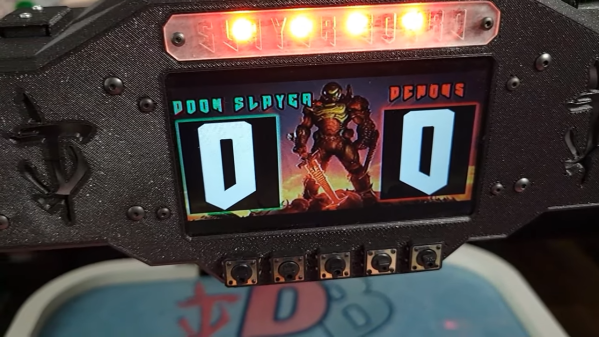
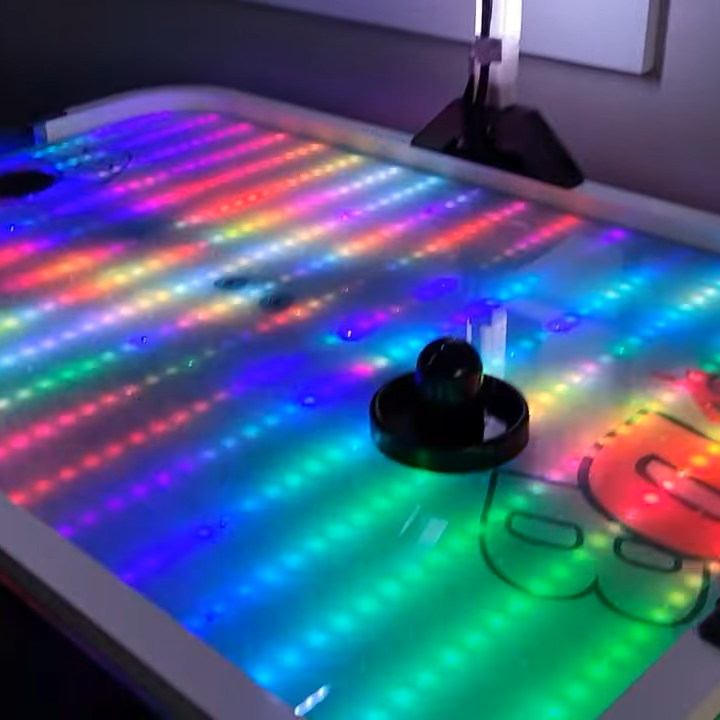
Two of the most striking features are the score board (with LCD screen and sound) and the play surface which is densely-populated with RGB LED lighting and capable of some pretty neat tricks. Together, they combine to deliver a few different modes of play, including a DOOM mode.

The first play mode is straight air hockey with automated score tracking and the usual horns and buzzers celebrating goals. The LED array within the table lights up to create the appearance and patterns of a typical hockey rink.

DOOM hockey mode casts one player as Demons and the other as the Doom Slayer, and the LED array comes to life to create a play surface of flickering flames. Screams indicate goals (either Demon screams or Slayer screams, depending on who scores!)

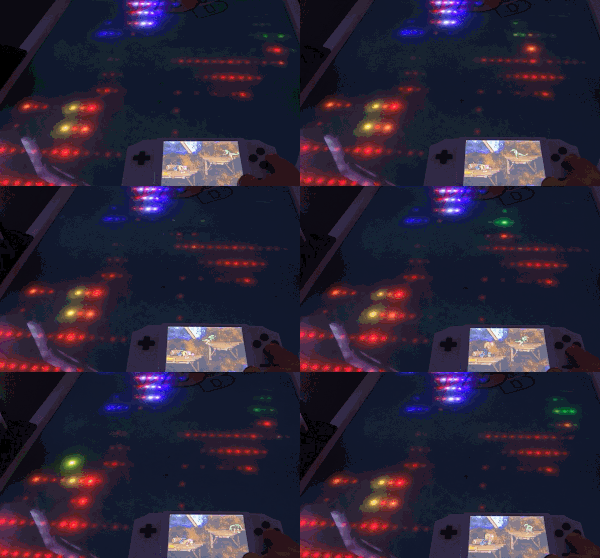
In retrogaming emulation mode, the tabletop mirrors the screen.

Since the whole thing is driven by a Raspberry Pi, the table is given a bit of gaming flexibility with Emulation Mode. This mode allows playing emulated retro games on the scoreboard screen, and as a super neat feature, the screen display is mirrored on the tabletop’s LED array. [Chris] asserts that the effect is imperfect, but to us it looks at least as legible as DOOM on 7-segment displays.

This project is a great example of how complex things can get when one combines so many different types of materials and fabrication methods into a single whole. The blog post has a lot of great photos and details, but check out the video (embedded below) for a demonstration of everything in action. Continue reading “Air Hockey Table Embraces DOOM, Retro Gaming”

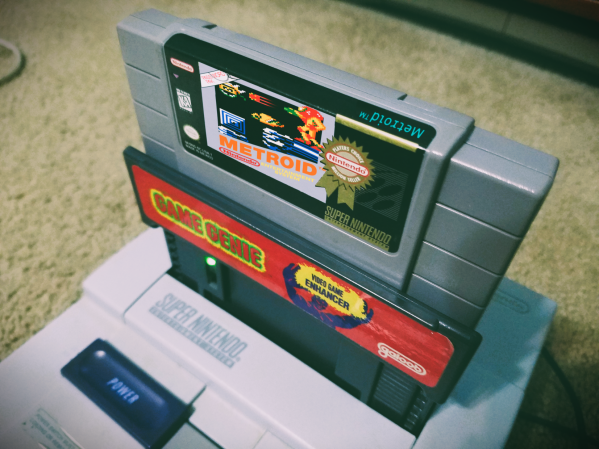
Photoshop image of the NES game Metroid on a Super Nintendo cartridge.

NES Classic Metroid Ported To Equally Classic Super Nintendo

There was a time early in the development of the Super Nintendo (SNES) where the new console was to feature backwards compatibility with NES games. The solution would have required a cumbersome cartridge adapter and a hard switch on every console to flip the CPU into 8-bit mode. Unfortunately, it was not meant to be — outside of the first public demo of the console, little evidence exists to suggest the gamers would have been able to supercharge their old NES carts on their Super Nintendo.

But thanks to the impressive port of Metroid to the SNES by [infidelity], we can imagine what such a capability might have been like. There’s more on offer here than reduced sprite flicker. There are additional frames of animation compared to the original, so now Samus’ arm cannon stays consistent rather than magically switching arms when turning around. A complete save game system from the Famicom Disk System version has also been implemented as well, with the traditional three slots. Although purists can still utilize the password system if they so choose.

Ultimately the most impressive inclusion of [infidelity]’s work is the MSU-1 enhancement chip implementation. Fun video intro sequences lead into the main menu where players can select the accompanying soundtrack. There’s the original 8-bit music remapped onto the SNES sound chip, the expanded 8-bit version from the Famicom Disk System, the reimagined sound of Metroid Zero Mission, or a full orchestral score. It really is the sort of situation where there are no wrong answers.

While you’re here, check out this post about bringing Poke’mon ROM hacks into physical cartridge form.

Continue reading “NES Classic Metroid Ported To Equally Classic Super Nintendo”

Zork Zcode Interpreters Appear Out Of Nowhere

Some of our readers may know about Zork (and 1, 2, 3), the 1977 text adventure originally written for the PDP-10. The game has been public domain for a while now, but recently, the interpreters for several classic 1980s machines have also appeared on the internet.

What’s the difference? Zork is not a PDP-10 executable, it’s actually a virtual machine executable, which is in turn run by an interpreter written for the PDP-10. For example, Java compiles to Java bytecode, which runs on the Java virtual machine (but not directly on any CPU). In the same way, Zork was compiled to “Z-machine” program files, called ZIP (which was of course used in 1990 by the much more well known PKZIP). To date, the compiler, “Zilch” has not been released, but the language specification and ZIP specifications have, which has led some people to write custom ZIP compilers, though with a different input language.

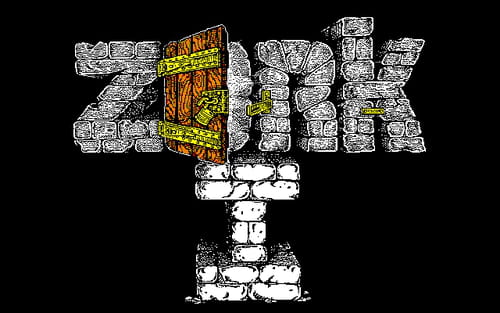
For more on the VM, check out Maya’s Zork retrospective. (And dig the featured art. Subtle!)

Of course, that’s not the only type of interpreter. Some programming languages are interpreted directly from source, like this BASIC hidden in the ESP32’s ROM.