Texas Instruments Changes The NE5532 And Others Into Incompatible Versions

First introduced in 1979 by Signetics, the NE5532 was a pretty spiffy dual op-amp for the time with low noise and low distortion. Over the years it has become a standard part that showed up in countless audio products, and has become a so-called jellybean generic component with Texas Instruments (TI) being one of countless manufacturers.

It being such a standard, multi-sourced part makes it thus even more puzzling that TI has now decided to completely overhaul this IC in a way that makes it incompatible with even the original Signetics NE5532. These changes are covered in detail by [Dave] of EEVblog as his mind is pretty much blown at such an incomprehensible change.

The changes entail an entirely different manufacturing process and a big change in specifications, while making no change to the part number. In revision K of the TI datasheet these changes are first seen, with some specifications changed for the better, like a higher unity gain bandwidth by 2 MHz, but a much slower slew rate.
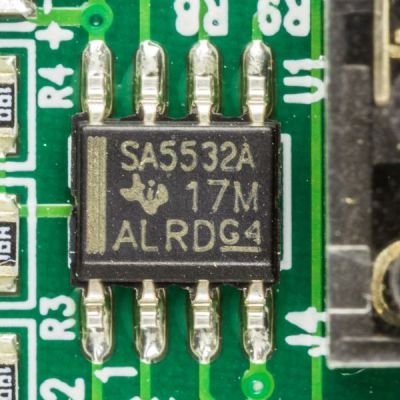
Kramer Electronics PT-102AN - board - Texas Instruments SA5532A
Texas Instruments SA5532A variant of the 5532 op-amp. (Credit: Raimond Spekking, Wikimedia)

Although the 5532 op-amps are multi-sourced, there are good reasons to just stick with manufacturers like TI, as that means receiving a product change notification (PCN) when anything changes. In the PCN related to this op-amp a change to process node is noted, along with other changes, but no reasoning.

Among the other big changes are a reduction in the supply voltage from 22 V to 18 V, and a halving of the ESD protection from 2 kV to 1 kV. Although it might be slightly more efficient on the new process node this way, it clearly comes with a lot of trade-offs that make it an overall worse op-amp, while also being incompatible with the same op-amp from other manufacturers.

In the video [Dave] goes through the datasheets of this jellybean part of other manufacturers, showing that they still have the original 1980s specifications. Only one exception here was the NE5532DR from Shenzhen HuaXuanYang Electronics, whose supply rail voltage is also 18 V for some reason, along with a similar internal transistor configuration that reduces the ESD resistance.

In addition to the NE5532 op-amp, it seems that TI also took an axe to the OPA134 op-amp, by removing its offset trim feature and listing the pins as ‘NC’, with a warning to not connect these pins and also worsening other specifications. This makes these similar jellybean parts incompatible, with no change to the part number. Worse is that it continues with the LMH6518, whose changes [Dave] argues might even kill oscilloscopes as they are commonly found in those.

Meanwhile the LM317M also got an overhaul, but here TI opted to give it a new part name, calling it the LM317MQ with at first glance no major degradations in the specifications, but instead some actual improvements. This makes it even more puzzling why TI didn’t give the other ICs a new part number to differentiate them from the jellybean part.

Until there’s some clarification from the side of TI, it might be a good idea to source these parts from a manufacturer that is not TI, especially when replacing these ICs in older devices.

Continue reading “Texas Instruments Changes The NE5532 And Others Into Incompatible Versions”
Matchbox Transceiver Pushes The Spy Radio Concept To Its Limits

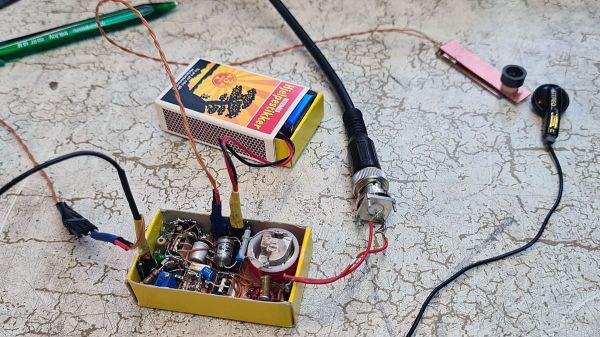
The Altoids tin has long been the enclosure of choice for those seeking to show off their miniaturization chops. This is especially true for amateur radio homebrewers — you really have to know what you’re doing to stuff a complete radio in a tiny tin. But when you can build an entire 80-meter transceiver in a matchbox, that’s a whole other level of DIY prowess.

It’s no surprise that this one comes to us from [Helge Fykse (LA6NCA)], who has used the aforementioned Altoids tin to build an impressive range of “spy radios” in both vacuum tube and solid-state versions. He wisely chose solid-state for the matchbox version of the transceiver, using just three transistors and a dual op-amp in a DIP-8 package. There’s also an RF mixer in an SMD package; [Helge] doesn’t specify the parts, but it looks like it might be from Mini-Circuits. Everything is mounted dead bug style on tiny pieces of copper-clad board that get soldered to a board just the right size to fit in a matchbox.

A 9 volt battery, riding in a separate matchbox, powers the rig. As do the earbud and tiny Morse key. That doesn’t detract from the build at all, and neither does the fact that the half-wave dipole antenna is disguised as a roll of fishing line. [Helge]’s demo of the radio is impressive too. The antenna is set up very low to the ground to take advantage of near vertical incidence skywave (NVIS) propagation, which tends to direct signals straight up into the ionosphere and scatter them almost directly back down. This allows for medium-range contacts like [Helge]’s 239 km contact in the video below.

Banging out Morse with no sidetone was a challenge, but it’s a small price to pay for such a cool build. We’re not sure how much smaller [Helge] can go, but we’re eager to see him try.

Continue reading “Matchbox Transceiver Pushes The Spy Radio Concept To Its Limits”

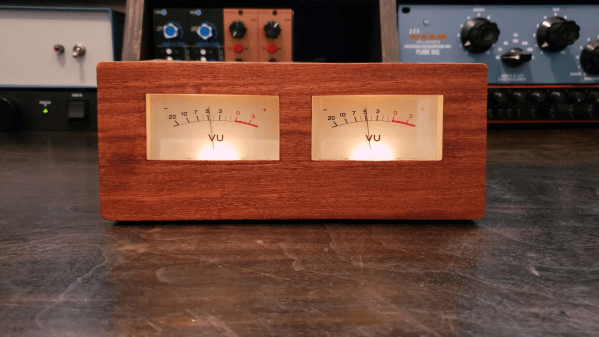
Salvaged Meter Movements Really Pop In This DIY VU Meter Bridge

If you’re going to build a nice VU meter bridge for the recording studio, the first thing you need is a nice pair of VU meters. But lest you think it’s as easy as putting some meters into a nice box and calling it a day, think again.

This project comes to us from [Frank Olson], whose projects usually incorporate wood as part of the mechanism, as with his famous wooden ribbon microphone. This build does indeed use wood, and to excellent effect, but only in the project’s final enclosure. Before that, [Frank] had salvaged a pair of good-looking moving coil meters from an old tape recorder. He muddled through some ideas before settling on a design. A NE5532 dual-channel audio buffer module is used as a preamp, with each channel feeding into a bridge rectifier before heading to the meter. Wisely, [Frank] chose to illuminate the meters with their existing incandescent bulbs, so a small DC-DC supply was added to provide the necessary 8 volts.

As for the enclosure, that’s where [Frank]’s experience working with veneers paid off. He chose mahogany, carefully cut all the pieces to shape with a knife, and glued it all up with CA glue — at least we assume it was CA; based on previous efforts, he uses a lot of the stuff. The tung oil finish looks fantastic, and the completed build aesthetic looks great! The video below shows it all.

If you need some backstory on the VU meter, we can help with that.

Continue reading “Salvaged Meter Movements Really Pop In This DIY VU Meter Bridge”