
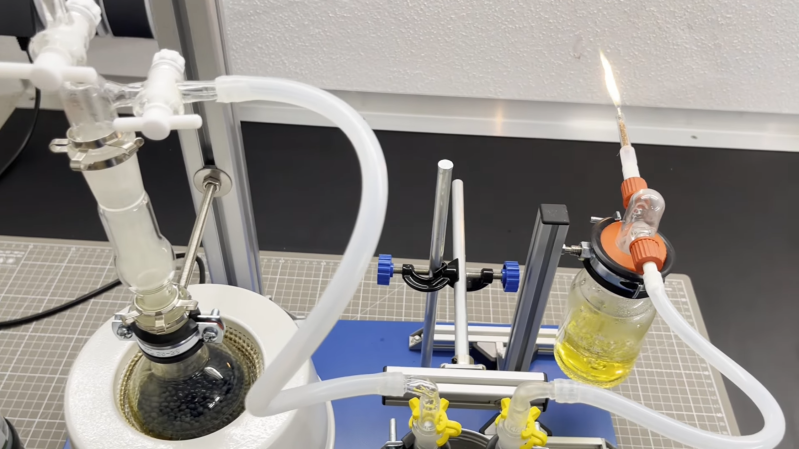
Although crude oil contains a vast diversity of hydrocarbons, a comparatively small number of these make up the bulk of demand for oil. Cracking solves this mismatch: most of the demand is for light, short-carbon-chain molecules, so a cracker breaks down long-chain hydrocarbons into lighter, more commercially-valuable chemicals. This is usually done in massive industrial plants, but as [Markus Bindhammer] showed, it’s possible even in a tabletop apparatus.
There are several methods of cracking, but [Markus] used catalytic fluid cracking: a feedstock high in alkanes (hydrocarbons containing fully saturated carbon-carbon bonds) is heated in the presence of a catalyst, whereupon its long alkane chains split to form alkenes (hydrocarbons with a carbon-carbon double bond) with the loss of a hydrogen molecule. In [Markus]’s setup, a heating mantle heated a boiling flask containing paraffin oil and an amorphous silica-alumina catalyst. Vapors from this flask passed through a condenser tube and a bottle of bromine water, then escaped through a flashback arrestor. Bromine reacts far more readily with alkenes than with alkanes, so the disappearance of its characteristic yellow color would visually indicate the production of alkenes.
To avoid unwanted oxidation, [Markus] purged the cracker with argon before using it. While running the cracker, a flammable mixture of light hydrocarbons and hydrogen escaped from the flask of bromine water. The yellow color of bromine disappeared, and two phases formed: one aqueous, and a lighter phase of hydrocarbons and brominated hydrocarbons. The hot side of the reactor did not survive well; the catalyst turned black with coke, and the heating mantel’s cover fused to the boiling flask. However, the reaction undoubtedly succeeded: while a pool of normal paraffin oil wouldn’t ignite, the cracked oil lit easily.
To go the other way, from small molecules to larger hydrocarbon chains, [Markus] has also used the Fischer-Tropsch process.












Is this UK/international English or US English? Was he cracking kerosene (similar to diesel) or petroleum wax?
See here: https://en.wikipedia.org/wiki/Liquid_paraffin_(drug)
Thanks.
That’s a third meaning of the word for me to keep track of. :)
I also was not aware that paraffin oil has different meanings in English:)
Fluid cracking catalysts have been used in refineries for ages . They started out with amorphous silica alumina catalysts and transitioned to crystalline silica alumina zeolites which gave much better yields of desired products . The experiment described looks like something out of an old text book .
Only heavy crude produces kero./parafin, and diesel. The heavy only comes from a few places, uh, Venezuela, Russia, and that geographic strait that’s been in the news so recently… Enjoy your dieoff!
Arkansas crudes are known for their high paraffin content, which is extracted as a byproduct (paraffin wax) or broken down to make lubricating oils and process oils. The buildup of these paraffin waxes is a common challenge for well operators in the state, requiring routine removal treatments
Utah crude has some of the highest paraffin content among U.S. streams and solidifies at ambient temperatures, requiring heated tanker trucks for transport
A large portion of California wells produce a heavy, paraffinic/naphthenic base.
Pennsylvania, Ohio, New York, West Virginia, the Appalachian Basin, Famed for its historic “Pennsylvania Grade” crude have wells that produce sweet, paraffin-based crude that is highly prized specifically for manufacturing premium lubricating base