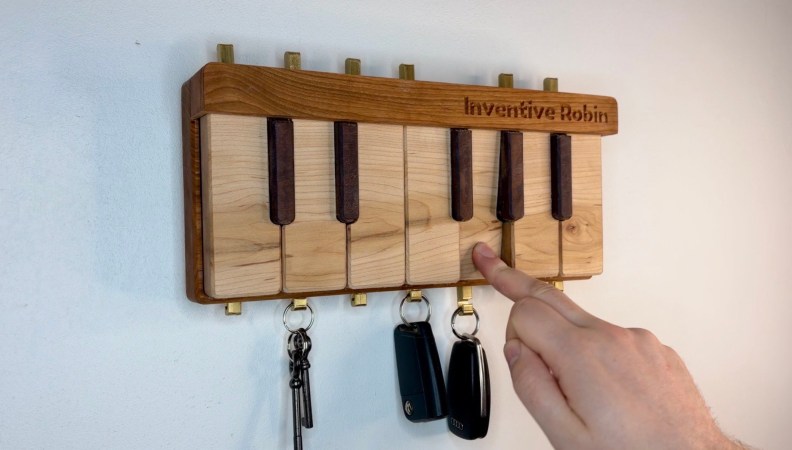
There are many ways to deal with keys: a bowl next to the entryway, a junk drawer, or you can just leave them in your pockets and hope you remember to check on Laundry Day. [Inventive Robin] has come up with his own, unique take on the key holder concept: he’s got piano keys to hold his car keys, CNC’d out of some nice hardwoods.
Of course, it’s not just a fake one-octave piano with hooks glued to it; that wouldn’t be quite enough to catch our fancy. There’s a mechanism hidden under the “white” keys– made of maple– that lowers the brass hooks when you press the, er, wooden actuator, so you can retrieve your, uh, lock-openers. Keys, that is. They’re both keys, of different sorts, because English is a wonderful language. In any case, pressing the maple key a second time lifts the brass hook, trapping the likely metal key hanging on it.
The mechanism was carved from acetyl sheet on the same Shapoko CNC machine that handled the wood, and was assembled with purchased metal rods, springs, and some plastic standoffs. It’s very satisfying to watch it work unenclosed, so check out the build video embedded below to see that in action– jump to 4:46 if you don’t want to get the whole design brief.
It’s not the most complex of hacks, but it’s beautifully done inside and out, and [Robin] is clearly happy with the result. It’s nice enough that visitors might want to photograph the key holder, but perhaps have them do it sans keys– those photos could potentially be a security risk.
Continue reading “Wooden Piano Keys Hold Your Less-Wooden, Not-Piano Keys”