
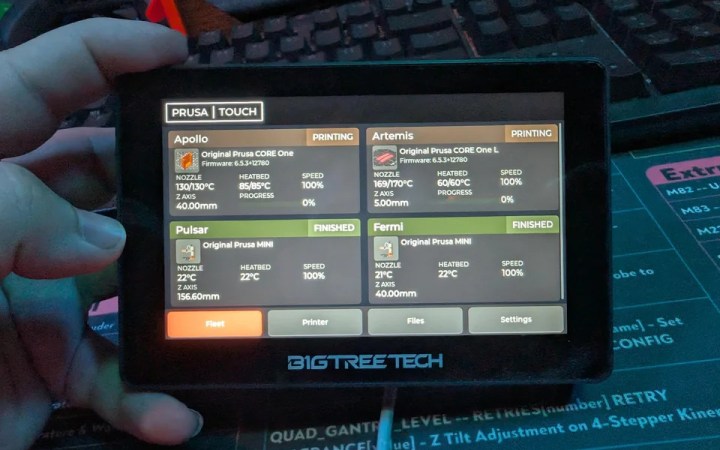
Status Display Keeps Eye On Your Prusa Fleet

Whether you’ve been dragging an old MK2 or MK3 kicking and screaming into the present through the available upgrade paths, or recently picked up a CORE One, pretty much any of the 3D printers still being actively supported by Prusa are able to connect to the network for the purposes of remote monitoring and control. Although their printers can work entirely offline, Prusa offers a smartphone application as well as web interface that makes it easy to keep tabs on all the hot plastic action.

If you’ve got a few Prusa printers on the net and would like a dedicated interface for controlling them, check out this custom firmware for the BigTreeTech K-Touch and Panda Touch devices. These touch screen gadgets were originally intended for controlling printers running Klipper, but thanks to [Nomads Galaxy], they can now talk to Prusa printers either directly over the local network or through the Prusa Connect cloud API with a user interface that mimics the aesthetics of the official offerings.

Continue reading “Status Display Keeps Eye On Your Prusa Fleet”
Long-Theorized GPS Weakness Exploited On Large Scale

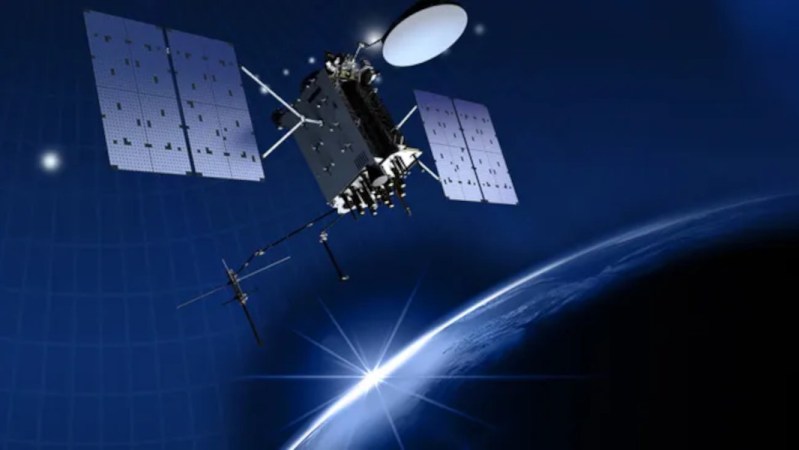
GPS has become fairly common in our everyday lives, not only able to pinpoint our locations on Earth but also as an incredibly accurate timekeeping method. But since these satellites are around 20,000 km above Earth, the received signals on the surface of the planet can be incredibly weak. This makes them prone to jamming and spoofing, a weakness of the technology that has long been known. Although attempts to mitigate these problems have been ongoing, there has recently been a large-scale attempt to interfere with these signals that put all mitigation efforts to the test.

One proposed way to improve resilience is to supplement existing GNSS systems with low-Earth-orbit navigation satellites. In this example, a company called Xona is using a satellite called Pulsar-0 that operates in low-Earth orbit (LEO) and provides positioning and timing signals that are around 100 times stronger than standard signals from GPS/GNSS satellites. It is able to receive GPS signals as well, ensuring the two systems agree on one another. And, because Pulsar’s navigation signals originate from LEO and are much stronger than conventional GNSS signals, Xona expects them to be significantly more resistant to jamming.

Beyond geopolitics, spoofing GPS has some applications in finding legendaries in Pokemon Go as well as making it fairly trivial to steal GPS-guided drones.









