
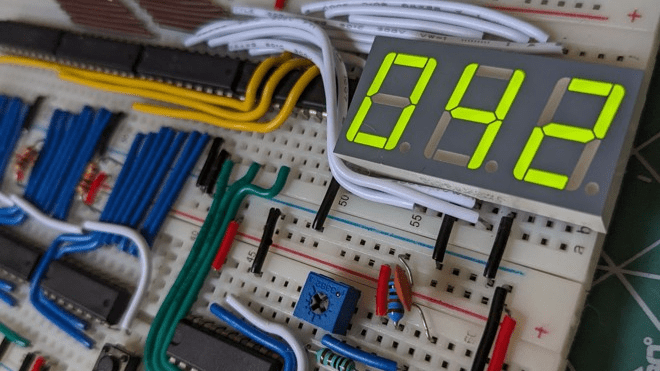
Integrated electronic modules like counters and displays are convenient and space-saving, which may also make them easy to take for granted. [Nagy Krisztián] demonstrates this by making three very different digital counter designs, each breadboarded with a 7-segment LED display. Push a button, and the displayed number increments by one for each press. It was a personal project that ended up educational in more ways than one.
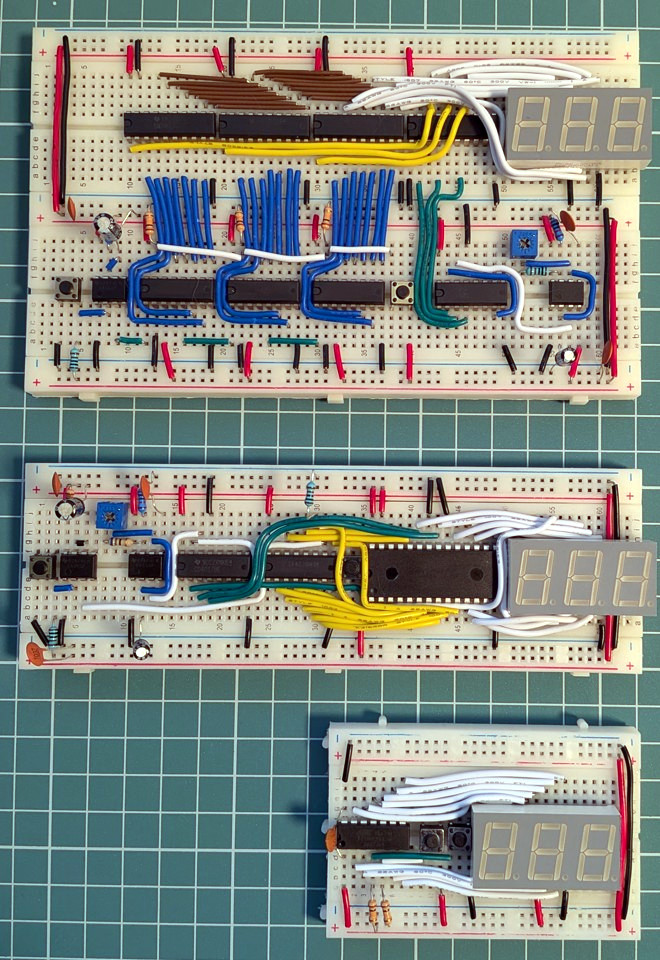
The first version uses discrete components only, and even though it handles the counting with CD4026B decade counter ICs instead of building counters from scratch with NAND gates, it’s still by far the largest of the three. The second version simplifies driving the display with an AT28C64B EEPROM acting as a sort of hardware lookup table translating binary counts into 7-segment digit display patterns. The third uses an ATtiny24A microcontroller, and unsurprisingly has the smallest footprint.
All of this highlights two things. One is that implementing even a simple counter and 7-segment LED readout is a nontrivial affair when one gets right down to it, even when taking advantage of purpose-built ICs. The second is that the complexity that is on full display in the first version doesn’t simply disappear as the footprint and component count goes down. Rather, it moves into software and other infrastructure, like the need for compilers and chip programmers.
The whole thing is both educational and a reminder of how good the average hardware hacker has it today. There are so many effective electronic assemblies, available to just about anyone at low cost, that it can be very easy to take it all for granted and forget just how much breadboard space and wires were needed for even simple-seeming things.
[Nagy] is certainly no stranger to dealing with a lot of wires, as we’ve seen when he fooled a 286 processor into thinking it was plugged into a functioning vintage motherboard.












For the first circuit, the effort could have been halved if the guy had connected the BCD outputs directly to LEDs with internal BCD-to-7-segment decoders.
Common display like HP5082-73xx series LED.
I remember creating BCD to 7 segment converter via gates, it was an interesting exercise to work with boolean algebra and Karnaugh maps…
And by using separate 7-segment displays for each digit would avoid the multiplexer logic completely.
The HP displays were incredibly more expensive than MAN-7 or FND500 seven segments then. Using a 7490/7447 and possibly a 7475 latch between them was a standard, if not especially cheap solution. I made a 5-digit frequency counter with those. Approximately knowing the input frequency magnitude helped while you only had the 5 least significant digits shown.
Well, Siemens made a commercial product that did what You could have built using a diode matrix.
Look for AEG DM12-9-8 diode matrix. There is a releated video on YT.
Well. I did the similar when I made a switch matrix that was used for controlling a 1980’s TV station memory.
Each of these selectable memories was connected to a trim potentiometer.
Another way has been shown by Ben Eater by using an EPROM in order to do the job.
An unsportive but practical way would be usign an ICM 7217 which is still produced.
One-chip solutions became available in the mid 1970s from National Semiconductor, Intersil, General Instrument and others. Back then, no designer right in his mind would have used TTL or CMOS SSI/MSI if he had access to things like MM74C925, ICM7208 and AY-5-4007.
Actually many designers who were eminently sane would (and did) used direct logic. Due to costs and yields, the single-chip solutions could easily push a design out of its targeted cost parameter.
Remember, the job is not to “drive digits”, it is to “drive digits within a specified cost”. No designer could be a professional if they only solved half the problem.
Ages ago as a hobbyist, I found the price of 74C925 way out of reach plus shipping. I used to use CA4553 and CA4543 combo to multiplex three digits. They could simply be ganged to make a six digit counter.
Impressively tidy breadboarding there!
Yeah, that is some near-CDO levels of tidiness (it’s not “OCD”, dammit, put the letters in order! :)
I gave up on that type of jumpers years ago and just use the Dupont style, which often means there’s a giant forest of wires in the way of things. Color-coding them does mitigate that somewhat, as was done here. .. but as you say, damn.
Sorry they were CD4553 and CD4543 and they could be persuaded to run LCD as well as LED displays.