
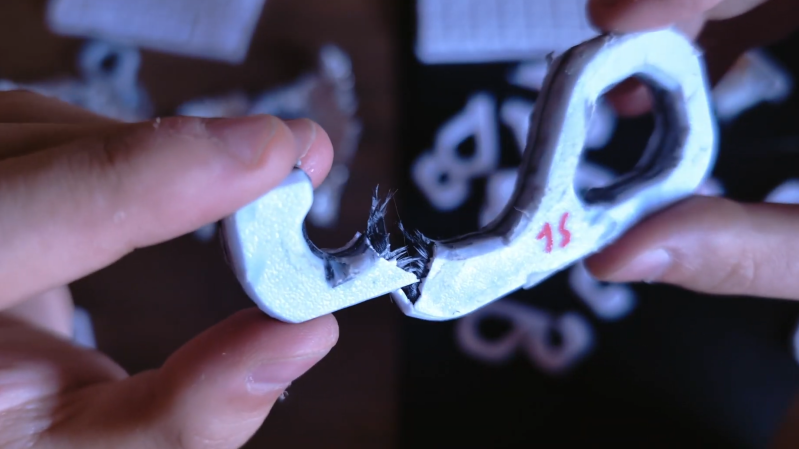
As strong and light as carbon fiber-epoxy composites are, the same can’t always be said of carbon-fiber reinforced 3D printer filaments. Of those that do improve over stock filament, the best performance comes from long, continuous strands, but the printers that can embed these are quite expensive. [MagicLAG], looking for a cheaper method, made something even stronger: prints reinforced with subsurface carbon-fiber cloth.
They tried a few other methods first, including pausing the print and manually embedding carbon fiber strands, ironing strands into the finished part, and ironing carbon fiber cloth into the bottom layer. For the main method, though, he printed the test part in three pieces: a core part, and two outer shell layers. Between the core and the shell is a small gap, into which carbon-fiber cloth can be epoxied. Under good conditions (not using quick-setting epoxy), this mostly preserves the outer surface and dimensional accuracy.
To test the various strengthening methods, [MagicLAG] printed hooks and tensioned them on a load cell until failure. None of the methods using single-stranded fiber showed any improvement; the fiber simply bent and let the surrounding plastic break. As a control for the epidermal cloth parts, they printed shells and cores and epoxied them together. These controls performed better than the standard parts, but not nearly as well as the carbon-fiber cloth composites. With only a few layers of cloth, these more than tripled the yield strength of the basic hook.
If you’d rather use a carbon-fiber filament, the type of plastic matters; carbon fiber makes PLA, at least, weaker. Regardless of form, some caution is called for whenever handling carbon fiber, since it seems to show some asbestos-like effects.












Fiber impregnated filament is for maintaining integrity at high temperatures.
Vendors marketed it as an improvement to mechanical properties in general. It rarely does, and often does the opposite.
Datasheets, people.
The epidermis is the outermost layer of skin. That’s not where the CF is here.
Indeed, other than the fact it is in some examples, though they do try some more novel methods that are surface treatments.
Though really have to ask why bother – you want composite parts for mechanical reasons just use the 3d printer to create the mould or former and be done with it. Just doing the composite work as composite work stand alone will give you more control of the results and end up being much easier. As trying to embed at the printing stage isn’t likely to actually create a better part than that, and the expense and I’d suspect maintenance of a machine that can actually lay in real reinforcement strands of a length that really matters mechanically really doesn’t seem worth it. Plus most of the time a relatively simpler machine that can print the more engineering filaments but is otherwise just a normal printer will do the job for you far more easily.
I mean, they are printing the mold, it’s just integral to the finished part. We already fill composite with core material so having plastic core isn’t insane to current methods. This skips over using mold release and, if done right, you can just use clamping pressure instead of expensive vacuum bagging consumables but still get some of the benefits. Biggest flaw is that composite tow and weave is isotropic – it only has tensile strength in one direction. When making composite parts they vary the tow or weave direction (0, 45, 90) to create a pseudo anisotropic material. It’s pretty clear that they’re getting some benefit from the resin used (in this case it’s just standard epoxy, yeah?) but if you actually laid the fabric in multiple orientations you could get something out of it for the cost of epoxy and fabric while using a bottom dollar printer.
Totally agree! Some people on Reddit had the same opinion. But I think this ‘epiderming’ technique is actually easier for intricate parts and cuts down on materials.
For smaller parts, forging could be better, but it uses more carbon and epoxy. For bigger ones, skinning works, but you’d have to put in extra effort on the surface finish and work around crevices to not lose detail. A mold is also a great option, but all the filament used for the mold (if you’re only making one part) gets wasted, and working with a two-part mold can be tricky—at least for a complete noob like me!
Also, someone on Reddit mentioned that soluble filament could be used to wash away the 3D printed parts and save weight, which I think is a great idea.
Many thanks for sharing your thoughts on the method!
You’re actually completely right XD! Total slip on my part, it should have been ‘dermis’. But honestly, I think it sounds cooler this way, and the goal was just to differentiate it from regular carbon fiber skinning. Thanks for catching that!
I am, once again, reminding people that use of carbon fiber is often to make strong but flexible filiments more ridgid. Nylon is the best and arguably most practical example.
It’s weird to frequently see 3dp articles discussing things that are very old news to the 3d2a community.
I feel like you didn’t watch the video or are missing the point- the good thing about his method is that you get the benefits of composite-skinned parts with relative design ease and less post processing than skinned.
This isn’t anything like adding 10% by volume short strands of fiber to filaments and calling it an “engineering filament”, this is tripling (in his test) the strength of the part by replacing a perimeter with proper woven cloth and resin.
As customary, writing a comment without watching the video. Sorry, but these clickbait thumbnails are getting out of hand. Even if the content might be awesome, it’s a hard pass.
I get where you’re coming from, and I also feel a bit dirty playing into the YouTube ‘meta’. But if I put a lot of time into making something I genuinely believe is worth watching, I want to give it a chance to be seen. I draw the line at fake or misleading thumbnails, but at the end of the day, even if someone cured cancer, it wouldn’t help anyone if nobody knew it existed!