
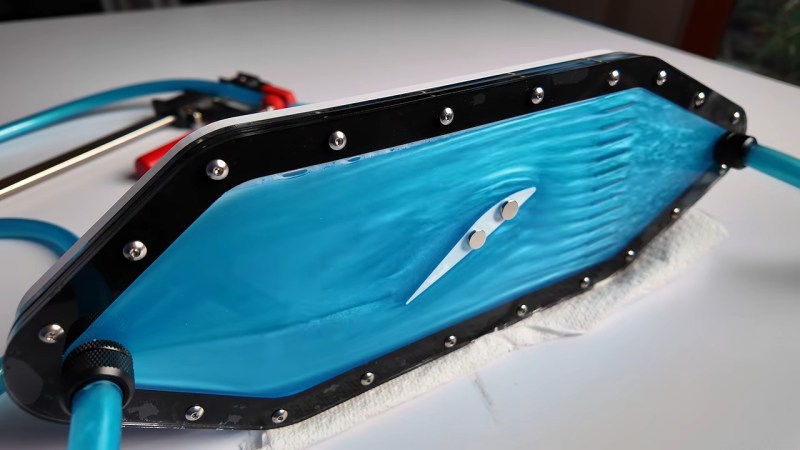
Fluid simulations are one of the “killer apps” of high-performance computing, but if you can’t afford the performance, they can take a depressingly long time to run. Depending on your use case, as long as you keep the Reynold’s number in mind– or are just looking for a qualitative look at pretty flows–you might be able to get away with purely-practical simulations using rheoscopic fluid, as [Visual Thinker] demonstrates in a recent video.
The fluid, as you can guess from the name, lets you scope out rheos— that’s flow, for those of you didn’t take Greek. Making it is as simple as you could ask for: get some mica flakes, which are readily available to add ‘sparkle’ to cosmetics, and mix with water and a drop of soap. The soap isn’t always necessary, but depending on your mica it helps keep it in suspension and avoid clumping– [Visual Thinker] found it helped him a good deal. Being flat plates of reflective material, the mica flakes catch the light and sparkle beautifully– and since they align with the fluid shear, they show you exactly what’s going on in your ‘simulation’.
[Visual Thinker] isn’t starting with serious simulations; the first thing he tries is essentially a toy that lets him see fluid flow around a Benchy by sticking magnets in it and using it to move a cross-section of its hull though a thin layer of fluid sandwitched betwixt pieces of laser-cut acrylic. We don’t call it a toy to disparage it, though– we totally want one. [Visual] mentions the idea of a coffee table combining the concept with the kind of underslung mechanism we see in sand drawing tables, which sounds dangerously hypnotic. If any of you build one, please try and tear your eyes away long enough to let us know.
He has another beautiful piece that make the video worth watching: a wind-tunnel, again made of laser-cut acrylic and printed parts. With careful consideration of the scale and flow speeds, that one might actually prove useful– and even if it doesn’t, it’s pretty enough that it doesn’t really matter. Beauty has its own utility sometimes.
Most wind tunnels we see around here use actual wind, but rheoscopic fluid was invented for this sort of thing, even if it does make for pretty baubles.











I wonder what could be put into that water-based mica soup to magnetically agitate it from the outside…
https://hackaday.com/2019/12/10/tracking-wasted-time-with-a-ferrofluid-clock/
I wonder if/how it handles flow separation? Can one use multiple outputs to experimentally determine flow vectoring perhaps, or perhaps hall effect sensors or variably aligned transformers to determine lift? So many possibilities to make this vaguely more quantitative.
Usually in wind tunnels, lift is measured with load cells on the wing profile supports. And flow separation will certainly happen, with the appropriate Reynolds number and angle of attack. What would there be to “handle” ?
I wonder how effectively that slurry would work as a liquid cooling medium for a desktop… Because that’s what the next wacky gaming rig needs featured in the window on the side of the case. Have this somewhere in the water cooling circuit, run the coolant through, maybe have the little airfoil in the middle attached to a servo that moves it according to CPU load or some other metric… Slap some RGB LEDs on there, woooOOOOoooo fancy
Water cooling splits into tiny tubes in the radiator and into thin channels in the water blocks. I think adding anything solid would be very likely to jam.
They use copper sintering powder in some to maximise surface area for thermal transfer. It is copper and something like baking soda. You bake it and the soda goes to gas and leaves you with roughly 10 micron copper sponge that would totally clog up.
You can get pearlescent opaque coolants designed for water-cooling, which look very similar to this
(eg: https://uk.thermaltake.com/thermaltake-p1000-pastel-coolant-marble-blue.html, https://www.primochill.com/products/primochill-opaque-pre-mix-32oz).
Although every forum will tell you that it will gunk up all your components and you’ve have to clean them every six months, but I’ve never seen any actual evidence of that…
Now if you do make a coffe table, you want to use ferromagnetic flakes, no? To draw patterns/reactions without opening it each time.
If you could find ferromangetic flakes that could stay suspended, that would be a cool way to do it ! I can’t think of a substance that flakes like mica and is ferromagnetic, though. The coffee table idea would be like a sand table– they don’t use magnetic sand that I have seen, instead the the underslung magnet is moving a ferromagnetic object inside the medium to act as a stylus/stirrer.
You want magnetos viewing film. Micro capsules of basically MagnaDoodle
As someone who has don’t dozens of CFD simulations with OpenFoam and a few with Code Saturn, I would not state that they take a “depressingly long” time to run. Memory, right now is a problem. If I make a change to my car model, it takes me about as long to prepare the case, as it does to run it, on a 3900x, with a car model at 9mm cubes, in a appropriate test section.
That stated, there is a lot to be learned from analog CFD. So, the article is a good one.
Given its affect on our society, any mention of AI, makes me want to wretch.
…additionally, if it weren’t for the AI he is using–we would be able to afford computer hardware to run CFD.
I like the results he got with the simple mica powder/water/dishsoap recipe.
There is another clever one that I have used that involved decanting shaving cream and water that I like using. I’ll see if I can find the old research paper on making it and post it back here.
Some days ago I read a paper noting that instead of mica flakes, ordinary shaving foam in a ration 1:20 with water makes a really good rheoscopic fluid. It has to be shaving foam with stearic acid as an ingredient. Just mix it and wait till the stearic acid and other part of the foam separates. Then use the rest mixed with some food color. I tried it and it worked very very well. The stearic acid works better than mica as it doesn’t separate out as fast as mica powder. And its cheaper. Link to the paper: https://arxiv.org/pdf/1806.06120
+1 on the shaving cream method. Done it a few times with great results!