
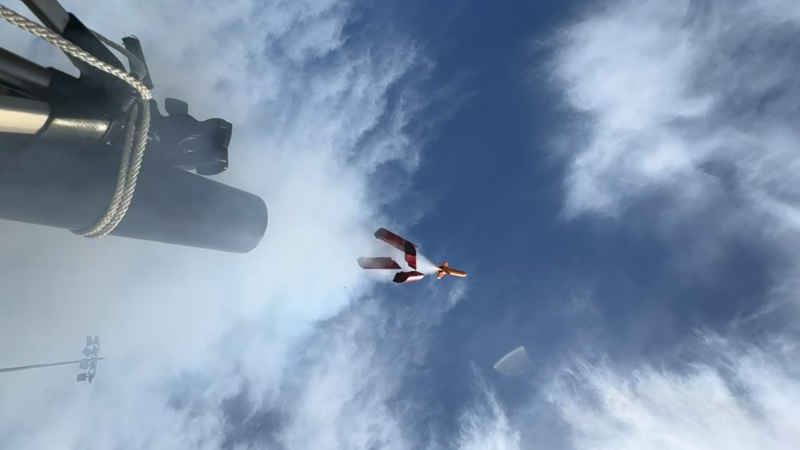
If you want improve a model rocket’s performance, all the common options come with serious trade-offs: you could increase the motor’s size, which raises safety issues, or you could cut down on weight, which limits the possible payload. [Con Hathy] was therefore intrigued by the design of the Arcas sounding rockets, which with the aid of a gas-fed launch tube could reach an altitude of 100 km. Even in models without a gas generator, a launch tube apparently boosted performance, an effect which [Con] was able to replicate in a much smaller model rocket.
In theory, as the rocket engine fires, it should pressurize the tube behind the rocket, providing an extra boost out of the tube. To test this, [Con] 3D printed a test rocket, launched it both from a standard rail and from a tube, and compared the results. During tube launches, a printed sabot fit around the rocket and formed a seal with the launch tube. The results were surprising: the tube-launched rocket actually performed substantially worse than a rail launch. After building a simulation, [Con] found that, as the rocket moves down the tube, the volume of tube it needs to back-fill with gas increases faster than the engine puts out exhaust; it was pulling a slight vacuum behind it, slowing itself down.
To solve this, [Con] decreased the diameter of the launch tube. To let the rocket fit into the tube, he also modified it to use pop-out stabilizer fins which wrap around the rocket while in the tube. The sabot was also shrunk, and had foam added to improve the seal between it and the rocket. For this second test, [Con] also connected a pressure sensor to the base of the launch tube. The results on the second launch were much better: according to an altimeter, it managed to fly 72% higher. Based on the pressure sensor’s data, a longer tube could have squeezed out still more performance, but this still demonstrated the principle quite well.
We’ve seen a tube-launched rocket before, though not with such a performance focus.












16″ is the optimal tube length for a .223 round. scale it up and add some rifling ;)
Yup, that is the reason guns have those barrels sticking out instead of a much more compact launch mechanism that just holds the casing and fins on the bullet.
You forgot about the square cube law, I think.
“Scaling it up is a game” of diminishing returns. These is no magic ratio that will help you.
There is no need to try and trap the gas in a tube that surrounds the entire rocket, just what is coming out of the motor. This is called a piston launcher. Competition model rocketeers have been using piston launchers since the 1960s to take advantage of this. You can find an explanation and an older plan at https://www.scribd.com/document/106529347/Model-Rocket-Piston-Launcher, while a more modern version can be found at the Apogee web site – https://www.apogeerockets.com/downloads/Technical_Publications/Tech_Pub_11.pdf.
Interesting, never saw this during my model rocketry phase.. But I suppose the advantage of the tube is you can make it longer to contain the pressure for more than the very first instant of launch
if you use the rocket body as cylinder you have less surface area to push you forward. A straight cylinder is not the best nozzle once the piston is ejected. The article you linked to talks about 30% more height, this method got 72%.
The spigot mortar, like the Hedgehog system also used this type of launching. I seem to remember the system was used by the USN for the landing at Inchon during the Korean war
(Now when you land at Inchon you go through customs)
ive always had the notion to do this for actual rockets. run a tbm through a mountain at a 45 degree angle, cap it at both ends with pressure domes. build a few underground high pressure gas vessels. stuff in a rocket+sabot in the tube and seal the domes. depressurize the tube and pressurize the pressure vessels. at launch open the valves and pressurize the tube behind the rocket. the upper cap is on a free hinge, vaccum keeps it closed, but as the rocket rides up the tube the gas pressure increases to blow the lid (spinlaunch’s membrane seals might also be useful here). sabot is jettisoned and the rockets ignite.
If you have the tunnel through the mountain, add a magnetic masss launcher while you’re at it.
I used a 1m PVC pipe with diameter just large enough to accommodate the fins, then launched single and multi-stage D-powered rockets with no sabot. The difference from a rail launch was particularly evident when launching heavier, electronics-laden experiments. – Sizzle, sizzle, WOOF!!!
Um. “Piston launchers” have been common in assorted areas of competition model rocketry for decades. In addition to the boost, it allows deleting the draggy launch lug.
There’s a military shoulder-launched rocket that has the fins mounted on a ring stored at the end of the launch tube, the rocket picks up the fins as it passes through the ring exiting the tube. It’s less work than making reliable fold-out fins and in this case would allow an even narrower launch tube.
Actually tube launchers have been around on model rocketry for at least 45 years. They are called “piston launchers.” The rocket is riction mounted to a length of BT5 body tube that has a fixed (or floating) piston inside. As the motor is starting up, the launcher captures the initial pressure and begins accelerating the rocket upward, drawing the cylinder (the BT5) along. When the tube reaches full travel, a stop (typically an engine block or tube coupler) hits the bottom of the piston and the rocket pops off.
A typical B Egglofter will typically reach apogee from a non augmented launch rod using a B6-2. With a fixed head piston, it will reach apogee with a B6-4, a significant altitude increase. Using a floating head piston will give even greater performance.
Roger
Back in the late 60’s, Gordon Mandell of MIT wrote a great article about Closed Breech Launcher dynamics, which is what the Arcas launcher was. By 1970 most motor gas assisted launches were piston launchers as they were much more efficient and provided greater altitudes.
I would think there may be another factor here, the rate of combustion strongly depends on the pressure, so the motor wastes some fuel between the moment of ignition and the moment the pressure is high enough to generate significant thrust. The tube probably helps contain the gas to build pressure in the first few milliseconds, reducing the waste.
I think some people put plugs in the motors that are blown out at a certain pressure to achieve basically the same thing?
Just wondering how large the tube would need to be to get cube sat into orbit, let alone a manned launch. I wonder how much propellant it might save. Instead of building a tube above ground and having to support it, Perhaps we could just drill a deep hole in the ground. If the tube were resilient enough to be reused, it could reduce the cost of human spaceflight, just by way of reducing the size of the first stage.
Makes me want to try this with a longer tube and a second stationary motor reversed in the bottom of the tube to provide more pressure.
I guess one could untangle engine and tube performance and optimize them separately by using external pressure source and rupture disk. Pressure sensor could be used to detect engine ignition so one does not toss unignited rocket up in the air.
if it goes down the tube, won’t it crash fast into the ground?
“Con] found that, as the rocket moves down the tube, the volume of tube it needs to back-fill with gas increases faster than the engine puts out exhaust;”
and i’ll see myself out.