Improving The Cloud Chamber

Want to visualize radioactive particles? You don’t need a boatload of lab equipment. Just a cloud chamber. And [Curious Scientist] is showing off an improved miniature cloud chamber that is easy to replicate using a 3D printer and common components.

The build uses a Peltier module, a CPU cooler, an aluminum plate, thermal paste, and headlight film. The high voltage comes from a sacrificed mosquito swatter. The power input for the whole system is any 12V supply.

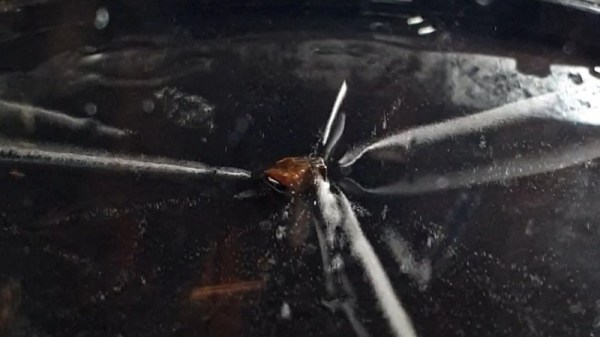
The cloud chamber was high tech back in 1911 when physicist Charles T. R. Wilson made ionizing radiation visible by creating trails of tiny liquid droplets in a supersaturated vapor of alcohol or water. Charged particles pass through, leaving visible condensation trails.

Continue reading “Improving The Cloud Chamber”

Desk Top Peltier-Powered Cloud Chamber Uses Desktop Parts

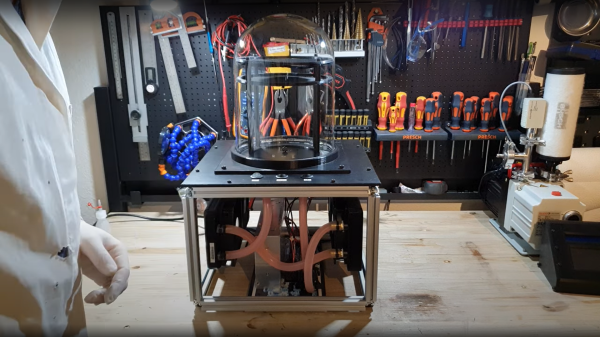
There was a time when making a cloud chamber with dry ice and alcohol was one of those ‘rite of passage’ type science projects every nerdy child did. That time may or may not be passed, but we doubt many children are making cloud chambers quite like [Curious Scientist]’s 20 cm x 20 cm Peltier-powered desktop unit.

The dimensions were dictated by the size of the off-the-shelf display case which serves as the chamber, but conveniently enough also allows emplacement of four TEC2-19006 Peltier cooling modules. These are actually “stacked” modules, containing two thermoelectric elements in series — a good thing, since the heat delta required to make a cloud chamber is too great for a single element. Using a single-piece two stage module simplifies the build considerably compared to stacking elements manually.

To carry away all that heat, [Curious Scientist] first tried heatpipe-based CPU coolers, but moved on to CPU water blocks for a quieter, more efficient solution. Using desktop coolers means almost every part here is off the shelf, and it all combines to work as well as we remember the dry-ice version. Like that childhood experiment, there doesn’t seem to be any provision for recycling the condensed alcohol, so eventually the machine will peter out after enough vapor is condensed.

This style of detector isn’t terribly sensitive and so needs to be “seeded” with spicy rocks to see anything interesting, unless an external electric field is applied to encourage nucleation around weaker ion trails. Right now [Curious Scientist] is doing that by rubbing the glass with microfiber to add some static electricity, but if there’s another version, it will have a more hands-off solution.

We’ve seen Peltier-Powered cloud chambers before (albeit without PC parts), but the “dry ice and alcohol” hack is still a going concern. If even that’s too much effort, you could just go make a cup of tea, and watch very, very carefully.

Continue reading “Desk Top Peltier-Powered Cloud Chamber Uses Desktop Parts”

Building A DIY Cloud Chamber

[RCLifeOn] happened to come into possession of some radioactive uranium ore. He thus decided to build a cloud chamber to visualize the products of radioactive decay in a pleasing visual manner.

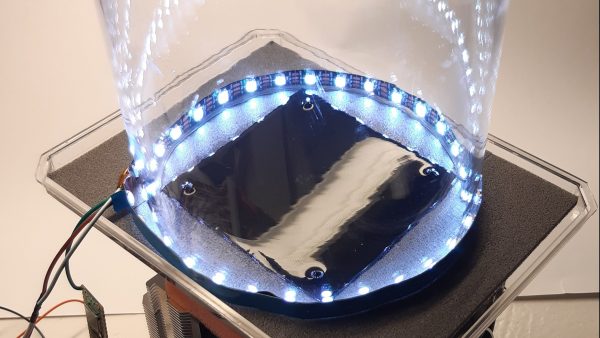
The construction is fairly straightforward stuff. A 3D-printer build plate was used to heat isopropyl alcohol to a vapor, while a bank of thermoelectric coolers then cool the alcohol down to -30 C to create a dense fog. The build uses a glass chamber with a bank of powerful LEDs to illuminate the fog, making it easier to see the trails from radioactive particles passing through. [RCLifeOn] later used a variety of radioactive sources to deliver a bunch of particles into the chamber for more action, too. He also experimented with blocking particles with a variety of materials.

It’s one of the bigger cloud chambers we’ve seen, and seems to work great. You can build a simple version pretty easily, or you could travel to a local museum or science center if you’re too busy to tackle it at home. Video after the break.

Continue reading “Building A DIY Cloud Chamber”

Building A Peltier-Powered Cloud Chamber

If you’ve been watching Oppenheimer and it’s gotten you all excited about the idea of radioactive decay, you might want to visualize it. A cloud chamber is the perfect way to do that, and [NuclearPhoenix] is here to show us just how to build one.

The build relies on a Peltier device to cool a 10 cm square copper plate down to temperatures as low as -30 °C (-22 °F). Isopropyl alcohol is evaporated via warming resistors within the cloud chamber, and then condenses in the cooled area, creating a thin layer of fog. Ionizing radiation that passes through the chamber can then be spotted by the the trails it leaves through the fog. It’s even possible to identify the type of radiation passing through by the type of trail it leaves. Alpha particles leave shorter traces, while more energetic beta particles which are difficult to stop tend to streak further.

It bears noting that if you see a ton of activity in your cloud chamber at home, it might be worth making some enquiries. Some cloud chambers you’ll see in museums and the like use a small radioactive source to generate some excitement for viewers, though. Video after the break.

Continue reading “Building A Peltier-Powered Cloud Chamber”

Hackaday Podcast 162: Hackaday Prize Is On, Thermal Printers Are So Hot These Days, Cloud Chambers Are Super Cool, And Batteries Must Be Replaceable

Join Hackaday Editor-in-Chief Elliot Williams and Managing Editor Tom Nardi for your weekly review of the best projects, hacks, and bits of news that we can cram into 45 minutes or so. We’ll look at the latest developments in DIY air-powered engines, discuss the whimsical combination of GitHub’s API and a cheap thermal printer, and marvel at impressive pieces of homebrew biology equipment. We’ve also got an exceptionally polished folding cyberdeck, a bevy of high-tech cloud chambers, and some soda bottles that are more than meets the eye. Finally we’ll go over the pros and cons of today’s super-smart cameras, and speculate wildly about what a new EU law means for our battery powered gadgets.

Take a look at the links below if you want to follow along, and as always, tell us what you think about this episode in the comments!

Direct download, and listen whenever you like.


Continue reading “Hackaday Podcast 162: Hackaday Prize Is On, Thermal Printers Are So Hot These Days, Cloud Chambers Are Super Cool, And Batteries Must Be Replaceable”

Peltier Cloud Chamber Produces Some Lovely Trails

[Advanced Tinkering] over on YouTube has some pretty unique content, on subjects of chemistry and physics that are a little more, interesting let’s say — anyone fancy distilling cesium? The subject of this build is the visualization of ionizing radiation tracks, with one of our old favorite physics demonstrators, the venerable cloud chamber. The build video (embedded below,) shows the basic construction and performance of a Peltier effect cooler setup. The system is used to create a layer of supersaturated (and cold) alcohol vapor in which the radiation source or other experiment can be immersed.

Peltier modules are a great solution for moving heat from one surface to another, but they are not terribly efficient at it, especially if you don’t keep the hot side temperature in check. Effectively they are a short-distance heat pump, so you need to dump the hot-side heat elsewhere. The method [Advanced Tinkering] chose here was to use a pair of off-the-shelf water cooling blocks, mounted into a 3D printed plate. The hot side dumps into a pair of fan-cooled radiators. Four double-layer Peltier modules are wired in parallel to a 60A power supply, which seems like a lot, but Peltier modules are hungry little things. A reasonable amount of power is needed to drive the cooling fans and water pump. The vapor source is a simple pad of liquid alcohol at the top of the stack, just above a metal screen which is held at a high voltage. The vertical electric field allows visualization of the charge of emitted particles, which will curve up or down depending on their polarity.
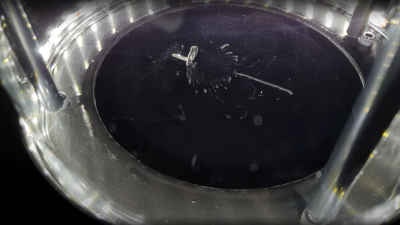
As can be seen from the second video linked below, some really nice cloud trails are produced, so it looks like they got the setup just right!

Do you need all this complexity to visualize simple radiation paths? No, you don’t, but just temper your expectations. Peltier-based builds are not uncommon, here’s another one, but some builders say they’re not very robust, so this build uses phase-change technology instead for some serious runtimes.

Continue reading “Peltier Cloud Chamber Produces Some Lovely Trails”

Maybe The Simplest Cloud Chamber

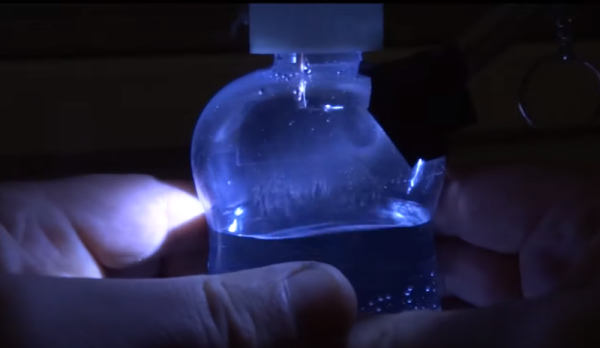
Have you ever seen a Wilson cloud chamber — a science experiment that lets you visualize ionizing radiation? How hard would it be to build one? If you follow [stoppi’s] example, not hard at all (German, Google Translate link). A plastic bottle. some tape, a flashlight, some water, hot glue, and — the only exotic part — a bit of americium 241. You can see the design in the video below and the page also has some more sophisticated designs including one that uses a CPU cooler. Even if you don’t speak German, the video will be very helpful.

You need to temper your expectations if you build the simple version, but it appears to work. The plastic bottle is a must because you have to squeeze it to get a pressure change in the vessel.

Continue reading “Maybe The Simplest Cloud Chamber”