Hackaday Prize Entry: Refugee Reuniter

The world is dealing with a serious refugee crisis, and with that comes a problem: finding people. The Refugee Reuniter, a project entered into this year’s Hackaday Prize, is a possible solution to this problem. It’s a device that allows people to reconnect with their family, whether it’s children lost in transit to destination countries, or mothers and fathers reuniting.

The basic problem the Refugee Reuniter is trying to solve is tracking people. This is a whole ball of wax that involves privacy and technological concerns. Ideas put forward so far include GPS trackers, implantable RFID tags, and other such draconian measures. The Refugee Reuniter puts another spin on this, while still assigning a unique, electronic ID to every name.

The basic hardware for the Refugee Reuniter is simply an RFID wristband or token, carried with the refugee at all times. This token is mapped to a name that can be looked up in a small terminal, tied to a specific location. If a refugee logs into one of these terminals, their location is logged and they can search for their relatives. It’s a simple technological solution to what is basically a gigantic dead-tree logbook, only backed up into an online database.


Hackaday Prize Entry: A Community Mesh Network

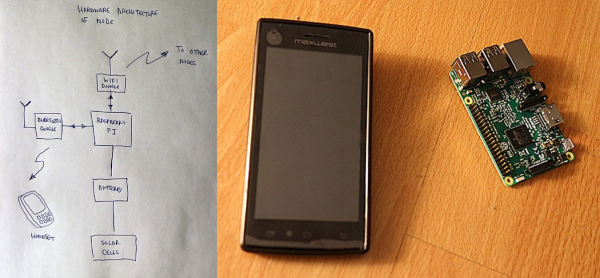
While the Internet of Things is here to stay, and will kill us all, there are a few places left on the planet that will remain unscathed during the robot uprising. These underserved communities still have a need for communications and networking, leading [hlew] to create a Community Engagement Mesh Network as an entry for The Hackaday Prize.

While there are many, many options available for DIY networking solutions out there today, [hlew] is leaning on some work done by some of [Bruce Land]’s students at Cornell. This project used simple and cheap nRF24 radio modules for a true mesh network with multi-node communication, dynamic route discovery, and dynamic route reconfiguration.

The CEMN will rely on this network to provide communications to underserved communities. The primary goal of this network is to broadcast information like crop reports and health advisories, but it can also be used for peer to peer communications between individuals.

Friday Hack Chat: Audio Systems

Join us this Friday for a Hack Chat on Audio Systems. It’s going down June 2 at noon PDT (handy time zone converter thing).

Every Friday, we gather round the campfire with the best in the business to tease out whatever secrets are stored in their mind. This is the Hack Chat, and this week, we’re going to be talking about audio systems with [Dafydd Roche]. Bring your low-distortion volume knobs and porcelain speaker cable risers, this is going to be a good one.

[Dafydd] got his start in electronics in an application for a music degree. He mentioned he’d built a few guitar pedals, which landed him a call from the electronics department at York University. They told him he was a terrible musician, but that he might excel at electronics.

Many years later he’s still going strong with audio applications with Expat Audio, manufacturers of fine preamps. [Dafydd] is also the Audio Strategic Marketing Manager at Dialog, and spends his days arguing with engineers and doing his best to solve customer problems. [Dafydd] has been on The Amp Hour, and has published articles on audio systems.

For this Hack Chat, we’re going to be running the gamut of audio, electronics, and small business. The questions on audio mythbusting are sure to entertain, and we’ll also be discussing audio signal chains and small business production. Bring your questions and put them on the sheet to guide the discussion.

Here’s How To Take Part:

join-hack-chatOur Hack Chats are live community events on the Hackaday.io Hack Chat group messaging.

Log into Hackaday.io, visit that page, and look for the ‘Join this Project’ Button. Once you’re part of the project, the button will change to ‘Team Messaging’, which takes you directly to the Hack Chat.

You don’t have to wait until Friday; join whenever you want and you can see what the community is talking about

Microchip’s PIC32MZ DA — The Microcontroller With A GPU

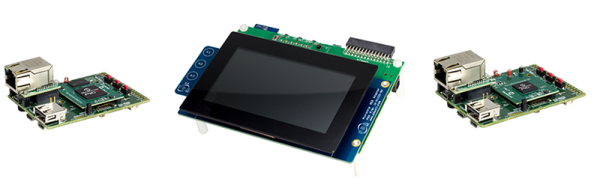
When it comes to displays, there is a gap between a traditional microcontroller and a Linux system-on-a-chip (SoC). The SoC that lives in a smartphone will always have enough RAM for a framebuffer and usually has a few pins dedicated to an LCD interface. Today, Microchip has announced a microcontroller that blurs the lines between what can be done with an SoC and what can be done with a microcontroller. The PIC32MZ ‘DA’ family of microcontrollers is designed for graphics applications and comes with a boatload of RAM and a dedicated GPU.

The key feature for this chip is a boatload of RAM for a framebuffer and a 2D GPU. The PIC32MZ DA family includes packages with 32 MB of integrated DRAM designed to be used as framebuffers. Support for 24-bit color on SXGA (1280 x 1024) panels is included. There’s also a 2D GPU in there with support for sprites, blitting, alpha blending, line drawing, and filling rectangles. No, it can’t play Crysis — just to get that meme out of the way — but it is an excellent platform for GUIs.

Continue reading “Microchip’s PIC32MZ DA — The Microcontroller With A GPU”

Hackaday Links Column Banner

Hackaday Links: May 28, 2017

Boeing and DARPA are building a spaceplane. Right now it’s only a press release and a few concept images, but it looks like this is an air-launched system kind of like a Tristar/Pegasus, only much higher and completely unmanned. It’s a ton and a half to low earth orbit, with a goal of 10 flights in 10 days.

Up in Albany? There’s a new hacker con happening in a few weeks. Anycon is a hacking, infosec, and cyber security conference happening June 16 & 17th in Albany, NY. The organizers of this con ([Chris], and his company Leet Cybersecurity) are loosely modeling this con after Derbycon. [Dave Kennedy] of TrustedSec will be attending as the keynote speaker.

GOOD NEWS! [Casey Neistat] is under investigation by the FAA. [Casey Neistat] is the YouTuber that flies drones right in the middle of the Hudson River corridor, and is a menace to general aviation around NYC.

This is neat. The Supplyframe Design Lab is the Hackaday Mothership right in the middle of Pasadena where we host our designers in residence, host a few meetups, and slowly fill every cubic inch of space with either dust or tools. The Design Lab just won a design award. You can check out the ‘design’ part of the Design Lab here, but keep in mind it will never be that clean ever again.

Here’s an interesting Twitter to follow. Alitronik is a curator of the weird and wonderful cheap crap that can be found on AliExpress. Need an Altera Cyclone dev board? Here you go. A desk-mountable OLED inspection microscope? Done. A seven dollar Tesla coil? Dude, you can totally fit this inside a hat.

[Drygol] had a nice old Commodore C16 with a broken TED chip. A shame, really. He did what anyone would do: put a C64 motherboard in the case for a fancy stealth upgrade.

Is the great crowdfunded 3D printer boom over? Some would say that ship sailed after dozens of 3D printer crowdfunding projects failed to deliver, or delivered very low-quality machines. These people were wrong. This Polaroid-branded 3D printing pen might not get funding. A year ago, this project would have been funded on day one. There would have been writeups in The Verge on how Polaroid is turning the corner after decades of wasted opportunities. Now, the Crowdfunded 3D printer boom is finally over.

The Hackaday crew was at the Bay Area Maker Faire last weekend and holy crap did we have a blast. Everyone came to the meetup on Saturday except for the fire marshall. The secret OSHPark bringahack on Sunday was even more impressive. We also saw a Donkey Car capable of driving around a track autonomously, but the team behind it didn’t have their work up on the Internet at the time.

OpenSTF Dock Ready To Farm Clicks

Deep in the heart of a Chinese click farm — and probably used by the company your company hired to build an ‘app’ — is a magical device. Call it a Beowulf Cluster of Phones. Call it the farm. By any name, it’s a whole bunch of smartphones, smart watches, tablets, and other Smart Things all controlled remotely. This is OpenSTF, or a Smartphone Test Farm. You can build your own, but as with anything requiring a whole lot of cables and devices, if you don’t plan it well, it’s going to look like crap.

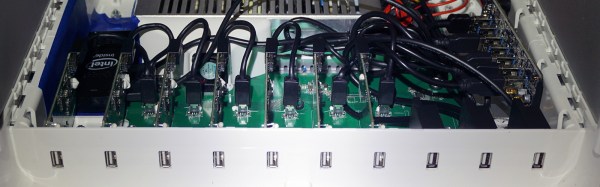
[Paul] needed an OpenSTF device lab, and found the perfect product to repurpose into a great looking enclosure. This device was the Griffin MultiDock 2, a charging station for smartphones and tablets ostensibly designed for classrooms. There really isn’t a lot going on inside this $500 phone charger, with a few modifications this enclosure can become an awesome phone farm.

This charging station is not meant to be used this way. On the outside, there are ten USB ports for ten different devices. Inside, there are three four-port USB hubs providing ten ports. ADB simply doesn’t work with this setup, so [Paul] had to completely replace the USB brains of this device. With new USB hubs, an Intel Compute Stick, and Sugru, [Paul] got OpenSTF up and running. While this would have been a fantastic waste of money had [Paul] bought this phone charging dock at full retail price, he didn’t. He apparently picked this up at a reasonable price, giving him a great looking phone farm that works just like he wanted.

Hackaday Prize Entry: MakerNet

One of the biggest trends in whatever market ‘Maker’ stuff belongs to is the Legofication of electronics. Building electronics is hard, if you haven’t noticed. Anything that turns transmission lines, current loops, and RF wizardry into something a five-year-old can use has obvious applications to education. For his Hackaday Prize entry, [Jeremy Gilbert] is building a fast, intuitive, modular way to explore electronics. It’s easier to use than the 100-in-1 Radio Shack spring clip kits, and you can actually make useful projects with this system.

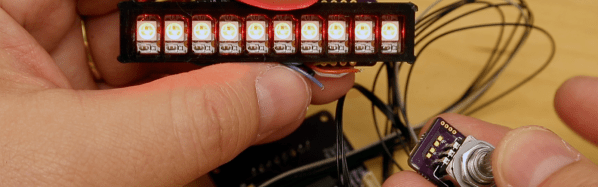
MakerNet is [Jeremy]’s solution to the problem of complicated electronics, Arduinos connected to breadboards with DuPont cables, and apparently, to actual electronic Lego sets. The core of this system is built around the Atmel SAM D21 microcontroller, an ARM Cortex-M0+ chip that has more than enough processing power for anything deserving of the ‘maker’ label. This mainboard connects to devices through what is basically an I2C bus. Each module in the system has an in and out header. A small SAM D11 (available for $1 USD) on each module handles all the communications.

Right now, [Jeremy] is experimenting with a dozen or so modules including a captouch board, an LED matrix, OLED display, rotary encoders, and lots of blinky LEDs. It’s just a prototype, but that’s exactly what we’re looking for at this stage of the Hackaday Prize. After looking at the video [Jeremy] produced (below), there’s a lot of promise here.

Continue reading “Hackaday Prize Entry: MakerNet”