Hackaday Prize Entry: 3D Prints For The Visually Impaired

Students with visual impairments can have difficulty with visual and spatial relationships. 3D printers can print almost everything, and with a lot of CAD work, this project in the Hackaday Prize provides these students with physical objects to learn any subject.

[Joan] and [Whosawhatsis] have already written the book on 3D printed science projects and have produced a 3D printed Braille map of a campus, but for this project, they’re making things a little bit simpler. Visually impaired students are tactile learners and the simplest of their 3D printable objects are fixed volume objects. This collection of 3D printable cylinders, cones, prisms, and pyramids give a physical representation of geometric solids. These objects also have another trick up their sleeve: they all contain the same volume. Fill the cylinder up with water, pour that water into a cone, and the student will discover that they all contain the same volume.  That’s useful for the visually impaired, but would also put these printable shapes at home in any elementary or middle school math class.

This project already has a rather large following, with teachers of the visually impaired contributing on a Google Group, and a ton of people downloading the models. [Joan] and [Whosawhatsis] are getting a lot of great feedback and growing the range of contributors, making this the start of an awesome community and a great Hackaday Prize entry.

Dumb Terminals And Raspberry Pis

Back in the old days, the cool kids didn’t have an Apple II or a Trash-80. The cool kids had jobs, and those jobs had Vaxxen all over the place. The usual way of working with a Vax would have been a terminal, a VT220 at least, or in the case of [Sudos]’ experiments with a Raspberry Pi, A DEC VT510, a single session, text only serial terminal.

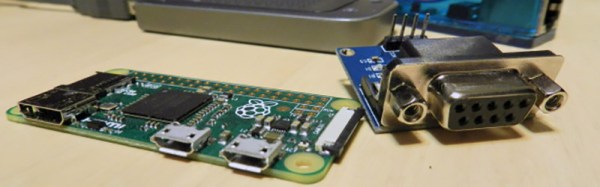
Usually, when we see a ‘new hardware stuffed into old tech’ project like this, the idea is simply to find a use for the old hardware. That makes sense; a dumb terminal from the late 90s should be a bit rarer than a Raspberry Pi Zero. This is not the case for [Sudos]’s build. He recently came across a few Raspberry Pi Zeros at Microcenter, and looking for a use for them, he decided to turn a serial terminal into a Real Unix System™.

As you would expect from a serial terminal, connecting a Raspberry Pi and putting some awesome character graphics on the screen is as simple as a Max3232 board picked up from eBay, a WiFi dongle, and an Ethernet adapter. Connect the Pi to the terminal with a serial adapter cable, and you’re off to the races.

While the VT510 serial terminal is just about the end of the line as far as dedicated terminals go, there are classier options. The VT100 terminal, older than most of the Hackaday readership, features a port on its gigantic board, meant to connect to whatever weirdness was coming out of Maynard in the late 70s. You can attach a BeagleBone to this connector, making for a very slick stealth mod.

Hackaday Prize Entry: Simpsons Hands

The creators of this Hackaday Prize entry say every month a new 3D-printed prosthetic solution comes on the scene. That doesn’t mean they’re not doing something different with their entry; yes, they’re still building a prosthetic hand, but they’re putting their own spin on it. This one isn’t using a string/cable/tendon setup, and the hand doesn’t even have four fingers. [Giovanni] and [Jenny] are going their own way, and what they’ve come up with is pretty special.

The most obvious feature of this prosthetic hand is a missing digit – Simpsons Hands – but this makes a lot of sense if you think about it. It’s doubtful any 3D-printed prosthetic hand will play a piano or touch type in the near future, so a pinkie finger is an appendix; an unneeded vanity that just increases the BOM and makes things harder to fit together.

Apart from the Simpsons Hands, this prosthetic hand is more or less what you would expect. The circuitry is just an Adafruit ATmega board, the mechanism is just a few servos, and the mechanics are well designed in carbon fiber PLA. What makes this prosthetic hand special for the team is that it’s the first of its kind in their native Colombia. Even if there’s a new 3D-printed prosthetic hand on Thingiverse every few weeks, this project makes it a truly global effort, and a great entry for the Hackaday Prize.

What’s The Deal With Atmel And Microchip?

It’s been nearly a year since Microchip acquired Atmel for $3.56 Billion. As with any merger, acquisition, or buyout, there has been concern and speculation over what will become of the Atmel catalog, the Microchip catalog, and Microchip’s strategy for the coming years.

For the Hackaday audience, this is a far more important issue than Intel’s acquisition of Altera, On Semi and Fairchild, and even Avago’s purchase of Broadcom in the largest semiconductor deal in history. The reason Microchip’s acquisition of Atmel is such an important issue is simply due to the fact the Hackaday community uses a lot of their parts. This was a holy war, and even changing the name of a line of chips to ‘MCMega’ would result in a consumer rebellion, or at least a lot of very annoying tweets.

For the record, I’ve tried my best to figure out what’s going on with Microchip’s acquisition of Atmel for the last few months. I’ve talked to a few Microchip reps, a few Atmel reps, and talked to a few ‘out of band’ connections – people who should know what’s going on but aren’t directly tied to either Atmel or Microchip. The best I’ve come up with is a strange silence. From my perspective, it seems like something is going on, but no one is saying anything.

Take the following with several grains of salt, but Microchip recently got in touch with me regarding their strategy following their Atmel acquisition. In a few thousand words, they outlined what’s going on in casa Microchip, and what will happen to the Atmel portfolio in the future.

Broad Strokes

In broad strokes, the Microchip PR team wanted to emphasize a few of the plans regarding their cores, software, and how Microchip parts are made obsolete. In simple, bullet point terms, this is what Microchip passed on to me, to pass on to you:

  • Microchip will continue their philosophy of customer-driven obsolescence. This has historically been true – Microchip does not EOL parts lightly, and the state of the art from 1995 is still, somewhere, in their catalog.
  • We plan to support both Atmel Studio 7 and MPLAB® X for the foreseeable future.
  • Microchip has never focused on “one core”, but rather on the whole solution providing “one platform.” This is also true. A year ago, Microchip had the MIPS-based PIC-32 cores, a few older PIC cores, and recently Microchip has released a few ARM cores. Atmel, likewise, has the family tree of 8 and 32-bit AVR cores and the ARM-based SAM cores.
  • We will continue to support and invest in growing our 8-bit PIC® and AVR MCU product families.

Specifics

In addition to the broad strokes outlined above, Microchip also sent along a few questions and answers from Ganesh Moorthy, Microchip’s President and COO. These statements dig a little bit deeper into what’s in store for the Microchip and Atmel portfolios:

How will the 32-bit products complement each other? Atmel has a few 32-bit microcontrollers, like the SAM and AT32 series. Microchip has the PIC-32. The answer to this question is, “Many of the 32-bit MCU products are largely complementary because of their different strengths and focus.  For example, the SAM series has specific families targeting lower power consumption and 5 volts where PIC32 has families more optimally suited for audio and graphics solutions. We plan to continue investing in both SAM and PIC32 families of products.

Will Atmel’s START support 8-bit AVRs? “Yes, although it is too early to commit to any specific dates at this stage, we consider modern rapid prototyping tools, such as START and the MPLAB Code Configurator, strategic for the our customers to deliver innovative and competitive solutions in this fast-paced industry.”

Now that Microchip has a complete portfolio of low-power, inexpensive 32-bit microcontrollers, will the focus on 8-bit product be inevitably reduced? No, we see that in actual embedded control applications there is still a large demand for the type of qualities that are uniquely provided by an 8-bit product such as: ease-of-use, 5V operation, robustness, noise immunity, real-time performance, long endurance, integration of analog and digital peripherals, extremely low-static power consumption and more. We don’t think that the number of bits is an appropriate / sufficient way to classify a complex product such as the modern microcontroller. We believe that having the right peripherals is actually what matters most.”

Security, Memories, WiFi, and Analog products. For both Atmel and Microchip, the most visible products in each of their portfolios is the lineup of microcontrollers. This isn’t the limit of their portfolios, though: Atmel has space-grade memories, Microchip has some very useful networking chips, and both companies have a number of security and crypto chips. In the statements given by Moorthy, very little will change. The reason for this is the relative lack of overlap in these devices. Even in segments where there is significant overlap, no EOLs are planned, circling back to the, “philosophy of customer-driven obsolescence.” In other words, if people keep buying it, it’s not going away.

The Takeaway

What is the future of Microchip post-Atmel acquisition? From what I’m seeing, not much. Microchip is falling back on their philosophy of ‘customer-driven obsolescence’. What does that mean? Any non-biased assessment of Microchip’s EOL policy is extremely generous. The chip found in the Basic Stamp 1, from 1993, is still available. It’s not recommended for new designs, but you can still buy it. That’s impressive any way you look at it.

The one thing we’re not getting out of this pseudo press release is information about what Atmel will be called in a few years. Will the Atmel mark be subsumed by a gigantic letter ‘M’? Will the company retain two different trademarks? There is no public information about this.

Yes, I know this post is a nearly verbatim copy of a pseudo press release. I’m not particularly happy this information was presented to me this way, but then again, the Atmel/Microchip ecosystem has been impressively secretive. This is the only information that exists, though, and I’m glad to have it in any event.

That said, there are a lot of people in the Hackaday community that want to know what the deal is with Microchip and Atmel. Short of pulling Jerry Seinfeld out of retirement, this is the best we’re going to get for now. Of course, if you have any info or speculation, the comments below are wide open.

Hackaday Prize Entry: Tongue Computer Interface

The Hackaday Prize is a celebration of the greatest hardware put together by the greatest hackers on the planet. If you go over the entries, you’ll find user interfaces for everything. Need a wheelchair controlled by eye gaze? That won last year. A foot controlled mouse? Done. Need a device to talk to the Internet while you’re in a lucid dream? We’ve seen that.

We’ve seen a lot of really cool, really strange stuff in the Hackaday Prize. We haven’t seen anything like Pallette, a finalist for the Assistive Technologies portion of this year’s prize. It’s a tongue-computer interface. You put Pallette in your mouth, like a retainer, and you can control a computer. Telekinesis with a tongue.

At its most basic level, Pallette is a Bluetooth mouse, hidden away behind the lower jaw. Infrared sensors triangulate the position of the tongue, and a microphone detects the tongue tapping on Pallette. Everything you can do with a mouse can be done with Pallette.

At first glance, Pallette seems to be just a little bit absurd. This idea changes when you see the video the Pallette team produced for the Hackaday Prize finals. Some people can’t use their arms, and for this, Pallette is a godsend. With this, anyone can use a computer, control a Sphero, or  fly a drone. It’s a completely novel device that can be used for anything, and an excellent example of what we’re looking for in the Hackaday Prize.

Continue reading “Hackaday Prize Entry: Tongue Computer Interface”

Hackaday Prize Entry: The Internet Of Casts

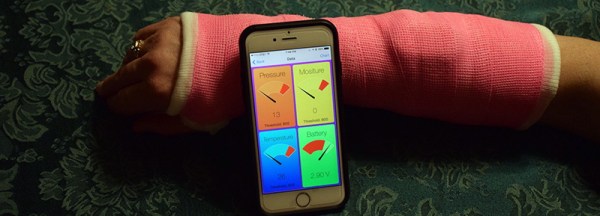
[Alex]’s entry for the Hackaday Prize is extremely simple: it’s a device to monitor the inside of casts. For every itch, for every broken bone, for every skin irritation, and for every episode of House that featured compartment syndrome, the CastMinder has an answer.

The CastMinder is a simple electronic device embedded inside an orthopedic cast. Attached to this tiny bit of electronics are a few sensors, relaying pressure, moisture, temperature, and of course the battery level to an iOS app. The use case for this device is actually very simple; the pressure sensor is a great idea if you have a cast and you’re unconscious in a hospital. A moisture sensor will at least tell you how many trash bags wrapped around your broken arm are necessary to take a shower.

The entire device is based on the LightBlue Bean, a tiny Bluetooth-enabled device that can be powered by a CR2032 battery. The enclosure is 3D printed, and the entire device is small enough to be embedded in a cast without the wearer noticing much. It’s a great idea, and a great project to make it to the semifinals of the Hackaday Prize.

Hackaday Links Column Banner

Hackaday Links: October 16, 2016

You need only look at the weekly user account leak from a popular web service or platform to know there’s a problem with security. Reusing passwords is the dumbest thing you can do right now, and the Mooltipass Mini is the answer to that problem. The Mooltipass originally began as a Developed on Hackaday series, and we log frequent sightings of the Multipass (maxi?) at security cons. The Mini is smaller, has exactly the same capability, and is completely unrepairable. It’s very cool, and if your email password is the same as your banking account passwords, you kind of need this yesterday.

Last weekend was the Open Hardware Summit in Portland. All the talks were worth watching, but editing the talks down into something sensible takes time. In lieu of this, OSHPark has gone through the livestream and timestamped everything

Continue reading “Hackaday Links: October 16, 2016”