Taste-O-Vision Is Now A Thing

taste

Not satisfied with late 1950s concepts of Smell-O-Vision [Nimesha]  has created something extraordinary: A digital taste sensor, capable of representing taste with a little bit of heat, electricity, and an Arduino

The device purportedly works by via thermal and electrical stimulation of the tongue using silver electrodes. According to this video, different tastes are created with different currents and temperatures. For example, a sour taste is produced on the electrodes by varying the current from 60uA to 180uA and increasing the temperature up to 30 degrees C. Mint is produced by simply decreasing the temperature from 22C to 19C.

The control electronics include an Arduino, a motor controller, and a heat sink attached to one of the silver electrodes. Communication is done through USB, and of course there’s a mobile app for it, more specifically a protocol called Taste Over IP. This allows anyone to send a taste to anyone with one of these devices.

Videos below, and before you laugh, we’d really like to try one of these out.

Thanks [Jess] for the tip.

Continue reading “Taste-O-Vision Is Now A Thing”

Hackaday 68k: Enclosure, Backplane, And Power

hero

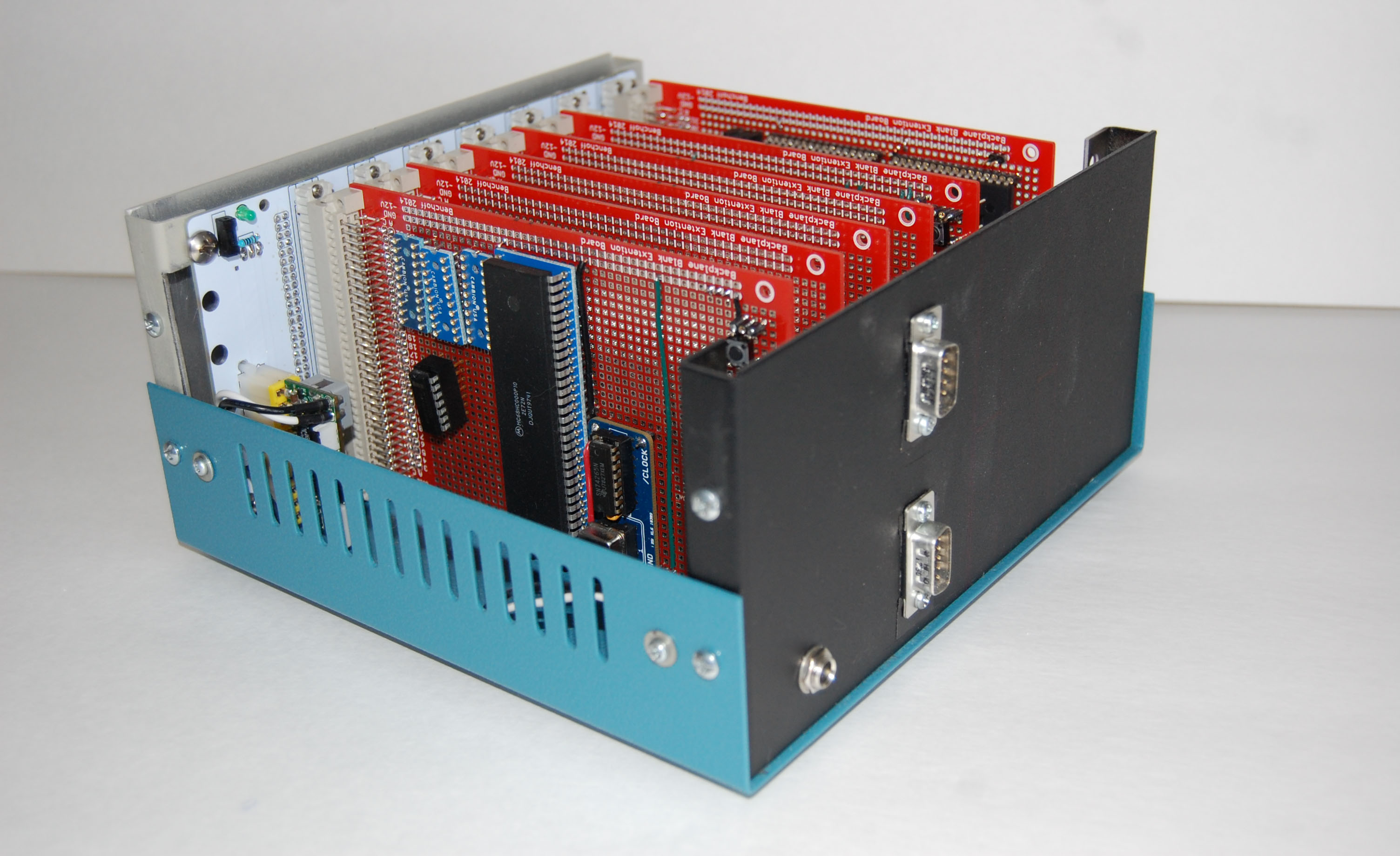
It’s about time for an update for Hackaday’s latest project – a modern retrocomputer based on the Motorola 68000 CPU. In this update, we’ll be taking a look at the enclosure, the backplane itself, and how we’re going to power this thing.

This is only an update to the project; you can check out the current status over on Hackaday Projects. It’s Hackaday’s new collaborative project hosting site where you (and your friends) can design, build, or document anything you have in mind. Request an invite for the alpha release of Hackaday Projects and you can give this project a skull! Seriously, this project is only the third ‘most skulled’ one on Hackaday Projects.

Now that the completely transparent pitch for Hackaday Projects is over with, we can get on to the update for the Hackaday 68k. Click that ‘Read More…’ link.

Continue reading “Hackaday 68k: Enclosure, Backplane, And Power”

Improving A Homebrew CT Scanner With Barium

CTscanner

[Peter] has been working on his homebrew CT scanner for a while, and it’s finally become something more than a spinning torus of plywood. He’s managed to image the inside of a few pieces of produce using an off-the-shelf radiation detector and a radioactive barium source

When we last saw [Peter]’s CT scanner, he had finished the mechanical and electronic part of the Stargate-like device, but the radioactive source was still out of reach. He had initially planned on using either cadmium 109 or barium 133. Both of these presented a few problems for the CT scanner.

The sensor [Peter] is a silicon photodiode high energy particle detector from Radiation Watch this detector was calibrated for cesium with a detection threshold of around 80keV. This just wasn’t sensitive enough to detect 22keV emissions from Cd109, but a small add-on board to the sensor can recalibrate the threshold of the sensor down to the noise floor.

Still, cadmium 109 just wasn’t giving [Peter] the results he wanted, resulting in a switch to barium 133. This was a much hotter source (but still negligible in the grand scheme of radioactivity) that allowed for a much better signal to noise ratio and shorter scans.

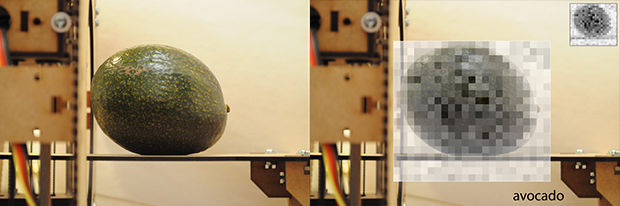
With a good source, [Peter] started to acquire some data on the internals of some fruit around his house. It’s still a slow process with very low resolution – the avocado in the pic above has 5mm resolution with an acquisition time of over an hour – but the whole thing works, imaging the internal structure of a bell pepper surprisingly well.

Wireless AC Control With The Raspberry Pi

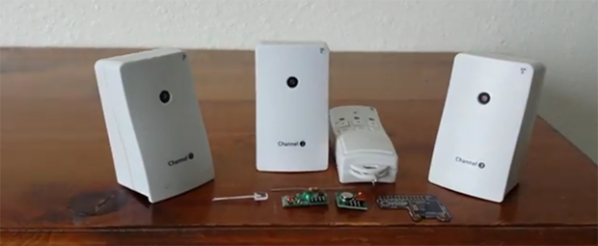
We’ve seen some of [Connor]’s work before, and it looks like he’s now turning to product design. He’s come up with an adapter for the Raspberry Pi to control a few wireless wall socket relays, allowing anyone with a Pi to control lights, coffee makers, TVs, and anything else that falls under the very broad home automation banner.

The system uses a 315MHz radio breakout board for a Raspberry Pi to control the relays in one of three wall socket adapters. There’s a script running on the Pi with a very nice GUI to turn the lights on and off.

[Connor]’s product is extremely similar to a certain WiFi-enabled wall-plug relay system controlled by a smartphone, and to that end, he’s decided to call his device the Belchin’ Emo Switch. The name might need work, but he’s selling three Raspberry Pi-controlled wall plugs for the same price of one wall plug from Brand A.

Below you’ll find [Connor]’s videos for his device. You can also check out this reddit thread where he shows off just how open source he can be; there are part suppliers and even how he’s packaging this system for shipment.

Continue reading “Wireless AC Control With The Raspberry Pi”

Get Your Hackerspace A 3D Printer

logo

LulzBot is yet again giving away a few of their very fancy and well-reviewed 3D printers away to a few hackerspaces.

This isn’t the first time LulzBot has given away a few of their printers; a year and a half ago, they gave away eight AO-100 printers and they also donated one to our ‘ol buddy [Caleb] for TheControllerProject, a forum to connect disabled gamers to people who have the means and ability to make custom gaming controllers.

The rules for this giveaway are simple: Be a hackerspace, and display, “creativity and contributions to the free software and open hardware community.” It’s as simple as that. If you’re a hackerspace without a 3D printer – which would be somewhat astounding at this point – here’s your chance to get one of the best 3D printers around.

The contest will be open starting March 1 and ends on March 14, with entry requiring a hackerspace fill out a form somewhere on the LulzBot servers.

US Government Screws Up Terrorist Watchlist, Few Surprised

Dave

It looks like [Dave Jones] got himself on a US government watch list. We don’t mean [Dave L. Jones], awesomesauce electronic wizard and host of eevblog, though. Some three-letter agency is just looking at someone named [David Jones]. Is this going to screw over our Aussie friend? You betcha.

[Dave] bought a few things through Element 14 that he would later pick up at their Sydney warehouse. When he got there, he discovered the parts were ‘on hold’. Out of curiosity, he asked what the holdup was and discovered his name was flagged on a US government watch list.

If you’re keeping score, this is an Australian citizen buying stuff from an Australian subsidiary of a UK company, and being told ‘no’ by the US government.

The folks behind the counter at the Element 14 warehouse were extremely helpful, clearing the hold and getting [Dave]’s parts in just a few minutes. This has, apparently, been going on for a while; [Dave] recalled a few times when orders showed up a few days late with the Farnell/Element 14 people apologizing with the word ‘hold’ in there somewhere.

Of course this means it’s possible for someone working at the Element 14 warehouse to clear one of these US government holds, and even if they don’t the order will still go through in a day or two. Government efficiency at its best.

At the time of this writing, [David Bowie], the singer for The Monkees, the creator of Grand Theft Auto, and the British author famous for perpetual motion machines were unavailable for comment. -ed.

NXP’s ARM Micros With Motor Controllers

motor

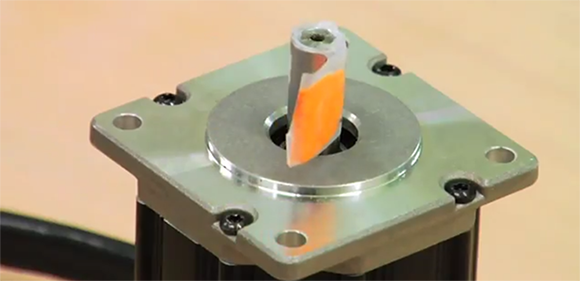
It’s still relitavely early in the year, and all those silicon manufacturers are coming out with new toys to satiate the engineer and hobbyist for years to come. NXP’s offering is the LPC1500, a series of ARM microcontrollers optimized for motor and motion-control applications.

The specs for the new chips include an ARM Cortex-M3 running at 72MHz, up to 256kB Flash, 36kB SRAM, USB, CAN, 28 PWM outputs, an a real-time clock. There are options for controlling brushless, permanent magnet, or AC induction motors on the LPC1500, with dev boards for each type of motor. Each chip has support for two Despite NXP’s amazing commitment to DIP-packaged ARM chips, the LPC1500 chips are only available in QFP packages with 48, 64, and 100 pins.

Don’t think the LPC1500 would be a perfect chip for a CNC controller – the chips only support control of two motors. However, this would be a fantastic platform for building a few robots, an electric car, or a lot of the other really cool projects we see around here.